
I've been on a Star Trek kick lately. While I have been mostly enjoying Starfleet Academy I have also dipped back into Picard and just started a rewatch of Star Trek: The Next Generation. I never watched TNG when it aired but instead caught up with it on Netflix on DVD years later as part of a massive OCD binge of all things Trek. And while I never caught it in the 1980's and 1990's when it aired, there is something comforting and nostalgic about TNG and that's not just because of the very 80's soft beige, grey and cranberry decor and dramatic fade-outs to commercial (although very much also that) but its now-quaint value system in which Starfleet's best and brightest do their best to live up to their high ethical standards.
I had seen The Next Generation's pilot episode, "Encounter at Farpoint" a couple of times before, once even on the big screen when the beautiful Blu-ray remasters were released and had always thought it was a little dull and not really reflective of the heights the show would achieve in its later seasons. In 2026, however, it feels refreshing and almost radical. In light of the recent very dumb arguments about whether or not Star Trek has become "woke," 1987's "Encounter at Farpoint," is decidedly so with everything from male crewmembers running around in skirts, to characters making offhand and subversive remarks about humanity's past obsessions with "tribal gods." Remember, the future of Star Trek is well-documented as a post-capitalist, largely agnostic utopia. So, yes, it's woke at a molecular level which is why all the right wing kvetching is even sillier than normal.

In "Farpoint" a seemingly all-powerful, god-like being called Q diverts the Enterprise and puts its crew on trail for the past barbarism of humanity. Mind you, although Q presents himself in various historical guises, his court is apparently based on a chaotic, post apocolypic, mid-twenty-first century court. This tracks. However, the charges of barbarism are forcefully rebutted by Captain Picard who both acknowledges humanity's terrible past but argues that humanity has grown and improved over the centuries.
This storyline really resonated with me on this watch and reminds me of the current dialogue in the United States about American history. The current administration is doing everything in its power to stifle any discussion of US history that might put the country in a "negative light," including pressuring museums into removing exhibits that highlight things like slavery and genocide of native people. This is pretty typical of conservative thinking in recent years which seeks to whitewash our history and return to an era of fawning over "great men," instead of reconciling with the realities of the past.
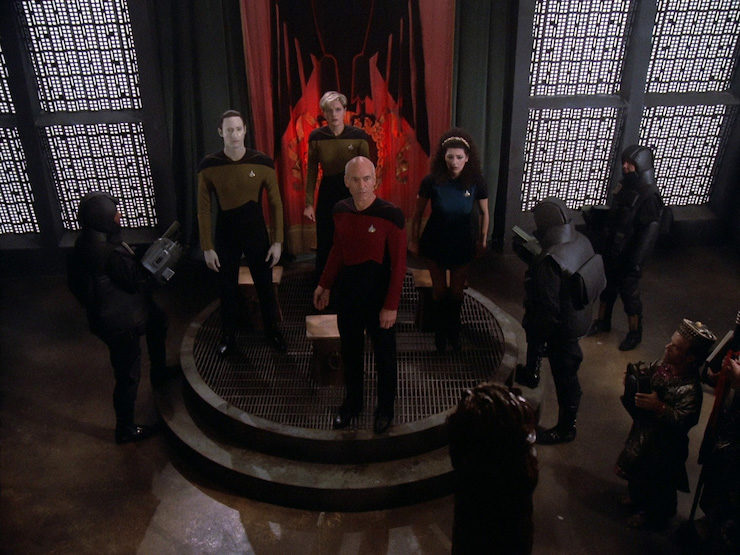
While Captain Picard can look back on the problematic sweep of human history with supreme confidence that humanity has grown and improved, American conservatives seemingly cannot. Indeed, when Picard is told by Q that his mission at Farpoint will serve as a test of humanity's quality, the captain does not flinch, confident in the fact that even this brand new crew will act in an ethical way and prove Q wrong.
Perhaps the most refreshing thing about watching Star Trek in 2026 is seeing people in leadership who are both competent, curious, and ethical which is especially nice considering the 2026 leadership in the US is composed of a mix of Cardassians, Romulans, and Ferengis.

No comments:
Post a Comment