
Godzilla (1998)
Directed by Roland Emmerich
Genre: Kaiju/Disaster
THE MOVIE
The beloved 1990’s series of Japanese Godzilla movies came
to a close in 1996 with Godzilla vs Destoroyah, which killed off the Japanese Godzilla to make way for Toho’s long-held
dream of a big-budget American movie. A Hollywood Godzilla had been in Production Hell for a long time under various incarnations but was finally realized by the team of writer Dean Devlin and director Roland Emmerich. The two filmmakers, hot off the success of Independence Day, were given the task of reimagining the Godzilla mythos.
On paper, they may have seemed a good bet to make a Godzilla movie: they
were known for making crowd-pleasing sci-fi disaster movies with loads of
special effects, all things that would help one make a good Godzilla
movie. Even their weaknesses as
filmmakers-generic stock characters, unoriginal ideas-had all also been
long-standing issues with the Japanese Godzilla movies and might have actually allowed them to make something that
captured the particular flavor of the Japanese movies.
However, it seems that these filmmakers didn't have a
real understanding of or respect for the cinematic legacy of Godzilla or
what made Godzilla an iconic movie creature.
Instead, they looked toward other inspirations such as The Beast from 20,000 Fathoms (itself
an inspiration for the 1954 movie) and Jurassic Park and its sequel The Lost World, which were very fresh in
the public mind at the time.
Godzilla’s
origins and nature are best left vague and mysterious. As a creature, he doesn't hold up to a lot of
scientific scrutiny. When you start
looking at Godzilla through some kind of Michael Crichton-esque hard sci-fi
lens, he seems ridiculous and in attempts to make him “realistic,” you end up
with something that is little more than
a 90 meter dinosaur, which itself is ridiculous. And Godzilla is so much
more than just a big dinosaur. At his
best, he has been a nuclear Hell-beast in his first movie, or a raging mystical
war monster in Godzilla, Mothra, King
Ghidorah: Giant Monsters All Out Attack, or even the mysterious primeval
“alpha predator” in the 2014 movie. A
good incarnation of the King of the Monsters, has to carry some thematic weight
and the 1998 version is merely a big mutated lizard whose existence is vaguely
attributed to French nuclear testing. Also, Zilla lacks Godzilla's trademark Atomic Breath. Instead, he has what can only be called an accidental combustion sneeze.
Instead of inspiring us with dread and awe, the movie plods
along with a kind of a light sitcomish tone, as the lead Mathew Broderick is
joined by some generic comedy actors and a couple of cast members from The Simpsons. There is also an idiotic subplot where the
Mayor of New York and his aide are made to look like Siskel and Ebert, the
famous movie reviewers who had justifiably panned Devlin and Emmerich's previous movie. This petty and stupid running joke is
indicative of the immaturity of the filmmakers.
But the light tone, above all, is where the movie really goes astray and
what keeps it from feeling like a real Godzilla movie. It is interesting to compare it with the 2014
American Godzilla movie, which, if nothing else, maintained an appropriately
dark and ominous feel throughout. It is also informative to compare it to Peter Jackson's King Kong remake, a movie that practically drips with love and respect for its source material.
THE MONSTER/EFFECTS
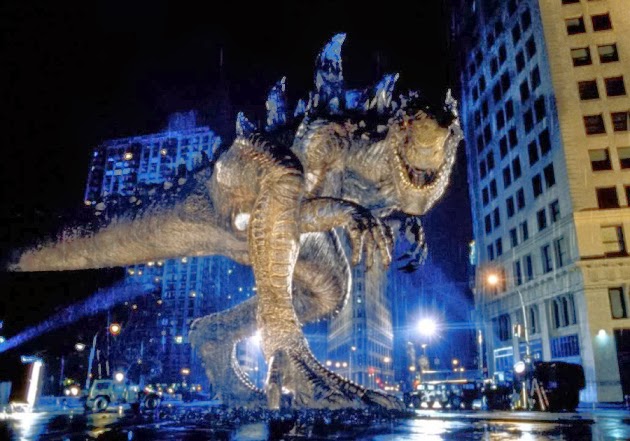
Despite his resemblance to Jay Leno, Zilla is really the Rodney Dangerfield of monsters: He gets no resepct. I’ll be honest, I don’t hate the movie’s creature design-which
has officially been dubbed Zilla by Toho Studios. Designer Patrick Tatopoulos did an decent
job giving Godzilla a modernized makeover, making him to be a lot
faster and more nimble and addressing some of the problems with the traditional Japanese suits. A lot of fans
dislike the T-Rex-like body of Zilla, but the fact is that Godzilla has always
been modeled after a T-Rex, it’s just that he was originally designed based on
A) outdated ideas about how Theropod dinosaurs actually moved and B) the need
to have a man in a suit. Neither of
these factors should have really been an issue in 1998 and I don’t mind a
horizontal walking Godzilla. It has actually
always bothered me that Godzilla dragged his tail on the ground as that never
seemed like a plausible way for him to move.
I also don’t mind a skinnier Godzilla as he has always seemed comically
obese in the Japanese movies.

Zilla testing out his nightly monologue.
I do take issue with Zilla’s head, however, which lacks any
real character or menace. The decision to
give the head an exaggerated jaw is visually interesting and unexpected but it
really is such an extreme departure from any previous incarnation of the
character as to be unrecognizable. I
think that if the head had been tweaked to at least give Zilla a more
traditional Godzilla head, people would not have reacted so badly to the
design.

Remember, there are no bad monsters, only bad directors.
The movie also features a subplot about Zilla reproducing
asexually and laying eggs in Madison Square Garden, which hatch into
raptor-like babies. Again, this is another
instance of the filmmakers aping the Jurassic
Park movies and has nothing to do with making a recognizable or good
Godzilla movie.
Finally, Zilla commits the cardinal sin of any incarnation
of Godzilla: He goes out like a punk.
Godzilla’s toughness is one of his defining character traits. Godzilla fans are fairly obsessed with this
attribute of the character. For Zilla to
get taken down by some military helicopters while being tangled up in a suspension bridge was the final insult to the
character. It proves that the filmmakers really didn't "get" the character.
THE LEGACY
Although, the movie made quite a bit of money, it failed to
meet the expectations set by its ostentatious publicity campaign (“Size
matters!”). The movie was also
critically reviled. These two factors
both put a nail in the coffin of any potential franchise based off of the 1998
movie.
That said, the story of the movie was continued in an
animated series that was actually quite a bit more faithful to the original
movies. It featured a surviving Zilla
offspring, which battled any number of fanciful monsters, including a cyborg
version of the movie Zilla, dubbed (in true late '90's style) Cyber Godzilla.

Animated Zilla is much more badass and even has a version of the Atomic Breath.
Perhaps most importantly, the failure of the American movie
meant that the Japanese Godzilla series came out of hiatus much earlier than
had been planned, and with a new vitality.
Godzilla 2000 was released in
1999 and is practically crackling with a need to redeem the character. G2K
features a badass new design of the character and the plot features him taking on a usurper who looks
a bit like a cross between Zilla and Gamera. This character, literally tries to become Godzilla and is violently thwarted.

Orga,, from Godzilla 2000, looks like what would happen if Gamera and Zilla got it on.
Interestingly, the Millenium series seems to have taken some
inspiration from the American Godzilla movie in terms of scope and scale. While the Japanese movies continued to rely on
suitmation, the Millenium movies occasionally used CGI for certain
effects. In fact, certain sequences that
have become standard in the series seem to have originated in the 1998
Godzilla. Full body, underwater swimming
shots were practically unheard of prior to the American movie but became somewhat common in the Japanese movies. Also, the now ubiquitous “water swell” that invariably precedes Godzilla’s landing in the Shinsei movies (and even the 2014 American movie) seems to have memorably originated with Emmerich’s
movie. Zilla’s jagged spines were an
influence on both the first Millennium Godzilla and even the second American
Godzilla.

This ubiquitous "tidal wave" sequence started with the 1998 movie.
Since Toho actually owns the rights to the character, Zilla,
and the events of the American movie have even crossed over into the Millennium
movies. In Giant Monsters All Out Attack two Japanese characters discuss the attack on
New York but snarkily conclude that the Americans are mistaken in thinking that the
monster was actually Godzilla.

In the final Millenium movie, Godzilla: Final Wars, Zilla actually appears and is quickly dispatched by the Japanese Godzilla. Zilla has even appeared in the ongoing IDW Godzilla comic series. So, it’s nice to see that the monster has an official (although ignominious) place in Toho’s stable of kaiju.

In the final Millenium movie, Godzilla: Final Wars, Zilla actually appears and is quickly dispatched by the Japanese Godzilla. Zilla has even appeared in the ongoing IDW Godzilla comic series. So, it’s nice to see that the monster has an official (although ignominious) place in Toho’s stable of kaiju.
As if starring in the 1998 movie wasn't punishment enough. Poor Zilla cannot get a break.
MOST MEMORABLE MOMENT
Zilla's initial New York landfall is actually pretty cool. It is probably the one sequence in the movie that feels appropriately dangerous and awesome.
HOME VIDEO AVAILABILITY
Widely available in all major formats.
SEE ALSO
King Kong (2005), The Beast From 20,000 Fathoms, Godzilla 2000, Godzilla (2014)
TRAILER

No comments:
Post a Comment