
Rise of the Planet of the Apes (2011)
Directed by Rupert Wyatt
Genre: Sci-fi, Biotech Thriller
As yet another case of Hollywood remaking, rebooting, or prequelizing a classic movie, no one really expected Rise of the Planet of the Apes to be any good. After all, for or every Star Trek (2009), and Godzilla (2014) there are a host of uninspired remakes of Total Recall, A Nightmare on Elm Street, Robocop. The original Planet of the Apes is an unqualified classic of science fiction that has firmly established itself in the popular mind. It had already suffered the indignity of one half-baked "reimagining" in the form of the 2001 Tim Burton movie of the same name. So, Rise had quite a bit going against it.
But this movie along with Star Trek and Batman Begins are textbook examples on how to reboot a dormant franchise. Director Rupert Wyatt and his screenwriters took a bold and interesting approach to the material. Perhaps counter intuitively, their story stays far away from the iconic 1968 movie and its trappings. While the movie was sold as a Planet of the Apes prequel, it really isn't. For a big studio franchise movie, this is quite subversive. It has some similarities to Conquest of the Planet of the Apes but it stubbornly insists on its own continuity and identity. I don't think that there is a word for what this movie is. It's kind of a parallel prequel to Planet of the Apes.
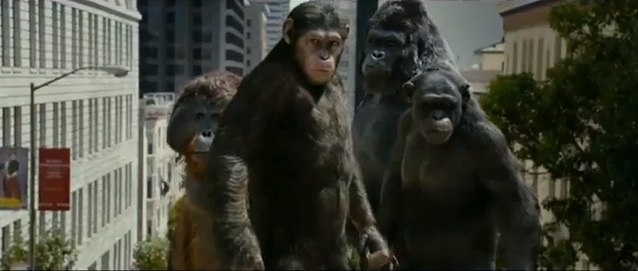
Ape-vengers, assemble!
THE MOVIE
Rise of the Planet of the Apes reimagines the origins of the Planet of the Apes in the context of a Michael Crichton-esque biotech thriller and stays about as grounded and realistic as possible for a movie about a super-intelligent ape uprising. It also functions as a surprisingly effective domestic drama. Thanks to another really terrific motion capture performance from Andy Sirkis (who has brought to life characters such as Gollum from the Lord of the Rings movies and King Kong from the Peter Jackson remake), we are wholly invested in Ceasar's journey from the adopted "son" of James Franco's scientist character and literal son of a chimp who was torn from her rain forest home and given an experimental Alzheimer's treatment to leader of movement of genetically enhanced apes. They really need to give this guy a special Academy Award already. As good as some of the prior Apes movies were, they were always more concerned with larger sociological themes than character relationships and they were never this emotionally involving.
That's not so say that Rise is not "about" anything. It serves as a moving meditation on man's relationship with animals and particularly the horrors and indignities suffered by lab animals. This idea of the origins of the ape society being in lab chimp "culture" is new to the series and gives it weight and immediacy.
After Ceasar, the next most compelling character is the chimp Koba, who has a smaller role in this movie than in the sequel but who even with his small amount of screen time, strikes a memorable figure. Koba represents a parallel development from Ceasar. While Ceasar was raised in a loving home, Koba has been in and out of labs and is physically scarred from his experiences. He is mangy-looking and mean with one milky blind eye. It's particularly chilling the calm way he submits to laboratory tests. Even before he is granted enhanced intelligence, Koba seems to be biding his time.

Perhaps granting super intelligence to this particular ape was not the best idea.
CREATURES/EFFECTS
The creatures in Rise are photorealistic apes created using amazing CGI mo-cap performances, a definite departure from the amazing make-up created for the all the previous Apes movies. This movie is definitely going for a kind of realism that would not be attainable with actors in apes suits, which was quite actually quire successful in the Burton remake. As in all of the previous movies, the apes consist of Chimpanzees (and Bonobos), Gorillas and Orangutans. I also wish that they would have included Baboons. Because baboons are terrifying and an ape uprising with baboons as foot soldiers would scare the crap out of everyone.
Maybe the most striking thing about the success of the motion capture performances is in the characters eyes. There is something about eyes that is hard to capture in human or humanoid creatures (including apes.) One of the hallmarks of a bad CGI character is dead soulless eyes. While animators have been able to capture eye anatomy successfully for years, there is something about the way eyes move that has proved elusive. Perhaps the problem has been in animators themselves who may not be as studied in physical performance as they are technically proficient. The inclusion of actors in this process perhaps provides the "soul" that is sometimes missing from CGI characters. While the CGI in Rise is not perfect, this ability to successfully recreate eye movement goes a long way towards supporting the performances and creating emotional investment in the characters, particularly in these performances which are largely silent and reliant on eye and body language.

HOME VIDEO AVAILABILITY
Widely available in all formats.
MOST MEMORABLE MOMENT
I love the whole sequence that takes place in the ape sanctuary in which Ceasar has to learn how to function in this new harsh environment. This part of the movie almost plays like a prison film.
One question I am left with from this movie is how the apes increased their numbers so dramatically from the time that they escaped the facility to the battle at the Golden Gate Bridge. I believe there is a sequence of them attacking a zoo to liberate the other apes but I don't believe that there is a sequence in which the apes have delivered the treatment to the zoo animals.
SEQUELS
Dawn of the Planet of the Apes was released in 2014 and considered by many to be a better film than its predecessor. Certainly, it is more focused on the apes than the humans and it features a larger role for Koba. It was considered a big hit and will certainly be follow up with another sequel.
TRAILER

No comments:
Post a Comment