Thursday, February 19, 2026

The Mandalorian, Season 2


The second season of The Mandalorian is considered by many to be the best of the series with a balance of the straightforward genre storytelling of season one and the introduction of some very important connections to the large Star Wars universe, including some major character appearances. One of the things that I love about the show is how all-inclusive it is, bringing elements of everything from the Original Trilogy, prequels and animation. Compare that to J.J. Abrams who reportedly so disdained the Prequels that he wanted to blow up Coruscant in The Force Awakens. In fact, The Mandalorian even embraces the Sequels and does some groundwork to set them up. Season two also really explores what it means to be a Mandalorian, introducing Din and Grogu to others who consider themselves Mandos but who do not necessarily subscribe to the fundamentalist creed of Din's community. This puts Djarin into several situations where his Mandalorian ideology is challenged, leading to some interesting character exploration.

Much as in season one, The Mandalorian season two is oddly-paced with perhaps only half of the episodes being directly tied into the main plot of Din Djarin's assigned mission to bring Grogu back to the Jedi. The rest of the season is filled with lots of side missions which often makes the larger story feel like a video game. Din is frequently tasked with fetchquests in which he needs to accomplish a specific thing to bring him closer to his larger goal of finding more Mandalorians and ultimately a Jedi. 

That's not to say that those episodes aren't thoroughly enjoyable including meeting important characters in Chapter 9 "The Marshall" and Chapter 11, "The Heiress" or a near survival horror episode in Chapter 10, "The Passenger," which finds Mando and Grogu crashing on a spider-infested ice planet. The Carl Weather's directed, "The Siege" is nothing short of an incredible distillation of kinetic Star Wars action. Episode 9, "The Believer," brings back season one character and former Imperial, Miggs Mayfeld and sends them into an Imperial base where they each have to contend with their changing beliefs in a great character-centric episode.


A notable character brought in from animation is Bo Katan, who was featured in both The Clone Wars and Rebels. She is played here by Battlestar Galactica's Katee Sackhoff, who also voiced her in animation. Once a scion of a great Mandalorian house, she is now leading a small group of warriors who are attempting to mount a resistance to the Imperial Remnant and ultimately resettle Mandalore. She is after Moff Giddeon who it was revealed possesses the Darksaber, which Katan hopes she can use to rally the surviving Mandalorians. Much like the other Mandalorians we have met in animation, her group does not follow The Creed in the same way as the Armorer's community, and they are fairly open and freely remove their helmets. They refer to Din's covert as "Children of the Watch," which actually fills in some gaps in the timeline.

Back during the Clone Wars era, the planet of Mandalore was ruled by a progressive, pacifist leader who had sought to lead the planet away from the centuries of warfare which had nearly destroyed their world. Indeed, the Mandalorians were confined to dome cities as the rest of the planet was effectively a wasteland. A conservative and militaristic group called Death Watch had opposed the leadership and sought to return Mandalore to its violent roots. Bo Katan was introduced as a member of this group and through several arcs of The Clone Wars we saw a struggle for the planet which culminated in which Maul (in his crimelord era) and Death Watch took control of Mandalore only to have it liberated by a Republic force aligned with Bo Katan. 


The Children of the Watch are therefore an even more zealous offshoot of Death Watch that interpret The Creed in a very literal way with strict rules about their usage of armor and their interactions with outsiders. Most of them like Din are converts to The Creed with no connection to Mandalore whatsoever. Indeed, someone like Bo Katan can certainly make a more convincing argument that she is a "real" Mandalorian than Din, since she was born and raised on the planet and steeped in its culture.

The other "Mandalorian" that Din and Grogu meet this season is Boba Fett, Star Wars' original Mandalorian character. The term Mandalorian was first used internally at Lucasfilm to describe the armor designed for this character, originally described as having been made of "Mandalorian steel.' the term Beskar was created in the 1990's in one of the old EU novels. Boba first appeared in animation in a segment of the Star Wars Holiday Special (You can watch this much of the special on Disney Plus as "The Faithful Wookie" and he later appeared in a small roles in The Empire Strikes Back and Return of the Jedi. He is revealed in Attack of the Clones to have been cloned from Jango Fett, the donor from which the Republic's clone army was created. Early in season two, Din acquires Boba's armor in an adventure on Tattooine, where Boba had seemingly met his demise in Jedi

We are reintroduced to the character in the Robert Rodriguez-directed Chapter 14 "The Tragedy" where we learn Fett has teamed up with season one character Fennec Shand and has tracked Mando to Tython in order to reclaim his armor. This leads to a really kick-ass battle between a re-armored Boba and a squad of stormtroopers. This sequence fulfills a long-standing wish if Star Wars fans to see Boba Fett go HAM and the episode does not disappoint. Later, we learn that Boba's "father" Jango Fett had been a foundling much like Din and Grogu and had at some point followed The Creed. When Grogu is kidnapped and Mando's ship destroyed, Boba pledges to assist in getting him back, kicking off an epic bromance that carries on into The Book of Boba Fett. Throughout the season, we see Din getting more and more comfortable with other Mandalorians who do not necessarily share his interpretation of The Creed.


Season two also serves as the live action debut for another major Star Wars character from animation, Ahsoka Tano who had served as Anakin Skywalker's Padawan during the Clone Wars and has developed over several projects into one of Star Wars' most beloved and interesting characters. Din is lead to her by Bo Katan, a frequent ally of hers during the Clone Wars and beyond. Ahsoka's episode "The Jedi" has a strong Japanese influence in its music and design and is seemingly inspired by the great Studio Ghibli movie Princess Mononoke, which also features a formerly pastoral land which has been blighted by a cruel mistress intent on stripping it down for weapons and industry and who is opposed by a supernatural opponent who strikes from the forest. The early designs for Ahsoka's character were directly based on Princess Mononoke so this brings her origins full circle.

While Din's goal is to bring Grogu to a Jedi for training, Ahsoka due to her complicated relationship with the order (and we later learn her frustrations attempting to train her own apprentice) declines to train Grogu, referring Din to a Jedi site where Grogu may be able to make contact with a surviving Jedi. Regardless, the two team up in order to take down the villainous Morgan Elspeth and we learn Ahsoka's true mission is to track down, Grand Admiral Thrawn, a towering figure from Star Wars old Expanded Universe who was seemingly lost at the end of Rebels.


The season comes to a close as Din gathers his new Mandalorian allies on a mission to rescue Grogu from Giddeon's cruiser. Mando battles everything from a Darksaber-wielding Giddeon to a squad of Darktroopers, battle droids cherrypicked from the videogame side of the old EU. Djarin defeats Giddeon and therefore earns the Darksaber which puts him into conflict Bo Katan. As our main characters are trapped on the cruiser's bridge about to be assaulted by Darktroopers, noneother than Luke Skywalker arrives to save them, having tracked Grogu from the Jedi site on Tython.

While Luke's extended fight with the Darktroopers is impressive (again seeing a full-on post Return of the Jedi Luke at the height of his power is another thing fans have been wanting to see forever) and he really makes quick work of the droid squadron in a sequence that mirrors Vader's corridor fight at the end of Rogue One. Of course, he is conveniently hooded during this sequence and only reveals his face for a brief sequence at the very end of the episode. The process to recreate a young Mark Hamil produces mixed results just on the wrong side of the Uncanny Valley. As I understand it, it is some combination of AI de-aging, a look-a-like stand-in, and some kind of performance capture from Hamil himself. Honestly, having Mark Hamil there in his Jedi costume, seems to have more to do with publicity and fanservice than anything that actually contributed meaningfully to the performance. Simply using the look-a-like actor would have honestly been less distracting. Or just cast Sebastian Stan, you cowards!


The series ends on a heartbreaking note as Grogu goes off with Luke to be trained as a Jedi, leaving Mando behind, having broken the rules of his covert twice this season by removing his helmet both times for Grogu and which will ultimately put him into an inevitable conflict with his community. Also, I have never disliked Luke more than in this moment in which he tales Grogu away from Din. 

It seems like the arc they are establishing for the New Republic-era Luke is that he has failed to learn from the failures of the old Jedi order and the Jedi's emotional stupidity which has so failed his father. He has a little of the old order's arrogant dickishness. I think this is all pretty consistent with where he ends up in the Sequel Trilogy, so I like it. It should be noted that the Luke Skywalker of the old Expanded Universe made very different choices and actively broke with this element of the order and allowed the Jedi in his New Jedi Order to have healthy romantic and family attachments.

Look, I just want a scene in one of these Mandoverse projects in which Din and Luke bond over both being in creepy cults.

patrickgarone | Instagram, Facebook | Linktree

Monday, February 16, 2026

We Need Star Trek Now More Than Ever

Star Trek: The Next Generation - Watch on Paramount Plus

I've been on a Star Trek kick lately. While I have been mostly enjoying Starfleet Academy  I have also dipped back into Picard and just started a rewatch of Star Trek: The Next Generation. I never watched TNG when it aired but instead caught up with it on Netflix on DVD years later as part of a massive OCD binge of all things Trek. And while I never caught it in the 1980's and 1990's when it aired, there is something comforting and nostalgic about TNG and that's not just because of the very 80's soft beige, grey and cranberry decor and dramatic fade-outs to commercial (although very much also that) but its now-quaint value system in which Starfleet's best and brightest do their best to live up to their high ethical standards. 

I had seen The Next Generation's pilot episode, "Encounter at Farpoint" a couple of times before, once even on the big screen when the beautiful Blu-ray remasters were released and had always thought it was a little dull and not really reflective of the heights the show would achieve in its later seasons. In 2026, however, it feels refreshing and almost radical. In light of the recent very dumb arguments about whether or not Star Trek has become "woke," 1987's "Encounter at Farpoint," is decidedly so with everything from male crewmembers running around in skirts, to characters making offhand and subversive remarks about humanity's past obsessions with "tribal gods." Remember, the future of Star Trek  is well-documented as  a post-capitalist, largely agnostic utopia. So, yes, it's woke at a molecular level which is why all the right wing kvetching is even sillier than normal.

Star Trek: The Next Generation" Encounter at Farpoint (TV Episode 1987) -  IMDb

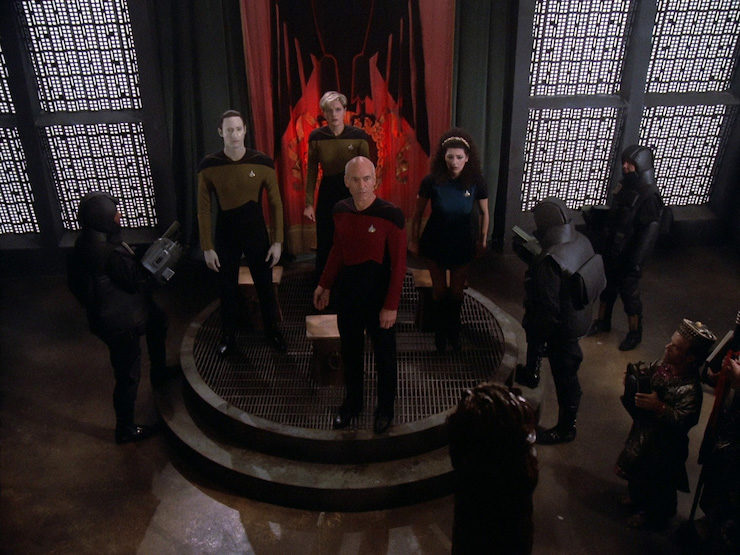
In "Farpoint" a seemingly all-powerful, god-like being called Q diverts the Enterprise and puts its crew on trail for the past barbarism of humanity. Mind you, although Q presents himself in various historical guises, his court is apparently based on a chaotic, post apocolypic, mid-twenty-first century court. This tracks. However, the charges of barbarism are forcefully rebutted by Captain Picard who both acknowledges humanity's terrible past but argues that humanity has grown and improved over the centuries.

This storyline really resonated with me  on this watch and reminds me of the current dialogue in the United States about American history. The current administration is doing everything in its power to stifle any discussion of US history that might put the country in a "negative light," including pressuring museums into removing exhibits that highlight things like slavery and genocide of native people. This is pretty typical of conservative thinking in recent years which seeks to whitewash our history and return to an era of fawning over "great men," instead of reconciling with the realities of the past.

Reinterpreting "Encounter at Farpoint" — A 30th Anniversary Tribute to Star  Trek: TNG - Reactor

While Captain Picard can look back on the problematic sweep of human history with supreme confidence that humanity has grown and improved, American conservatives seemingly cannot. Indeed, when Picard is told by Q that his mission at Farpoint will serve as a test of humanity's quality, the captain does not flinch, confident in the fact that even this brand new crew will act in an ethical way and prove Q wrong.

Perhaps the most refreshing thing about watching Star Trek in 2026 is seeing people in leadership who are both competent, curious, and ethical considering the leadership in this country is composed of a mix of Cardassians, Romulans, and Ferengis.

star trek donald trump : r/startrekmemes

Monday, February 2, 2026

An Ahsoka Tano Primer


At the time of The Mandalorian’s second season, Ahsoka Tano was already a character with a deep history on the animated side of Star Wars, in addition to appearances in The Mandalorian, The Clone Wars, Rebels, her own eponymous show and other media appearances. At the time of this writing, much of her life has been covered on screen (with some intriguing gaps) and it can be argued that she is one the franchises best and most beloved characters.

She wasn’t always so loved, however. First introduced in the theatrical release of The Clone Wars she was a character jointly created by Dave Filoni and George Lucas and takes some visual cues from Filoni’s love for Studio Ghibli movies, particularly Princess Monanoke. Ahsoka was initially met with controversy and disdain by Star Wars fans (imagine that!) due to her sometimes annoying and bratty characterization and over-familiarity with our beloved legacy characters (“Artooey!”). She was introduced as the Padawan apprentice to Anakin Skywalker which initially felt like a jarring retcon to the Prequels. Also, the idea of Anakin having an apprentice at all seemed crazy, although a characteristically terrible Jedi decision.


However, Ahsoka was slowly and methodically developed over the first few seasons of The Clone Wars and during the course of the conflict, Tano was layered with depth and the burden of leadership and responsibility. She also took on some of her master’s independence and tendency for improvisation as well as his martial skill. Ahsoka literally matured before us and through her eyes we experienced the toll of the Clone War on the galaxy and the Jedi. Soon fans were less worrying about her being a retcon than about her seemingly inevitable demise. Her complete absence from Revenge of the Sith hinted at a tragic fate for the young Togruta.

She went on too many notable adventures in The Clone Wars to really get into here and has experienced everything from brainworm-controlled zombies, to being sold off into slavery, to almost having a romance with a young Mandalorian. In possibly her most fateful arc on the show, she and Obi-Wan and Anakin find themselves on a mysterious world called Mortis on which live a trio of Force deities who's mythic struggle seems to mirror the balance of power in the galaxy. During the course of this storyline Ahsoka is killed and resurrected by the Daughter, the embodiment of the Light Side of the Force, and perhaps this act has imbued Ahsoka with some special destiny of which we have yet to really see. Ahsoka season two seems to be going in the direction of continuing this story. Ahsoka's frequent visual companion and herald, the owl-like Morai is also tied into this storyline and her connection with the Daughter.


Ahsoka's story came to a head toward the end of the fifth season of The Clone Wars in a series of episodes which saw her framed for a bombing at the Jedi temple, and which resulted in her going on the run and being captured and put on trial, with only Anakin really attempting to prove her innocence. Ultimately Anakin exonerates her, but the events sour her on the Order and, in a truly shocking moment, she leaves Anakin and the Jedi behind to go off on her own. This moment alone cements her status as a true icon of the franchise and one of the best characters in the whole saga.

We find out that after leaving the Jedi she disappeared into the underworld of Coruscant where she got mixed up with some smugglers. She eventually reconnects with the Mandalorian warrior Bo Katan who is attempting to liberate her planet from a criminal syndicate lead by Maul (yes, that one.) Ahsoka contacts Anakin and petitions the Jedi for military assistance on behalf of the Mandalorians and she is granted temporary command over a battalion of clone troopers. This final arc of The Clone Wars is some of the greatest Star Wars storytelling ever and includes one of the finest lightsaber fuels of the entire saga. Ahsoka defeats and captures Maul but en route to Coruscant, Order 66 is transmitted and Ahsoka and a clone narrowly escape. Maul also manages to escape on his own.

She lives on the run for a while trying avoid the Empire and its Jedi purge, eventually running afoul of one the Jedi-hunting Imperial Inquisitors (which she easily dispatches.) She takes the corrupted red kyber crystals from his lightsaber and purifies them into a pure white color. These crystals are in the katana-style sabers she wields hereafter. Tano then links up with Senator Bail Organa who is establishing the basis what will eventually be the Rebel Alliance, assuming the identity of Fulcrum.


We pick up her story next in Star Wars: Rebels as she is revealed as the rebel agent with whom our cell of rebels has been communicating since the beginning of the show. She’s now much older and wiser than during her Clone Wars years and despite not identifying as a Jedi, Ahsoka briefly serves as a mentor for our Jedi characters Kanan and His apprentice Ezra. Once again, she easily clowns Inquisitors practically taking their lightsabers and smacking them in the face with them. While she is not technically a Jedi, she has become quite a powerful Force-wielder.

Ahsoka and the Jedi make their way to the abandoned planet of Malachor, the site of a historic conflict between the Jedi and the Sith and the activation of an ancient and powerful weapon. The trio meet Maul there who is attempting to activate the dormant weapon. They are soon joined by a trio of Inquisitors and finally by Vader. Throughout her short time on Rebels, Ahsoka has been attempting to piece together the identify of the Sith Lord, with the dawning realization that he is actually her former Master. On Malachor, the two duel and Vader seemingly defeats her, in another one of the great Star Wars face-offs.

In a storyline in the final season of the show, Ezra Bridger returns to the Jedi temple on his homeworld of Lothal and uses it to enter a previously unseen-dimension in the franchise, The World Between Worlds-a kind of Force nexus in time and space. Indeed, the World Between World sequences are full of audio cameos from all over the saga, past and future. During his exploration of this realm, Ezra discovers a portal to Malachor during the Vader/Ashoka duel and manages to pull her out, rescuing her from her fate. Escaping the Emperor's attempts to enter the World Between Worlds, the two are separated and Ahsoka escapes back to Malachor at some point after the destruction of the temple. Since she is entirely absent from the Original Trilogy, it is entirely possible that Ahsoka was trapped on deserted planet for years.


Her live-action debut in The Mandalorian is her next chronological appearance in the Saga. Her brief animated coda during the finale of Rebels takes place later and is likely (although not definitively) an animated version of a scene in Ahsoka season one.