Tuesday, September 8, 2026

Monster Movie of the Week: Prometheus (2012)

Prometheus (2012 film) - Wikipedia


Director: Ridley Scott

Genre: Sci-Fi, Horror, Body Horror

​With the recent announcement that Ridley Scott will be attempting to close out his moribund Alien prequel trilogy, I ran back to see where I left off with this series only to realize that I have not covered either of these films in Monster Movie of the Week. Time to remedy that because I really enjoy this duology, particularly Alien Covenant. This is largely due to Michael Fassbender’s performance as the rogue android David, who is not only the most compelling character in the Alien series but one of the most fascinating characters in all of science fiction cinema. If these third movie ends up being produced, it will be remembered as the David Trilogy more than an Alien Prequel trilogy, because these movies have a strange and uneasy relationship with the mainline Alien films.

Prometheus kicked the whole thing off in 2012 with a movie that was a big hit on release but who’s reputation has suffered a bit in the ensuing decade plus and is mostly remembered for being overly cute about its connection to the Alien series and its goofy and incompetent human characters than anything else. That said, there is a lot to enjoy here such as a stacked cast (Noomi Rapace, Charlize Theron, Idris Elba, Guy Pearce), an unforgettable opening sequence, beautiful cinematography, a terrific Fassbender performance, dark and imaginative design, and deep ties to forgotten Alien lore.

THE MOVIE
Prometheus (Ridley Scott, 2012) – Offscreen

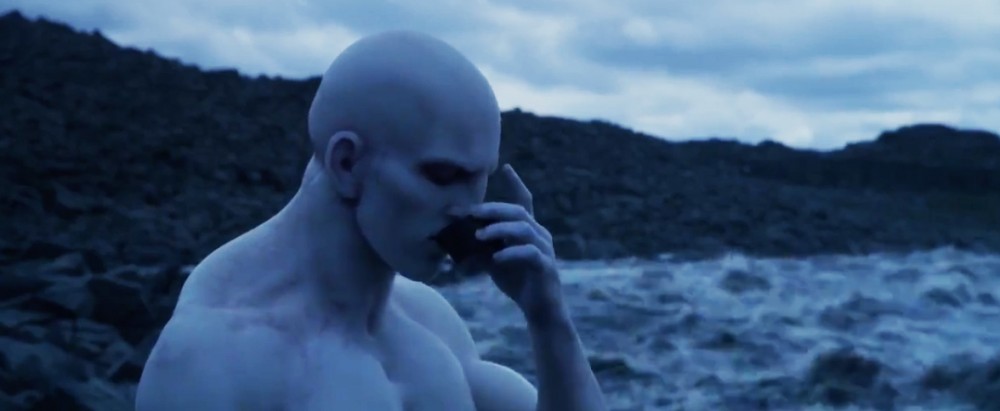
The film starts with an eerie sequence in which a humanoid alien ritualistically consumes a viscous black substance which causes him to convulse, die and quickly decompose in a primeval land. As we follow the breakdown of his tissues and cells it is made visually clear the substance of his body is actually seeding life on this planet, apparently Earth.

This is the best scene in the movie and with no dialogue evokes a kind of visual mythic truth. The movie’s title supports this. Prometheus was the Greek Titan who sacrificed himself to benefit mankind. These aliens, which we later refer to as Engineers, are oversized and marble-skinned and themselves evoke classical statues of Greco-Roman gods. Our protagonists, a pair of married anthropologists Elizabeth  Shaw and Charlie Halloway, develop a theory that a group of alien creatures had made contact with humanity in its infancy and they have uncovered the astronomical coordinates pointing to a distant extra-solar world. The Weyland company, headed by an old billionaire funds an expedition to explore this planet and assembles a squad of experts in different fields to accompany the anthropologists on the starship Prometheus.

This is a fun concept that is drawn from the Chariots of the Gods theory which was popular in the twentieth century. Scott would probably have been exposed to it as a young man. Chariots of the Gods and other similar books posited that “Ancient Aliens” visited Earth throughout our history as supported by accounts in world religion and mythology. Not for nothing, many of the more fantastic passages in works like the Bible or the Bhagavad Gita sound like ancient people trying to describe futuristic technology with accounts of “columns of fire,” and “flying chariots.”

While the crew is in suspended animation for their long interstellar journey, the ship is maintained by David, part of an advanced android series produced by the Weyland Corporation. Right off the bat, we know there is something off about this android who exhibits a fascinating mix of very human characteristics like neediness, pride and vanity. We meet him in his early scenes having the run of the deserted ship, seemingly content to do what he likes (including creepily spying on Shaw’s dreams as she sleeps) and follow his own whims only to bristle when the crew awakens and he is made to serve. Fassbender plays him with a twinkle in his eye and an undercurrent of dark humor. I like to think of David as something akin to a fallen angel who rebels against his creators, preferring to reign in Hell.

The mission is ostensibly lead by Meredith Vickers, played by Theron, who is a stuffy corporate type who also reveals shades of the take-charge common sense that Alien’s Ripley is known for. Vickers and Shaw seem to be jockeying to be the movie's "Ripley." While it was groundbreaking in the first two movies to have this kind of strong female lead, it is feeling a little tropey at this point in the series. It would almost be more striking in an Alien movie at least to have a male protagonist instead of constantly hitting the same Final Girl beat at the end of each movie. Ripley  

There is some speculation in the movie that Vickers might be a synthetic and it is left ambiguous in the narrative as to whether she actually is. I prefer the interpretation that she is as I think it makes her character and relationship a little more interesting. Otherwise, I feel like the movie doesn't really know what to do with her.

They arrive to find the planet is seemingly an uninhabited wasteland. The Prometheus lands near the only visible structure, a pyramid-like dome and the crew set out to explore. This is actually a concept from the early incarnations of Alien which featured a pyramid instead of a derelict spaceship.

Xenomorph relief art in the Ampule room : r/LV426

They find the structure abandoned with only a few giant corpses and evidence of some catastrophe. The bodies resemble the fossilized Space Jockey the Nostromo crew find in Alien (although far smaller). They take a severed head from one of these creatures back to the ship and are able to remove the helmet revealing one of the bald, marble-skinned aliens from the prologue, which Shaw concludes are “our makers.” Of course, David knows something of living in close quarters with his own disappointing makers and provides an interesting perspective on this high-minded quest.

The Movie Waffler

Instead of Xenomorph eggs, the crew finds an eerie chamber with a giant humanoid face overlooking dozens of canisters. These “ampules” contain and begin leaking a substance not unlike the black jelly the Engineer consumed in the prologue, which decomposed his body and also acted as a genetic accelerant. The crew take some of this material back to the ship for study and we see some native worms exposed to a puddle of it. The crew begins to speculate that this world is not the home of the Engineers but a place where they worked on biological weapons.

David has been receiving orders from an unknown source and on its command, he exposes Charlie to a small amount of the accelerant. Up until this point, Halloway has gone out of his way to be dickish and antagonistic to David, who is nothing if not spiteful. One is led to think that if he had been a little nicer, David might have targeted someone else. Later that evening, after a ham-handed conversation about her infertility, Shaw and Halloway have sex, now exposing her to the accelerant.

As I said above, Prometheus is famous for the stupidity of its crew of “elite scientist” characters. That includes things like taking off your helmet for no reason on an alien planet or being unable to run in a diagonal line. The movie is really a fascinating mix of smart and stupid. This is exemplified by the two scientists who are stranded in the dome during a storm and encounter the clearly-dangerous serpent-like creatures that have mutated from the worms exposed to the black goo and these two exhibit almost no basic common sense or survival skills. One of the two is immediately killed and the other has his suit breached and gets a face full of the genetic accelerant.

The Deathly Dangers of Creating A David – The Cinematropolis

Meanwhile on the next trip into the structure David goes deeper into the building and discovers a navigation chamber which also contains one of the Engineer creatures in suspended animation. David, of course, is sick of all these humans but bound by programming to serve them (or at least one of them) but you get the sense he would much rather fuck off with one of these Engineers if he could.

Halloway is starting to show signs of illness from his exposure to the goo, and begins to rapidly mutate. Vickers makes the very Ripley-esque decision to not allow him on the ship. He essentially forces her to immolate him.

Shaw awakens in a hospital bed with David observing her. The two have developed at least a mutual warmness by this point. Shaw has been the only one to treat David with any consideration. Nonetheless, Shaw is restrained and told that she is pregnant with what David drolly refers to as “not exactly a traditional fetus.”

The missing scientist Fifeld returns to the ship and the accelerant has mutated him into something aggressive and…alien. The crew manages to dispatch him. 

Shaw later escapes and makes her way to the ship’s medipod, and in the movie’s goriest and most harrowing scene, the automated surgical unit removes a writing squid-like creature from her and staples her up. Shaw locks the creature in the pod, and finds David, Vickers, and the thought-to-be-dead Peter Weyland, played by Guy Pearce in a lot of old age make-up. Weyland has been on the ship the whole time and is clinging to life to meet the Engineers to ask that they grant him immortality. Which is at once a ridiculous motivation and one that tracks with Earth’s billionaire population.

What Was Ridley Scott Thinking When He Made Prometheus? — Cinema & Sambal

Shaw (still stapled together) accompanies Weyland and David to the navigation room where they awaken the Engineer in what is now revealed to be a ship similar in design to the derelict from Alien. The Engineer is not happy to see any of these people and reacts violently, killing Weyland, decapitating David, and nearly killing Shaw before she escapes. The creature activates the ship, apparently ready to dump its cargo on Earth.

Shaw notifies the Prometheus which rams the Engineer ship. Vickers ejects her section of the ship (which contains the medical chamber) and soft lands on the planet. Shaw manages to escape the crashing ship but Vickers is crushed under it. The Engineer escapes the wreckage and pursued Shaw to the pod, where they have a pretty good chase. She opens the medical chamber, releasing the creature that had been removed from her and which is now enormous and overpowers the engineer, and jams a tube down his throat.

By the way, there is an alternate cut of this chase scene that is much better.


David contacts Shaw on the radio. He has survived the crash (although still decapitated) and he knows where there is another Engineer ship in the complex. The two set off together to find their makers.

In the closing moments of the movie the Engineer corpse begins to twitch and a Xenomorph-like creature digs its way out. And you can almost hear Ridley Scott off camera saying “Here’s your bloody Alien!”

THE MONSTERS

Okay. What is up with these creatures? And what does all this have to do with the ship in Alien our beautiful, precious, perfect organism or James Cameron’s Killer Queen for that matter? Or the Dog Alien? Or the weird skull faced wiggly-nosed creature in Alien Resurrection? It’s okay. I’m here to help with your Xenomorph related questions.

The Engineers

The Engineers are an ancient humanoid species with advanced technology that apparently went around seeding planets for life. They did this on Earth and our ancestors recorded their visits. Scott has said that Jesus was one of them on more than one occasion. I’m not sure if he was kidding but it does seem like human beings did something to them to piss them off. 

The Space Jockey from Alien may have been one of them. Certainly the ship is similar and the armor/flight suits worn by the Engineers is identical to the figure from the derelict ship. However, that creature is far larger than the Engineers we see in this movie. Perhaps they are a third species that the Engineers emulated or worshipped. Perhaps they made the Engineers.

The Accelerant

The Engineers stored a substance at their facility which was discovered by the Prometheus crew. The substance quickly mutated any creature it came in contact with, making them larger and more aggressive. The substance does not seem to instantly kill and in fact seems to be designed to iterate over multiple generations. We see this play out with XXX. It passes through him, changes and passes through Shaw. In Shaw its effects are localized to the site of exposure in her womb in which a new creature is born. That creature, the Trilobite, grows quickly. It overpowers another host, the Engineer, and impregnates it, presumably with a refined version of the substance that now carries genetic material from two different human beings. The resulting hybridized creature is starting to look more like the classic humanoid Xenomorph. Perhaps after a couple more infusions of human DNA we might get something even more familiar.

Indeed, the black goo seems to be working toward the familiar alien life cycle. Essentially Shaw becomes the analogue to the Xenomorph egg, the Trilobite becomes the face hugger which impregnates the Engineer with a a proto-Xeno known as the Deacon. Perhaps after enough time the creatures might stabilize into a hive structure, eschewing the black goo all together.

Alternate Fifield Monster

While the Fifield monster we get is largely executed practically with make-up, there's an alternate version of the scene done with a much more Xenomorphic version of the creature and its a lot  better.

TRIVIA: Prior to the release of Prometheus, the great director Guillermo del Toro (a few of his movies covered in this column), had been working on one of his dream projects, an adaption of H. P. Lovecraft’s novella, At The Mountains of Madness.  The turn-of-the-last-century book details a cursed expedition to the South Pole which uncovers an ancient citadel full of slimy, nightmarish creatures. Seeing Ridley Scott’s Alien prequel, del Toro concluded that his movie would have been too similar Prometheus and this project has been effectively dead since then.

SEE ALSO: 

This movie’s direct sequel is Alien Covenant, in which we find out what became of David and Elizabeth. 

X-Files: Fight the Future (1998) and the subsequent seasons of the series revolve around a similar mutagenic black good, which combines with human beings to create an alien creature.

At the tail end of the original Alien series is Alien Resurrection which I find to be a really interesting bookend to these two Scott prequels. If the David Duology is about the ultimate creation of the Xenomorph, Alien Resurrection is about its deconstruction and rebuilding.

Alien Romulus surprisingly picks up a lot of story threads from this film for what was to have been a back-to-basics Alien movie.

Prometheus has a shockingly similar plot and characters to the first AVP movieAlien vs Predator, for what was billed as a higher-pedigree return-to-form for the series.

Patrick Garone

Patrick Garone

Chicago-based writer & director. Author of City of the Gods and We Lowly Gods.

Saturday, September 5, 2026

REDUX Monster Movie of the Week: Jurassic Park (1993)


Note this entry was originally published 9/20/2009 and revised, expanded, and republished 9/5/2026

JURASSIC PARK (1993)

Director: Steven Spielberg
Genre: Science Fiction/Adventure/Survival

THE MOVIE:

I have a complex relationship with the Jurassic franchise. On one hand, Michael Crichton’s novel is one of my top five favorite books. When I first got my hands on the paperback in the summer of 1991, I ate it up and was obsessed with it. The book was a fun way for me to dive back into my childhood love of dinosaurs and was a great mix of paleontology, then-cutting edge biotech, and real danger and gore. People who only know Jurassic Park from the relatively wholesome movie don’t know the darkness, violence, and fierce social commentary of the book.

I saw the movie on its release day with a couple of friends and couldn’t help but be a little underwhelmed by it. As a dinosaur movie, it’s awesome but it leaves much of the book on the table (for valid reasons of time technology) and, worse, it takes Crichton’s dark cautionary tale about the dangers of biotech in the hands of entitled and irresponsible rich a-holes and turns it into a movie about how awesome dinosaurs are and, yay, nature, or something. That said, it’s still the greatest dinosaur movie ever made.

Where would monster movies be without Jurassic Park? Although, not strictly speaking, a “monster movie” (Spielberg was very conscious of making his dinosaurs animals and not movie monsters,) Jurassic Park helped usher in a new era of creature features and for the first time applied CGI to the task of creating photorealistic creatures. Over the next few years when this technology became cheaper and easier to use it helped usher in a whole wave of CGI-aided monster movies such as Anaconda (1997), The Relic (1997), Mimic (1997), Deep Rising (1998), Deep Blue Sea (1999,) Eight-Legged Freaks (2002) and a whole slew of others. Jurassic Park took a B-movie premise and gave it a respectful presentation, with an A-List director.


Jurassic Park is an adaptation of the late Michael Crichton’s blockbuster novel about an island theme park featuring dinosaurs cloned from amber-preserved DNA. This clever premise skirts actual science just enough to sound plausible. With the unprecedented realism of its visual effects, Jurassic Park has the feel of credible speculative fiction. Although, how cool would it have been if Spielberg had chosen to realize it as a faux documentary, the genre closest to what the book purports to be? If this movie ever gets remade (and there is good reason to do it) this is the route that they should go. The movie also launched Crichton-mania in the mid to late 1990's with (among others) adaptions of Congo, Sphere, and Disclosure rushing into production in Jurassic Park's wake as well as the Crichton-developed TV series E.R..

A small group of scientists are recruited to evaluate the island theme park prior to its public unveiling when a combination of a tropical storm and industrial espionage take out the Jurassic Park’s security systems causing the dinosaurs to escape their enclosures and overrun the island. A grumpy paleontologist must shepherd a pair of kids back to safety through the dino-infested island. As Hammond says in the movie, "Who better to get the children through Jurassic Park than a dinosaur expert." The heroes must then do everything they can to escape the island.

Jurassic Park was a pop cultural phenomenon when it was released. It was a movie whose sheer size and visuals had to been seen (not to mention heard) in a theater to be done justice. Even people who don’t normally go in for big summer special effects movies wanted to get a glimpse of Spielberg’s dinosaurs. One could actually make the ironic argument that the CGI technology used to bring the dinosaurs to life for the movie was a bit like Hammond’s technology to bring his dinosaurs to life in the story. It was a bit of a circus atmosphere: pay your $6 at the door and get a glimpse of the most realistic dinosaurs you’ll ever see. I vividly remember going to see it with a couple of high school buddies. June 11, 1993. Regardless, until Titanic was released, Jurassic Park enjoyed a four-year reign as the all-time box office champ.


One of the things that I genuinely love about the movie that I don’t think people talk about enough is the iconic production design which captures a kind of 1990’s tropical theme park adventure aesthetic. The movie is so rich in details that bring the nascent theme park to life. Everything from unmistakable red and neon green range rovers, the dinosaur fossil relief panels that decorate the visitors’ center, the painted velociraptor mural in the kitchen is all instantly recognizable. The on-location shooting was done in Hawaii and it gives the park a believable character and a sense of geography. Yes, Jurassic Park is a terrible idea and the product of humanity's overweening hubris, but I really want to go there. And layer the majestic John Williams score on top of that and it’s not hard to understand why many people consider this movie a classic.

THE MONSTER/EFFECTS:

The effects have held up nicely over the decades and feature a seamless blend between CGI, animatronics, and even some suitmation. At some points (such as the raptor kitchen chase) the three techniques are so deftly blended together that it is next to impossible to tell where one ends and the next begins.

The filmmakers were pushing technology to its limits when they made this movie so some of the more demanding sequences from the book were probably cut from the movie (such as the T-rex river chase later adapted in both Jurassic Park III and Jurassic World Rebirth) for technical and financial reasons and scenes like the annoying car-in-the-tree sequence were probably added as “filler.” Of course, they more than made up for this in the sequels which featured a veritable orgy of dinosaurs.

While this movie is famous for its ground breaking use of CGI to bring the dinosaurs to life in certain scenes requiring extended mobility and performance this was not the original plan. Jurassic Park went into production with the plan of using stop-motion dinosaurs in the full Ray Harryhousen tradition. The story of how a young ILM employee took it upon himself to bring CGI into the project could be a movie in itself and is told various places including the great Disney Plus documentary Light and Magic.

The sound design must also be given credit. As amazing as the visual effects were, the sound effects and vocalizations created for the dinosaurs are equally impressive. Who can ever forget the earsplitting roar of the T-Rex? The same is true for the more avian and unnerving raptor calls and screeches. Not to mention the distinctive Dilophosaur hiss. I don’t think hissing has ever been done better. Not even by my cat.

BOOK TO MOVIE

So obviously, the story is streamlined from the book.

Here are some of the major differences:

The version of the park in the book is a lot farther from opening than the movie. The guest facilities and most of the attractions are very much under construction in the book. The world of the book is a lot less polished and therefore a little more dangerous.

A major and fascinating subplot is the fact that at the start of the book some of the smaller dinosaurs have already gotten off the island and are disrupting both the ecosystem and the human population of Costa Rica. In fact, the investigation into these events really provides the jumping off point for the rest of the story. This subplot is completely omitted from the movie. It is briefly followed-up on in Crichton’s sequel, The Lost World, but that book was written in the wake of the huge success of the movie and is a strange hybrid of a sequel to both the book and the movie which recons certain elements of the novel, like Malcolm’s death. Crichton seemed disinclined to write sequels as a rule so who knows if he would have ever followed up on Jurassic Park if there had not been pressure from Amblin and Universal to create a sequel. It seems that the novel sets up a book about the escaped dinos spread into the world which would have been awesome. I know a version of this happens in the Jurassic World movies but it happens in Crichton's books in a way that is more dangerous and insidious.

One of the biggest changes is in the characterization of Hammond who is less a kindly grandfather concerned with bringing joy to the world’s children than a rapacious and irresponsible capitalist who is using this powerful and transformative technology for purely frivolous entertainment purposes without a thought to the human or environmental consequences. And that's not even to mention on the dinosaurs themselves. On a related note Elon Musk has recently indicated he wants to clone dinosaurs. So, yeah. Lessons learned.

Grant and Sattler are not a couple here so the in-retrospect uncomfortable age and status gap is not a factor in the book. Grant specifically likes children in the book because they like dinosaurs. The changes they imposed on Grant in the movie are all about giving him some kind of tiresome domestication arc. Malcolm is largely the same character in the book but there is much more of him in the novel to the point where he is very much Crichton’s mouthpiece for the themes of the book and his criticisms of out-of-control scientific progress and, implicitly, to the out-of-control capitalism that enables it.

Also, lest I come off painting Michael Crichton as some kind of woke, leftie figure I don't think that was the case as all. He was actually famous in the later years of his life as a climate change denier. I don't know what all his politics were but I'm sure they were complex. That said, I stand by my reading of this book in that it is implicitly critical of the kind of irresponsible venture capitalism that enabled Jurassic Park. What we are supposed to take away from this book is that Jurassic Park is a terrible idea. This is so much the case that the book ends with the military bombing the island and killing all the dinosaurs.

This also happens off screen in the continuity of the movies but is very much at odds with the tone of the film which is very "aww, dinosaurs are majestic and beautiful." The fact that the movie series for some reason decided to do this also has caused a lot of unnecessary complexity and confusion to the lore such as the need for second and third islands, moving dinosaurs around between the various islands, a second park on the ruins of the first, etc.

“Your kids, Crichton. We’ve got to talk about your kids!”

Tim and Lex are also in the book. They are not a Spielbergian addition. The long and ignoble tradition of Jurassic series child endangerment starts squarely with Crichton’s novel. To Spielberg’s credit, the kids in the movie are far less annoying than in the novel. The ages in the movie have been swapped, so that Lex is now a preteen instead of an eight year old. Look, you are not ready for book Lex who is one of the most aggravating characters in fiction and someone is stubbornly determined to be difficult and unhelpful in a series of high-stakes crisis situations. By contrast, movie Lex has some useful skills and is mostly calm, down-to-earth, and acts like a normal human being.

As with the movie, much of the book is following Grant and the kids attempting to get from the Tyrannosaur paddock back to the visitor center. The journey in the book is a bit more extensive involving run-ins with both Tyrannosaurs (including a juvenile which is scary in a different way than the adult), on a river (a great scene finally recreated in Jurassic World Rebirth) and through a waterfall (a scene repurposed in The Lost World), through an abandoned aviary filled with pterosaurs (Jurassic Park III) and finally evading raptors through the InGen labs in the visitor center. 

Perhaps most striking is the tonal difference between the book and movie. Crichton’s novel recounts the story’s many dinosaur attacks in sometimes graphic, medical detail. Many of the book’s characters are mauled or eaten alive and the book does not spare on the details.

Finally, the book features a different and slightly larger roster of dinosaurs including Compys, Stegasaurs (replaced by Triceratops in the movie),flying Cearadactyls, Microceratops, and Styracasaurus. 

It should be noted the book version of the Dilophosaurus is more accurate to the actual animal in that it is considerably larger and lacking the neck frill, although its being venomous started with Crichton's book.

MONSTERS FEATURED:

Tyrannosaurus Rex
Dilophosaurus
Brachiosaurus
Tricerotops (lying down only)
Velociraptors – Introduced the word velociraptor into common speech.
Parasaur
Gallimimus


MOST MEMORABLE SEQUENCE:

There are many amazing sequences in this movie but my personal favorite is a quick shot right after Grant and all land on the island. After you see the first Brachiosaurs there is a beautiful long shot of a herd of dinosaurs bathing in the lake in the golden sunlight. They should make a poster of this:


WHERE TO WATCH:


Widely available on Bluray  and in various combo packs with its sequels. Back in the old days of the VCR, Jurassic Park was the movie with which you showed off your home theater system.

SEQUELS:

The Lost World: Jurassic Park (1997), Jurassic Park III (2001), Jurassic World (2015), Jurassic World: Fallen Kingdom, Jurassic World Dominion (featuring Malcolm, Grant, and Sattler), Jurassic World Rebirth (2025)

MINORITY REPORT:

First casualty: A black Costa Rican worker gets munched on by a caged raptor.

The only black character of consequence is a pre-Pulp Fiction Samuel L. Jackson, who makes a novice minority-character-in-a-horror-movie mistake: He leaves the group to turn the lights on. No! If you are black and in a monster movie, you never leave a group of white people!

Minority Survival Threshold: 26%

Annoying-Ass Kid Survival Threshold: 100%

SEE ALSO:

King Kong (2005)
Primitive War (2024) While this dinosaur war movie has little to do with the Jurassic series it seems to go out of its way to feature many of the same dinosaurs in a more scientifically-accurate presentation and a level of gore and violence that is in keeping with Crichton’s novel.

READ ALSO:


Check out The Science of Jurassic Park by Rob Desalle and David Lindley. And also Crichton's novel.

Not that I condone reading.


THE TRAILER:


TRIVIA:


Actual velociraptors were only the size of a turkey and lived in Asia, so Grant would absolutely not be digging one up in Montana. The raptors in the movie resemble another species, Deinonychus which did live in what was now North America. Interestingly, around the time of the movie's release a related species, Utah Raptor, was discovered that more closely sized to the velociraptors in the movie (a bit larger actually.)

Patrick Garone

Patrick Garone

Chicago-based writer & director. Author of City of the Gods and We Lowly Gods.

Monday, August 31, 2026

Monster Movie of the Week: It Came From Beneath The Sea (1955)

It Came from Beneath the Sea - Wikipedia

IT CAME FROM BENEATH THE SEA (1955)

Director: Robert Gordon

Genre: Natural Horror/Monster on the loose


THE MOVIE


When it comes to bogeymen, there’s nothing like a good “It.”  “It” was a terror from beyond space!    “It” was alive!  Even Stephen King had an “It.”  Next to a good “Thing,” there’s nothing like “It” (unless you are an Addams in which case you have regular contact with both.)  One day I hope they will make a movie called “It! Vs. Thing!”


It Came from Beneath the Sea - Wikipedia


Today we will be talking about the particular “It” that came from beneath the sea. This is one of Ray Harryhousen’s most iconic monster movies and tells the story of a giant octopus irradiated by nuclear testing and driven from its home at the ocean depths. The fifties were the golden age of nuclear testing and this was fodder for all kinds of sci-fi and horror shenanigans in the movies. Not to mention the actual real world horrors associated with exploding nuclear bombs in the middle of the Pacific. Let us not forget, the original Godzilla movie was directly inspired not by the actual WWII bombing of Japan but by the US bomb testing in the Pacific in which a Japanese fishing ship was irradiated. 


The plot of ICFBTS is almost a template for everything from Jaws to many later kaiju movies. A submarine comes into contact with a mysterious sonar reading. It briefly collides with the object and later inspection of the submarine indicates the flesh of some kind of giant creature. Marine biologists are called in to identify the tissue, which they calculate is some kind of previously unknown giant octopus. Obviously the military doesn't buy it but they have to reconcile the havoc caused by this creature in the Pacific.


The mutated octopus of It Came from Beneath the Sea eventually makes its way to San Francisco and goes on a rampage before being blown up in the harbor. This movie gave Harryhousen the opportunity to work on a different kind of creature from the alien and terrestrial monsters he had already done, this being an aquatic monster composed mainly of tentacles. Even if you haven't seen the movie it's likely you've seen clips from it as it is often used to represent the whole genre and era of 1950's B-movies movies. There is something classic and iconic of the image of the stop-motion black and white tentacle running amok in 1950's America.


This is really a solid entry to the Atomic Monster genre that took off in the 1950's. Gojira was released the year before in Japan and other famous entries include classic creature features like Them!, Harryhousen's The Beast from 20,000 Fathoms, Tarantula!, and The Beginning of the End, among many many others In the aftermath of the bombings of Hiroshima and Nagasaki and at the height of the Cold War, nuclear annihilation was on everyone's mind.


It Came from Beneath the Sea - Wikiquote


THE MONSTER/EFFECTS


Other than its size, there is nothing particularly monstrous about this octopus (except that it has only six tentacles, but let's say it lost a couple in the initial run in with the sub. Is it then a sixtapus?)  The effects are overall very good as you would expect from a Harryhousen movie and the wonderful three-dimensionality that stop motion gives you.  There are some sequences that are among the most famous of 1950’s monster movies, such as the creature’s attack on the Golden Gate Bridge.


MONSTERS FEATURED


Just one octopus.


SEQUELS


None.


SEE ALSO


20 Million Miles to Earth 1957,  The Beast from 20,000 Fathoms 1954


TRIVIA


This is movie is being watched by a security guard in a scene prior to the creature’s initial attack in the American Godzilla (1998).


TRAILER


NEXT UP


A Christmas movie.


Patrick Garone

Patrick Garone

Chicago-based writer & director. Author of City of the Gods and We Lowly Gods.

Monday, August 24, 2026

Monster Movie of the Week: Annihilation (2018)


Genre: Sci-Fi, Eco-Horror, Body Horror

The 2010's saw a boom of excellent, indie science fiction movies like Under the Skin, Arrival, and Looper. Writer and later director Alex Garland was very busy during this period on classic projects like Dredd, and Ex Machina. Early in his career, Garland was known as a novelist for books like The Beach, but he soon transitioned to filmmaking, writing the screenplay for the first two 28...Later movies and Sunshine before transitioning again into directing. The excellent sci-fi movie Ex Machina was his directorial debut.

Annihilation is his second film and is adapted from the novel of the same name, the first of the Southern Reach trilogy by Jeff VanderMeer. I have tried to read the novel version but found it to be a little impenetrable. Both stories detail expeditions to explore a mysterious alienized region of the southern United States, the site of a meteor impact. The movie is a fairly loose adaptation of the book which takes the core concepts and basic characters and runs in its own direction with them, with some additional inspiration from Lovecraft's "The Color Out of Space," the old Soviet sci-fi novel Roadside Picnic, and J.R. Ballard's The Crystal World. The resulting film is often genuinely disturbing and features a couple of really outstanding and memorable creatures. It is a movie that was not widely seen upon its initial release but a movie which has gained in reputation over the years. I genuinely love this movie and think it is criminally underrated. I think it is going to be considered a classic in twenty years. This movie makes me wonder what someone like Garland would do with a franchise like Alien.

Natalie Portman stars as Lena, a molecular biologist and cancer researcher who is mourning her husband who at the start of the movie has been MIA on a mysterious military mission. Portman-as always-is great playing a very internalized character with a lot going on under the surface. Indeed, the emotional coolness of Annihilation can be off-putting for some people, contributing to the overall Kubrickian vibe of the movie. 


Her apparently-deceased husband, Kane-played by another Star Wars alum, Oscar Isaac, shows up at their house but there is something very wrong with him. He can't answer basic questions about what has happened to him or where he has been. When he begins to become seriously ill, Lena attempts to take him to the hospital but their ambulance is intercepted by government agents, and they are taken to a mysterious facility which is located outside an expanding phenomenon that has developed around a meteor crash. The boundary of this area is marked with a colorful, refracting curtain of light known as "the Shimmer."

Lena's husband is apparently the only survivor of the last mission to investigate the Shimmer and is now dying from exposure to whatever is inside. The director of the facility, Dr. Ventress, asks her to join the next expedition, an all-female group. Seeking answers and possibly a cure for her ailing husband, Lena joins them.


Things in the Shimmer go immediately awry as the group begins losing time and encountering bizarre mutations such as an albino alligator with a maw full of Biollante-esque teeth, mutated flowers, and deer/plant hybrids. The Shimmer is acting as a genetic accelerant, changing animals into strange new creatures and remixing their genes.


In their explorations they also find some evidence of the dark fate of the previous team and the movie juxtaposes imagery that is grisly but also fantastic and beautiful. In an abandoned swimming pool, the squad finds the corpse of a soldier that has suffered a colorful fungal explosion like something out of The Last of Us.

The surreal and haunting atmosphere of the Shimmer begins to act on the team which erupts in paranoia. This is not unlike the claustrophobia and anxiety in John Carpenter's The Thing. Much as in Carpenter's movie, members of the team are restrained and tied to chairs to assess their allegiance.

In an abandoned home (an identical one to Lena’s) the team encounters arguably the film’s most disturbing creature. On the surface the design is not that interesting. It is essentially a large bear with patches of skin missing, particularly on its face, which also subtly has elements of a human skull fused into it. The design of the mutant bear monster is unique among the creatures that live in the Shimmer as it emphasizes decay. Most of the other living animals that we encounter feature seemingly wild uncontrollable growth. 


A mutant bear is not unprecedented in horror, perhaps most famously in 1979's Prophecy (the creature in that movie went on to inspire South Park's Manbearpig) but in this case there are audio and behavioral elements that push this monster over the top. This creature had already murdered one member of the team and Lena had previously discovered the body with its throat ripped out. As we encounter the bear in the flesh, we hear that slain character's cries because this monster has apparently incorporated her vocal cords and is using voice to lure other characters to it.

Lena eventually makes her way to the mysterious lighthouse at the center of the Shimmer, where she finds an incinerated body and a video camera mounted on a tripod. She watches the recording to find that it is that of her husband, Kane who had recorded his self-immolation with a flash grenade. As we may have suspected, the man at the beginning of the movie is likely not her husband Kane. Interestingly, Kane speaks in with a distinctly southern American accent in this recorded scene only. He does not have it when he shows up at the house nor in any of the various Lena/Kane flashbacks we see throughout the movie. Is it due to the tendency of the Shimmer to remix various animals and people and perhaps Kane had been merged with one or more of his teammates. A similar phenomenon is observable in a mysterious ouroboros tattoo that seems to jump from person-to-person in Lena's group. 

Exploring deeper into the lighthouse, Lena discovers both Ventress and the core of the alien infestation which manifests itself as...a.fancy screensaver. Some of Lena's blood gets sucked into the vortex and begins generating a doppelganger. Lena escapes but encounters the hybrid which is another standout creature. 


Again, on the surface, the creature is not all that interesting. It is a humanoid with an almost oily, iridescent sheen. It's behavior, however, creepy and fascinating as it mirrors and mimics Lena's movements, eventually pinning her to a door as she tries to escape the lighthouse. Behavior is an underutilized element of monster design. I go back to Alien and its iconic Xenomorph, which is the greatest design in the history monsters but after so many movies and shows I find myself desperate to see new behavior other than hissing and killing. How scary would the Alien be if we saw more of its behavior and if that behavior were as creepy and unsettling as the design?

This final Annihilation  climax is an incredibly strange and unsettling sequence, heightened by the movie's hair-raising and discordant score, The creature is performed by Sonoya Mizuno who appears early in the movie as one of Lena's students and who is best known for her recurring role as  Mysaria on House of the Dragon.

Lena eventually uses the creature's MO of mirroring her to get it to accept a flash grenade and it burns itself and the lighthouse just as it begins to more fully transform into her. Lena escapes to the base to find that her husband has now recovered. Like The Thing, Annihilation ends on an uncertain note as to whether or not these characters are actually human. Really, the movie is clear on the fact that they are no longer fully human, but the question remains, how much of themselves remains.

SEE ALSO

The Thing (1982), The Color Out of Space (2019)

Patrick Garone

Patrick Garone

Chicago-based writer & director. Author of City of the Gods and We Lowly Gods.

Saturday, August 15, 2026

A Lost Story from the Universe of We Lowly Gods: The Tale of the Benefactor

File:Prometheus Adam Louvre MR1745.jpg - Wikimedia Commons


THE TALE OF THE BENEFACTOR

By Patrick Garone

    The old beggar cursed and jabbed at the fire with his cane and it hissed and spat at him in response. The boy reconsidered his decision to seek shelter with the man. He glanced at the cave entrance and saw rain falling from the heavens in gleaming, solid sheets of water, which refracted the cold and murky landscape beyond. 

    At least the fire held back the cool dampness. It felt good on his skin. His soaked tunic was starting to dry at last.

    Thunder boomed.

    “Is this your cave,” the boy asked.

    The old man said grimly: “No. I am seeking shelter from the storm.”

    “Oh,” the boy said, at a loss.

    “My home is on Krete. I make my way there.”

    The boy did not know where Krete was exactly, only that it was a big island to the south. 

    “Krete is far,” the boy said finally. “Why are you on Lemnos?”

    “Family,” the old man said without further explanation, gazing out at the wet landscape beyond. 

    The boy nodded, absently.

    “The mountains on this island are sacred and were once gods,” declared the old man, still staring out at the wet landscape..

    “The gods turned to mountains,” the boy asked with skepticism.

    “Only those Kronos has deemed to have committed grave offenses against the Titans, in this case the great Prometios, although many others have fallen afoul of the Lord of Heaven.”

    The boy detected some bitterness in the beggar’s voice.

    “Ah, for Prometios gave fire to mankind,” the boy ventured, waving a hand to the fire between them, “and this was an offense to the gods.” He had learned as much from the village priests.

    The old man huffed. “The Titans accused Prometios of many transgressions. Giving fire to mortals was only a small part of it.”

    “Are you a priest of Prometios that you know so much? Or a poet?”

    “I am merely an old man who has learned much throughout my many years of life, which I fear may soon come to its long-delayed conclusion.”

    The boy acknowledged this with disinterest. To be so old as to be at the end of one’s life was inconceivable to him. Old age was a vaguely embarrassing state, presumably born out of poor choices. It would never happen to him.

    Lightning flashed.

    “I would hear of Prometios, if only to pass the time,” the boy declared, “since I live on this island, which was beloved of the Titan and where you say his remains lie.”

    The boy knew that old men loved to tell stories. They practically bled them from their bald heads. 

    The beggar regarded him over the fire. “I am losing myself. Before long, there will be nothing left."

    "You must have stories to tell. Why not share one before it leaves you?"

    The old man regarded him for a moment. There was a gleam in his eye. Or perhaps it was just the fire. "Yes. I will give you a story while I still possess it.”

    Thunder boomed.

    He looked out beyond the cave entrance; the outside world warped through water. “I will speak until the rain ceases to fall.”

    The old beggar shifted his body and leaned toward the boy and into the fire so that its light animated his ancient, weathered face.

***

    After the overthrow of the All-Father, the Titans began their reign, taking over his old palace and ruling from his heavenly citadel. At that time, only the Children of Gaia populated earth. There were thinking Chimerics-like the nymphs, cyclopes and centaurs-who combined the features of the Titans with animals. These Chimerics were among Gaia’s first fevered creations.

    There were also colossal beasts and monsters born in the early dalliances between Gaia and Ouranos. These creatures were aggressive and ungovernable, and they preyed upon their smaller, weaker kin. In order to defend their Chimeric siblings and to ensure future use of the earth realm, the Titans made war on their monstrous brethren in a legendary war. At the end, the Titans were victorious, killing or driving the beasts to the ends of the earth. So violent and destructive were their battles that they shaped the very land, creating the legendary Mediterranean and the islands that would later become Greece.

    In return for protecting them, the Titans tasked the Chimerics with maintaining this new world, tending to its flora and fauna. The creatures were happy to do this since they were no longer subject to the predations of their monstrous siblings. This was the Titans’ first act of creating order in the world. 

    Gaia was, of course, displeased by the conflict between her children, but at least happy there would now be peace. She had grown old, and with each of her creations she had given up something until she was nearly spent. She was barely more than spirit by this point. However, she was not finished creating life. With her grandson, the Titan Prometios, she planned for her ultimate creation.

    “Grandmother,” he beseeched her, “do you really mean to do this thing?”

    “I must create them,” she said, “even if it means my end.”

    With that, she brought forth iron and metals from deep within her. She raised easily edible plants and docile animals and teeming fish in the realm of Oceanos, lord of the seas. But these acts were nothing to her but preparations for her last act, for she knew her newest creation would have neither sharp teeth nor claws to survive in the world. With the last of her strength, the great creator Gaia brought forth her ultimate work: man.

    “Promise me, my child,” she begged of Prometios with the last of her strength, that you will protect them."

    “I will, Grandmother,” the Titan said, weeping.

    He regarded this new life: dozens of tiny and weak creatures. Those newly created human beings were as men and women fused together in one shambling, two-headed body with an indeterminate number of limbs. Indeed, these new human beings were next to helpless. 

    Prometios sighed. Unfortunately, this was the way of many of Gaia’s creations. For every powerful and beautiful Titan, there were dozens of misshapen Chimerics and other more pitiful creatures. He turned himself to realizing Gaia’s ambitions.

    One by one he worked on them, making them better and stronger. First, he split them apart. He imposed gender on them, male and female, in the manner of the Titans themselves.  He stoked the fire of love and passion in them. This ensured that they would seek one another out to couple and increase their numbers in this new paradise. But Prometios split them artfully, so that in none was a perfect split between male and female and in each some of the opposite existed so that there might be a healthy dynamism and disruption to the otherwise rigid social order that he bestowed upon them and that they might be capable of some of the pleasure and freedom of the Titans.

    On this very island, he hid and raised humanity up. He taught them speech. He taught them hunting, farming, and building. In turn, they loved and worshipped him.

    Their adoration was intoxicating and nourishing. He knew this would be mankind’s salvation. Gaia had created beings whose existence was completely symbiotic with the Titans. And, yes, he introduced them to fire. And it was fire which drew the remaining Titans to him, for they had been searching the world for him, blaming him for the death of their mother. Shocked by humanity, it was only the pleas of Prometios which stayed the great scythe of Kronos from wiping them all out immediately.

    They chained Prometios and brought him before his family in the great hall of the heavenly citadel. Kronos and Rhea looked down upon him from their thrones. He saw familiar faces in the crowd of Titans and their children, such as Crios, lord of the underworld, and his father, Iapetos, spinner of fates.

    “Prometios,” Kronos began, his voice boomed in the open hall.

    “You stand accused of unimaginable crimes, firstly the murder of our mother, Gaia, the Lady of Creation.”

    “l’m guilty of nothing of the sort,” Prometios responded. “It’s a foolish accusation, Uncle.”

    Kronos bristled, perhaps regretting giving the famously clever Titan a forum.

    “We all knew Gaia. We knew her obsessions. I’m guilty of only lacking persuasion. I loved her dearly, and I was closer to her than any, save perhaps good Crios." 

    “This is true,” Crios added, for his realm was literally created from the bones of Gaia's body, long discarded. 

    Kronos frowned.

    “So you allowed my mother to destroy herself before your very eyes, for what? These miserable creatures?”

    “Those ‘miserable creatures’ are the last children of Gaia,” Prometios said. 

    “We are her children too,” Kronos countered. “And, as always, she favored her misshapen beasts and monsters to us, her greatest creations.”

    “What’s stopping us,” Rhea asked, her crown blooming with flowers, “from destroying them outright?”

    “They are a mockery, chattering animals made in our image,” Kronos added, “surely you must have known we would not tolerate them, you who thinks of everything.”

    “You won’t destroy them,” Prometios countered, risking a smirk. “I think you will find them...valuable.”

     Kronos and his queen took their leave of Prometios and ventured to their garden paradise, to this very island but to the men many years had passed, for time in heaven is rarefied compared to time on earth.

    In the years of his absence, men had taken the teachings of Prometios to heart and built great works, cities and culture. They had even built houses of worship to their Titan benefactor. Kronos and Rhea came upon one of these human cities, a pair of glorious giants and men fell at their feet in worship and adoration, knowing them to be of a kind with their lost lord.

    Kronos and Rhea then discovered what clever Prometios had already known. For whatever power and greatness they possessed before that moment, they had not known what it was to be a god, for a god requires lesser beings to provide worship. This was the wisdom of Gaia and Prometios that the love of human beings would forever change and define their kind. Indeed, it was the promise kept by good Prometios which changed the very world. Men multiplied and filled in the lands which the Titans had cleared of monsters and spread their worship of the gods to the furthest corners of the map.

    “What is it about them,” Kronos would later ask his nephew.

    “They are spirit and flesh,” Prometios replied. “Gaia made them to love us. And we cannot resist them. They can build temples and create religions around this love, but it is as simple as that. It’s a kind of lust or obsession which sustains us.”

    For his trouble, however, Kronos imprisoned Prometios. The Lord of Heaven was eternally fearful of his power being stolen from him. And in truth, the clever Titan did little to ingratiate himself to his lord. Poor Prometios endured unimaginable torture for the alleged crime of matricide. But his “crimes” didn’t stop the Titans from taking advantage of the systems he created. From that point on, the Titans actively cultivated mankind and their worship. If the world was their garden, human beings were the exotic flora whose nectar sustained them. They could help themselves no more than bees could resist flowers.

    Some of his most devoted mortal followers eventually located him, worshipping him in a secret singular cult. This worship was unique and more intense than the the other forms of god worship. Indeed, the bleeding, suffering god who had sacrificed himself for mankind had instilled a fervor not present in the adoration of the other Titans. It spoke to a great need in humankind that has yet been unmet.

    Ultimately, man's worship was not enough to sustain him and Prometios' great body turned to stone, the very mountain spine of this island.

***

    Inside the cave, the fire smoldered. Outside, the rain was slowing to a drizzle. The old man stood, his knobby knees prominent under his traveling robes.

    “With that,” he said, ”I leave you. I must head to Krete while I still remember myself.”

    “Wait,” the boy asked, “are you...a god?”

    “I was never properly a god, never worshipped by man, but I was there at the beginning and saw it all before being cursed to this.”

    “Ouranos,” the boy whispered

    The old man sighed wearily.

    “But how can you die,” the boy asked, deeply disturbed by the idea.

    “No one is immortal. Neither gods nor young boys, although both mistakenly think they are.”

    The boy looked on as Ouranos walked off to his fate.


Patrick Garone 2026

"The Tale of the Benefactor" is set in the universe of and is a de-facto prequel to my novel We Lowly Gods, which tells the story of the Chimerics at the end of the Greek era.!-- START PATRICK GARONE HORIZONTAL POST FOOTER -->

Patrick Garone

Patrick Garone

Chicago-based writer & director. Author of City of the Gods and We Lowly Gods.