Monday, August 31, 2026

Monster Movie of the Week: It Came From Beneath The Sea (1955)

It Came from Beneath the Sea - Wikipedia

IT CAME FROM BENEATH THE SEA (1955)

Director: Robert Gordon

Genre: Natural Horror/Monster on the loose


THE MOVIE


When it comes to bogeymen, there’s nothing like a good “It.”  “It” was a terror from beyond space!    “It” was alive!  Even Stephen King had an “It.”  Next to a good “Thing,” there’s nothing like “It” (unless you are an Addams in which case you have regular contact with both.)  One day I hope they will make a movie called “It! Vs. Thing!”


It Came from Beneath the Sea - Wikipedia


Today we will be talking about the particular “It” that came from beneath the sea. This is one of Ray Harryhousen’s most iconic monster movies and tells the story of a giant octopus irradiated by nuclear testing and driven from its home at the ocean depths. The fifties were the golden age of nuclear testing and this was fodder for all kinds of sci-fi and horror shenanigans in the movies. Not to mention the actual real world horrors associated with exploding nuclear bombs in the middle of the Pacific. Let us not forget, the original Godzilla movie was directly inspired not by the actual WWII bombing of Japan but by the US bomb testing in the Pacific in which a Japanese fishing ship was irradiated. 


The plot of ICFBTS is almost a template for everything from Jaws to many later kaiju movies. A submarine comes into contact with a mysterious sonar reading. It briefly collides with the object and later inspection of the submarine indicates the flesh of some kind of giant creature. Marine biologists are called in to identify the tissue, which they calculate is some kind of previously unknown giant octopus. Obviously the military doesn't buy it but they have to reconcile the havoc caused by this creature in the Pacific.


The mutated octopus of It Came from Beneath the Sea eventually makes its way to San Francisco and goes on a rampage before being blown up in the harbor. This movie gave Harryhousen the opportunity to work on a different kind of creature from the alien and terrestrial monsters he had already done, this being an aquatic monster composed mainly of tentacles. Even if you haven't seen the movie it's likely you've seen clips from it as it is often used to represent the whole genre and era of 1950's B-movies movies. There is something classic and iconic of the image of the stop-motion black and white tentacle running amok in 1950's America.


This is really a solid entry to the Atomic Monster genre that took off in the 1950's. Gojira was released the year before in Japan and other famous entries include classic creature features like Them!, Harryhousen's The Beast from 20,000 Fathoms, Tarantula!, and The Beginning of the End, among many many others In the aftermath of the bombings of Hiroshima and Nagasaki and at the height of the Cold War, nuclear annihilation was on everyone's mind.


It Came from Beneath the Sea - Wikiquote


THE MONSTER/EFFECTS


Other than its size, there is nothing particularly monstrous about this octopus (except that it has only six tentacles, but let's say it lost a couple in the initial run in with the sub. Is it then a sixtapus?)  The effects are overall very good as you would expect from a Harryhousen movie and the wonderful three-dimensionality that stop motion gives you.  There are some sequences that are among the most famous of 1950’s monster movies, such as the creature’s attack on the Golden Gate Bridge.


MONSTERS FEATURED


Just one octopus.


SEQUELS


None.


SEE ALSO


20 Million Miles to Earth 1957,  The Beast from 20,000 Fathoms 1954


TRIVIA


This is movie is being watched by a security guard in a scene prior to the creature’s initial attack in the American Godzilla (1998).


TRAILER


NEXT UP


A Christmas movie.


Patrick Garone

Patrick Garone

Chicago-based writer & director. Author of City of the Gods and We Lowly Gods.

Monday, August 24, 2026

Monster Movie of the Week: Annihilation (2018)


Genre: Sci-Fi, Eco-Horror, Body Horror

The 2010's saw a boom of excellent, indie science fiction movies like Under the Skin, Arrival, and Looper. Writer and later director Alex Garland was very busy during this period on classic projects like Dredd, and Ex Machina. Early in his career, Garland was known as a novelist for books like The Beach, but he soon transitioned to filmmaking, writing the screenplay for the first two 28...Later movies and Sunshine before transitioning again into directing. The excellent sci-fi movie Ex Machina was his directorial debut.

Annihilation is his second film and is adapted from the novel of the same name, the first of the Southern Reach trilogy by Jeff VanderMeer. I have tried to read the novel version but found it to be a little impenetrable. Both stories detail expeditions to explore a mysterious alienized region of the southern United States, the site of a meteor impact. The movie is a fairly loose adaptation of the book which takes the core concepts and basic characters and runs in its own direction with them, with some additional inspiration from Lovecraft's "The Color Out of Space," the old Soviet sci-fi novel Roadside Picnic, and J.R. Ballard's The Crystal World. The resulting film is often genuinely disturbing and features a couple of really outstanding and memorable creatures. It is a movie that was not widely seen upon its initial release but a movie which has gained in reputation over the years. I genuinely love this movie and think it is criminally underrated. I think it is going to be considered a classic in twenty years. This movie makes me wonder what someone like Garland would do with a franchise like Alien.

Natalie Portman stars as Lena, a molecular biologist and cancer researcher who is mourning her husband who at the start of the movie has been MIA on a mysterious military mission. Portman-as always-is great playing a very internalized character with a lot going on under the surface. Indeed, the emotional coolness of Annihilation can be off-putting for some people, contributing to the overall Kubrickian vibe of the movie. 


Her apparently-deceased husband, Kane-played by another Star Wars alum, Oscar Isaac, shows up at their house but there is something very wrong with him. He can't answer basic questions about what has happened to him or where he has been. When he begins to become seriously ill, Lena attempts to take him to the hospital but their ambulance is intercepted by government agents, and they are taken to a mysterious facility which is located outside an expanding phenomenon that has developed around a meteor crash. The boundary of this area is marked with a colorful, refracting curtain of light known as "the Shimmer."

Lena's husband is apparently the only survivor of the last mission to investigate the Shimmer and is now dying from exposure to whatever is inside. The director of the facility, Dr. Ventress, asks her to join the next expedition, an all-female group. Seeking answers and possibly a cure for her ailing husband, Lena joins them.


Things in the Shimmer go immediately awry as the group begins losing time and encountering bizarre mutations such as an albino alligator with a maw full of Biollante-esque teeth, mutated flowers, and deer/plant hybrids. The Shimmer is acting as a genetic accelerant, changing animals into strange new creatures and remixing their genes.


In their explorations they also find some evidence of the dark fate of the previous team and the movie juxtaposes imagery that is grisly but also fantastic and beautiful. In an abandoned swimming pool, the squad finds the corpse of a soldier that has suffered a colorful fungal explosion like something out of The Last of Us.

The surreal and haunting atmosphere of the Shimmer begins to act on the team which erupts in paranoia. This is not unlike the claustrophobia and anxiety in John Carpenter's The Thing. Much as in Carpenter's movie, members of the team are restrained and tied to chairs to assess their allegiance.

In an abandoned home (an identical one to Lena’s) the team encounters arguably the film’s most disturbing creature. On the surface the design is not that interesting. It is essentially a large bear with patches of skin missing, particularly on its face, which also subtly has elements of a human skull fused into it. The design of the mutant bear monster is unique among the creatures that live in the Shimmer as it emphasizes decay. Most of the other living animals that we encounter feature seemingly wild uncontrollable growth. 


A mutant bear is not unprecedented in horror, perhaps most famously in 1979's Prophecy (the creature in that movie went on to inspire South Park's Manbearpig) but in this case there are audio and behavioral elements that push this monster over the top. This creature had already murdered one member of the team and Lena had previously discovered the body with its throat ripped out. As we encounter the bear in the flesh, we hear that slain character's cries because this monster has apparently incorporated her vocal cords and is using voice to lure other characters to it.

Lena eventually makes her way to the mysterious lighthouse at the center of the Shimmer, where she finds an incinerated body and a video camera mounted on a tripod. She watches the recording to find that it is that of her husband, Kane who had recorded his self-immolation with a flash grenade. As we may have suspected, the man at the beginning of the movie is likely not her husband Kane. Interestingly, Kane speaks in with a distinctly southern American accent in this recorded scene only. He does not have it when he shows up at the house nor in any of the various Lena/Kane flashbacks we see throughout the movie. Is it due to the tendency of the Shimmer to remix various animals and people and perhaps Kane had been merged with one or more of his teammates. A similar phenomenon is observable in a mysterious ouroboros tattoo that seems to jump from person-to-person in Lena's group. 

Exploring deeper into the lighthouse, Lena discovers both Ventress and the core of the alien infestation which manifests itself as...a.fancy screensaver. Some of Lena's blood gets sucked into the vortex and begins generating a doppelganger. Lena escapes but encounters the hybrid which is another standout creature. 


Again, on the surface, the creature is not all that interesting. It is a humanoid with an almost oily, iridescent sheen. It's behavior, however, creepy and fascinating as it mirrors and mimics Lena's movements, eventually pinning her to a door as she tries to escape the lighthouse. Behavior is an underutilized element of monster design. I go back to Alien and its iconic Xenomorph, which is the greatest design in the history monsters but after so many movies and shows I find myself desperate to see new behavior other than hissing and killing. How scary would the Alien be if we saw more of its behavior and if that behavior were as creepy and unsettling as the design?

This final Annihilation  climax is an incredibly strange and unsettling sequence, heightened by the movie's hair-raising and discordant score, The creature is performed by Sonoya Mizuno who appears early in the movie as one of Lena's students and who is best known for her recurring role as  Mysaria on House of the Dragon.

Lena eventually uses the creature's MO of mirroring her to get it to accept a flash grenade and it burns itself and the lighthouse just as it begins to more fully transform into her. Lena escapes to the base to find that her husband has now recovered. Like The Thing, Annihilation ends on an uncertain note as to whether or not these characters are actually human. Really, the movie is clear on the fact that they are no longer fully human, but the question remains, how much of themselves remains.

SEE ALSO

The Thing (1982), The Color Out of Space (2019)

Patrick Garone

Patrick Garone

Chicago-based writer & director. Author of City of the Gods and We Lowly Gods.

Saturday, August 15, 2026

A Lost Story from the Universe of We Lowly Gods: The Tale of the Benefactor

File:Prometheus Adam Louvre MR1745.jpg - Wikimedia Commons


THE TALE OF THE BENEFACTOR

By Patrick Garone

    The old beggar cursed and jabbed at the fire with his cane and it hissed and spat at him in response. The boy reconsidered his decision to seek shelter with the man. He glanced at the cave entrance and saw rain falling from the heavens in gleaming, solid sheets of water, which refracted the cold and murky landscape beyond. 

    At least the fire held back the cool dampness. It felt good on his skin. His soaked tunic was starting to dry at last.

    Thunder boomed.

    “Is this your cave,” the boy asked.

    The old man said grimly: “No. I am seeking shelter from the storm.”

    “Oh,” the boy said, at a loss.

    “My home is on Krete. I make my way there.”

    The boy did not know where Krete was exactly, only that it was a big island to the south. 

    “Krete is far,” the boy said finally. “Why are you on Lemnos?”

    “Family,” the old man said without further explanation, gazing out at the wet landscape beyond. 

    The boy nodded, absently.

    “The mountains on this island are sacred and were once gods,” declared the old man, still staring out at the wet landscape..

    “The gods turned to mountains,” the boy asked with skepticism.

    “Only those Kronos has deemed to have committed grave offenses against the Titans, in this case the great Prometios, although many others have fallen afoul of the Lord of Heaven.”

    The boy detected some bitterness in the beggar’s voice.

    “Ah, for Prometios gave fire to mankind,” the boy ventured, waving a hand to the fire between them, “and this was an offense to the gods.” He had learned as much from the village priests.

    The old man huffed. “The Titans accused Prometios of many transgressions. Giving fire to mortals was only a small part of it.”

    “Are you a priest of Prometios that you know so much? Or a poet?”

    “I am merely an old man who has learned much throughout my many years of life, which I fear may soon come to its long-delayed conclusion.”

    The boy acknowledged this with disinterest. To be so old as to be at the end of one’s life was inconceivable to him. Old age was a vaguely embarrassing state, presumably born out of poor choices. It would never happen to him.

    Lightning flashed.

    “I would hear of Prometios, if only to pass the time,” the boy declared, “since I live on this island, which was beloved of the Titan and where you say his remains lie.”

    The boy knew that old men loved to tell stories. They practically bled them from their bald heads. 

    The beggar regarded him over the fire. “I am losing myself. Before long, there will be nothing left."

    "You must have stories to tell. Why not share one before it leaves you?"

    The old man regarded him for a moment. There was a gleam in his eye. Or perhaps it was just the fire. "Yes. I will give you a story while I still possess it.”

    Thunder boomed.

    He looked out beyond the cave entrance; the outside world warped through water. “I will speak until the rain ceases to fall.”

    The old beggar shifted his body and leaned toward the boy and into the fire so that its light animated his ancient, weathered face.

***

    After the overthrow of the All-Father, the Titans began their reign, taking over his old palace and ruling from his heavenly citadel. At that time, only the Children of Gaia populated earth. There were thinking Chimerics-like the nymphs, cyclopes and centaurs-who combined the features of the Titans with animals. These Chimerics were among Gaia’s first fevered creations.

    There were also colossal beasts and monsters born in the early dalliances between Gaia and Ouranos. These creatures were aggressive and ungovernable, and they preyed upon their smaller, weaker kin. In order to defend their Chimeric siblings and to ensure future use of the earth realm, the Titans made war on their monstrous brethren in a legendary war. At the end, the Titans were victorious, killing or driving the beasts to the ends of the earth. So violent and destructive were their battles that they shaped the very land, creating the legendary Mediterranean and the islands that would later become Greece.

    In return for protecting them, the Titans tasked the Chimerics with maintaining this new world, tending to its flora and fauna. The creatures were happy to do this since they were no longer subject to the predations of their monstrous siblings. This was the Titans’ first act of creating order in the world. 

    Gaia was, of course, displeased by the conflict between her children, but at least happy there would now be peace. She had grown old, and with each of her creations she had given up something until she was nearly spent. She was barely more than spirit by this point. However, she was not finished creating life. With her grandson, the Titan Prometios, she planned for her ultimate creation.

    “Grandmother,” he beseeched her, “do you really mean to do this thing?”

    “I must create them,” she said, “even if it means my end.”

    With that, she brought forth iron and metals from deep within her. She raised easily edible plants and docile animals and teeming fish in the realm of Oceanos, lord of the seas. But these acts were nothing to her but preparations for her last act, for she knew her newest creation would have neither sharp teeth nor claws to survive in the world. With the last of her strength, the great creator Gaia brought forth her ultimate work: man.

    “Promise me, my child,” she begged of Prometios with the last of her strength, that you will protect them."

    “I will, Grandmother,” the Titan said, weeping.

    He regarded this new life: dozens of tiny and weak creatures. Those newly created human beings were as men and women fused together in one shambling, two-headed body with an indeterminate number of limbs. Indeed, these new human beings were next to helpless. 

    Prometios sighed. Unfortunately, this was the way of many of Gaia’s creations. For every powerful and beautiful Titan, there were dozens of misshapen Chimerics and other more pitiful creatures. He turned himself to realizing Gaia’s ambitions.

    One by one he worked on them, making them better and stronger. First, he split them apart. He imposed gender on them, male and female, in the manner of the Titans themselves.  He stoked the fire of love and passion in them. This ensured that they would seek one another out to couple and increase their numbers in this new paradise. But Prometios split them artfully, so that in none was a perfect split between male and female and in each some of the opposite existed so that there might be a healthy dynamism and disruption to the otherwise rigid social order that he bestowed upon them and that they might be capable of some of the pleasure and freedom of the Titans.

    On this very island, he hid and raised humanity up. He taught them speech. He taught them hunting, farming, and building. In turn, they loved and worshipped him.

    Their adoration was intoxicating and nourishing. He knew this would be mankind’s salvation. Gaia had created beings whose existence was completely symbiotic with the Titans. And, yes, he introduced them to fire. And it was fire which drew the remaining Titans to him, for they had been searching the world for him, blaming him for the death of their mother. Shocked by humanity, it was only the pleas of Prometios which stayed the great scythe of Kronos from wiping them all out immediately.

    They chained Prometios and brought him before his family in the great hall of the heavenly citadel. Kronos and Rhea looked down upon him from their thrones. He saw familiar faces in the crowd of Titans and their children, such as Crios, lord of the underworld, and his father, Iapetos, spinner of fates.

    “Prometios,” Kronos began, his voice boomed in the open hall.

    “You stand accused of unimaginable crimes, firstly the murder of our mother, Gaia, the Lady of Creation.”

    “l’m guilty of nothing of the sort,” Prometios responded. “It’s a foolish accusation, Uncle.”

    Kronos bristled, perhaps regretting giving the famously clever Titan a forum.

    “We all knew Gaia. We knew her obsessions. I’m guilty of only lacking persuasion. I loved her dearly, and I was closer to her than any, save perhaps good Crios." 

    “This is true,” Crios added, for his realm was literally created from the bones of Gaia's body, long discarded. 

    Kronos frowned.

    “So you allowed my mother to destroy herself before your very eyes, for what? These miserable creatures?”

    “Those ‘miserable creatures’ are the last children of Gaia,” Prometios said. 

    “We are her children too,” Kronos countered. “And, as always, she favored her misshapen beasts and monsters to us, her greatest creations.”

    “What’s stopping us,” Rhea asked, her crown blooming with flowers, “from destroying them outright?”

    “They are a mockery, chattering animals made in our image,” Kronos added, “surely you must have known we would not tolerate them, you who thinks of everything.”

    “You won’t destroy them,” Prometios countered, risking a smirk. “I think you will find them...valuable.”

     Kronos and his queen took their leave of Prometios and ventured to their garden paradise, to this very island but to the men many years had passed, for time in heaven is rarefied compared to time on earth.

    In the years of his absence, men had taken the teachings of Prometios to heart and built great works, cities and culture. They had even built houses of worship to their Titan benefactor. Kronos and Rhea came upon one of these human cities, a pair of glorious giants and men fell at their feet in worship and adoration, knowing them to be of a kind with their lost lord.

    Kronos and Rhea then discovered what clever Prometios had already known. For whatever power and greatness they possessed before that moment, they had not known what it was to be a god, for a god requires lesser beings to provide worship. This was the wisdom of Gaia and Prometios that the love of human beings would forever change and define their kind. Indeed, it was the promise kept by good Prometios which changed the very world. Men multiplied and filled in the lands which the Titans had cleared of monsters and spread their worship of the gods to the furthest corners of the map.

    “What is it about them,” Kronos would later ask his nephew.

    “They are spirit and flesh,” Prometios replied. “Gaia made them to love us. And we cannot resist them. They can build temples and create religions around this love, but it is as simple as that. It’s a kind of lust or obsession which sustains us.”

    For his trouble, however, Kronos imprisoned Prometios. The Lord of Heaven was eternally fearful of his power being stolen from him. And in truth, the clever Titan did little to ingratiate himself to his lord. Poor Prometios endured unimaginable torture for the alleged crime of matricide. But his “crimes” didn’t stop the Titans from taking advantage of the systems he created. From that point on, the Titans actively cultivated mankind and their worship. If the world was their garden, human beings were the exotic flora whose nectar sustained them. They could help themselves no more than bees could resist flowers.

    Some of his most devoted mortal followers eventually located him, worshipping him in a secret singular cult. This worship was unique and more intense than the the other forms of god worship. Indeed, the bleeding, suffering god who had sacrificed himself for mankind had instilled a fervor not present in the adoration of the other Titans. It spoke to a great need in humankind that has yet been unmet.

    Ultimately, man's worship was not enough to sustain him and Prometios' great body turned to stone, the very mountain spine of this island.

***

    Inside the cave, the fire smoldered. Outside, the rain was slowing to a drizzle. The old man stood, his knobby knees prominent under his traveling robes.

    “With that,” he said, ”I leave you. I must head to Krete while I still remember myself.”

    “Wait,” the boy asked, “are you...a god?”

    “I was never properly a god, never worshipped by man, but I was there at the beginning and saw it all before being cursed to this.”

    “Ouranos,” the boy whispered

    The old man sighed wearily.

    “But how can you die,” the boy asked, deeply disturbed by the idea.

    “No one is immortal. Neither gods nor young boys, although both mistakenly think they are.”

    The boy looked on as Ouranos walked off to his fate.


Patrick Garone 2026

"The Tale of the Benefactor" is set in the universe of and is a de-facto prequel to my novel We Lowly Gods, which tells the story of the Chimerics at the end of the Greek era.!-- START PATRICK GARONE HORIZONTAL POST FOOTER -->

Patrick Garone

Patrick Garone

Chicago-based writer & director. Author of City of the Gods and We Lowly Gods.

Monday, July 20, 2026

The Vampire Lestat, Episode 7: The Failures

It takes one to know one. The season finale of #TheVampireLestat is available to stream now on AMC+ or watch it tonight at 9pm on AMC.

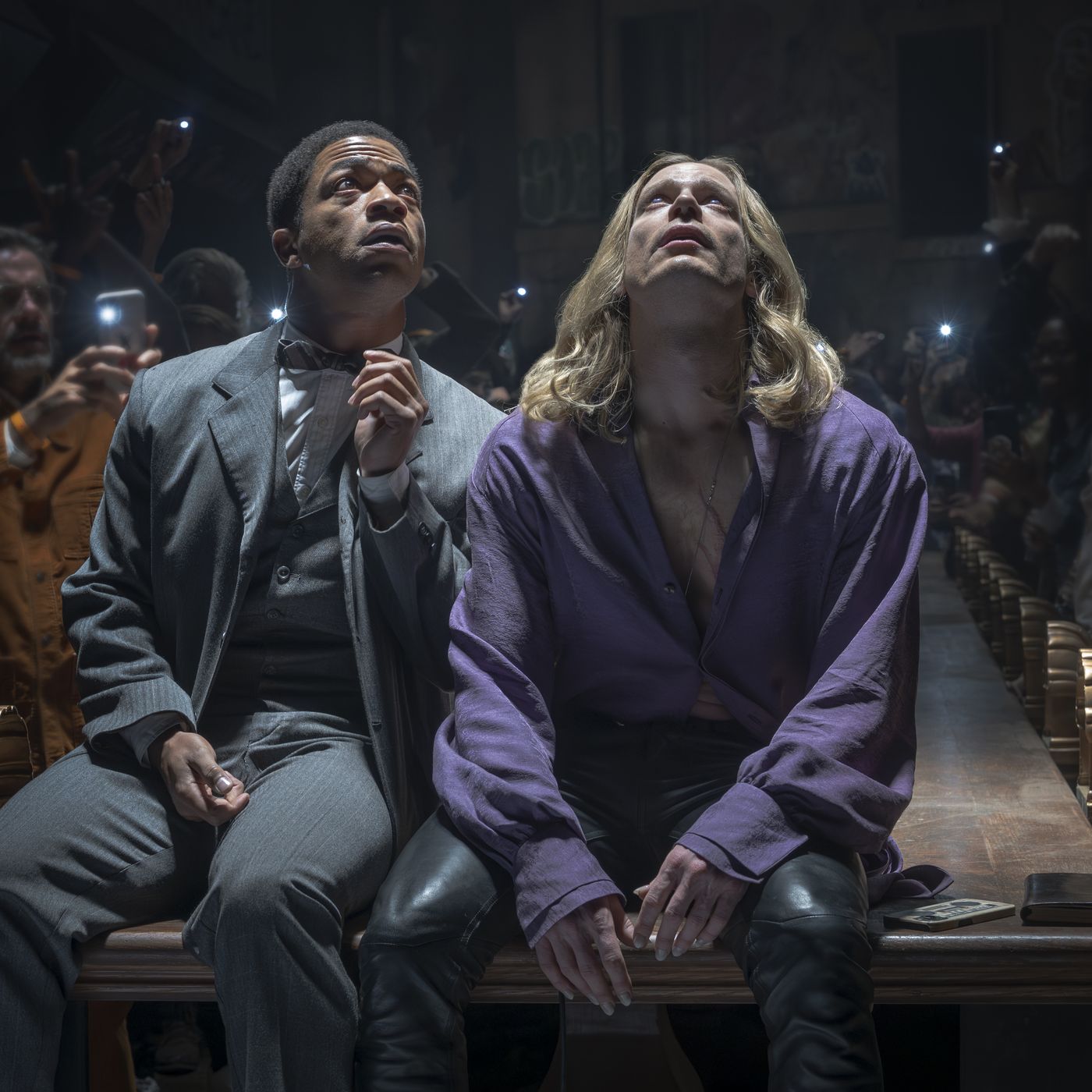
Much like the book on which it is based, The Vampire Lestat series is beautiful and inconsistent and messy. The first season finale is emblematic of this. This is an episode that spends an inordinate amount of time navel-gazing and lost in its own stylishness and cleverness but doesn’t really move the story forward in a meaningful way. It’s a “very special episode” that spins its wheels for an hour likely because they didn’t have the budget to actually do the concert.

We start with Lestat’s death dream and he’s walking through the daytime  forest transcribing birdsong. He follows a “murder” of waiters. Hearing songs from the outside as daywalking Daniel carries his head through the Montreal streets in a bowling ball bag. He arrives at the long table of his father seen both earlier in the season and prominently featured in the opening credits. The younger Lestats are all there.

The Vampire Lestat': Burning questions following 'The Failures' finale | Mashable


The scene then switches to the same table in Magnus’ tower, where Lestat’s maker sits with (most of) his fledglings. Antoinette from season one is present as is Tough Cookie, his drummer. She enters a number into the timer on his phone and slides it to him, indicating the amount of time he has left to live.


The scene switches to Louis’ head mounted onto a spike in a butcher shop and Armand’s reading his AA amends statement at him, recounting the various terrible things he did during the events of Paris and beyond both great and small. Armand also confirms his stalking and involvement with Daniel between the two interviews. He admits to being “an infinite nothing,” which is a solid interpretation of the character.


At the long table Magnus and the fledglings check in. As they are projections of Lestat’s psyche each is an exaggerated version of the characters we already know. Magnus here is less campy than we have seen him before. They are the “failure finders” there to sit in judgment of Lestat. While he is at the table, he is also in a bowling ball bag and at the same butcher shop as Louis.


The Vampire Lestat Episode 7 Recap - "The Failures"


Armand reveals Louis has been separated from his head for two hours. Dr. Fareed is also there monitoring Louis’ vitals. Armand reveals Lestat’s body and that his head is with his “companion.” Cut to Daniel Malloy in a bowling alley. Armand then reveals Fraudia as a prisoner.


Lestat confronts the accusations against him and questions Magnus, involvement in the committee, “I knew you for like a week!” He goes onto describe his time with Magnus which, curiously we never got to actually see dramatized in the show. He insisted his other “maker” Gabriella take over and Magnus obliges.


Armand still seeking Louis’ amends, outlines all his behind the scenes maneuvering that lead to his discovery of Regina. The whole Fraudia subplot was his doing, which is some very on-brand Armand fuckery.


Meanwhile Molloy is monologuing his petty grievances to Lestat’s severed head in between bowling rounds, which is bleeding into Lestat’s visions. In a surreal effect Dan’s head literally comes through the ceiling to intrude on the long table. I have to say, I’m not a fan of what they have done with this character this season and I don’t mean this as a book reader thing because Dan was a much less interesting character in the chronicles than in the show. I loved him in the first two seasons and feel like he has been reduced to a whiny petty brat in this season. He certainly has some reason to be mad at his treatment by Lestat but what happened to his lovely connection to Louis last season? I know a lot of fans are pushing the Queen of the Damned Devil’s Minion storyline but it really doesn’t make a lot of sense for these versions of the characters. Aligning these two seems forced and inorganic.


Interview with the Vampire - S03E07 - The Failures - Transcript


Still trying to get Louis to talk, Armand tells him that he “listened in” on the seance the night before. To be clear, he was observing or getting reports on Louis’ deeply personal and pained interactions with Regina and also eavesdropping on the incredibly difficult and traumatic seance. Classic Armand behavior, he maybe an empty void but he is violently intrusive of others. Armand states he has about one-hundred “followers,” I’m still not clear on what kind of movement is at play here. Presumably to stop the Great Conversion.


Around the long table the Failure Finders are reading off the negative reviews of Lestat’s music. The reviews actually sound like negative reviews of Rice’s work. Another familiar face that appears is Marco, the young opera singer Lestat kills in season one, which leads us to flashback of young Lestat watching the witch burnings. Although the witch burning place is from the book, Lestat never actually watches this as they would have happened long before his birth. Gabriella reveals she exposed him to this to urge him out of their village but laments that he stayed till he was thirty. 


Raglan James meets Molloy at the bowling alley and reveals that he wants the bag and the concert to go on. Man, the Talamasca is a mess in the Immortal Universe. That’s not to say that James isn’t acting on his own as he is prone to do, but I don’t see why the Talamasca would want the Great Conversion to happen. Raglan takes Lestat’s head.


To save Fraudia, Louis digs deep and recounts his various lies and crimes to Armand, telepathically. He also makes the connection between his prior work running brothels to Armand’s past as a sex trafficked youth. Louis takes responsibility for his own coldness and denial in their relationship. Armand, touched let’s Regina go and instructs Fareed to replace his head.


The characters at the Long Table at this point have become a Greek Chorus for Lestat retelling the story of his life, peppering him with insults as we see moments from the show play out often in reverse to booming musical accompaniment, while periodically chanting the refrain, “The Soul!” I don’t love all this. It’s seems almost self-consciously theatrical.


In true fashion, Lestat leaps on the table and begins playing to the crowd of people people he killed or traumatized. He begins glitching out as his head and body die. He is visited by Louis’ brother, Paul.


The Vampire Lestat' Season Finale Recap: 'The Failures'


Lestat awakens on the tour bus to find Gabriella, the band, and Raglan James. They are all trying to persuade him to play the show, but he is unwilling. He finds Louis on the bus and gets into a screaming match with Gabriella who is insisting he perform, referring to her as a “fucking monster.”


We then cut to a scene of Lestat in his Montreal home where he is actually recording “The Failures.” This would be therefore set post Akasha but before the auction scene in the first episode.  He steps outside to a post apocalyptic landscape with wide swaths of urban destruction. Is this because of the fact that the concert was in Montreal and it was ground zero or is the whole world like this?


*Straight into opening credits from recap

*Nice to see all the elements coming together from credits

*Great head acting from Jacob. The gradual decline, drooping lips, raspy voice and especially the eyes sliding into opposite directions was all very creepy.

*They are wrong for putting nine fingered Antoinette on the typewriter.

*Magnus: ”Consent is a 20th century concern.”Cancelled.

*Armand claims to be live-streaming his interaction with Louis to someone in Budapest. Who could this be? 

*Armand threatens to cut off Regina’s head and sew it onto Louis’ body which is actually a reference to a twisted Claudia anecdote that Armand relays in his own eponymous Vampire Chronicle.

*”Lestat’s mom made you, yeah? She give you the Autism Gift?”

*Lestat’s sustained perfect “O” of a moan is directly from the book

*Apparently Lestat was in Vienna in 1953. Maybe he knocked around Europe for a while before returning to New Orleans 

*We finally get to meet Black Licorice

*”I let too much spill too often.” Anne Rice would tend to agree with this.

*At the moment of death, Lestat describes “Silver threads” which is how the connections between the vampires and Akasha are described in QOTD.

*Paul apparently talking to god, says “Yes, ma’am.” Remember this is just Lestat’s idea of Paul. Nonetheless who was he speaking to? Akasha?

*Lestat refers to Raglan as “someone I now call a friend.” Guys, Lestat is about to drop a new Failure!!

Patrick Garone

Patrick Garone

Chicago-based writer & director. Author of City of the Gods and We Lowly Gods.