Tuesday, December 9, 2014

Alien Isolation Review


Anyone who reads my inaccurately-named Monster Movie of the Week feature on this blog knows that I am a lifelong fan of the Alien franchise.  So, I had been eyeing SEGA's Alien Isolation  for a while, impressed with its take on the material and its inspiration from Ridley Scott's 1979 horror movie rather than James Cameron's 1986 action film, which video games have been relentlessly ripping off since it was released.  Instead of being a shooter, like most games adapted from the series, Isolation  is an intense survival horror experience and seemingly a spiritual successor to the old Commodore 64 Alien game.  I also liked what I heard from its developers Creative Assembly, who in a series of videos prior to the release described the game's horrors in a hilariously quiet and deadpan manner.

Alien Isolation is a direct sequel to Alien and features Ellen Ripley's daughter, Amanda who was introduced in the extended cut of Aliens.  Amanda has gone to work for the Weyland Yutani company but has an agenda to find out the fate of her mother, missing since the "loss" of the Nostromo many years earlier.  At the start of the game, the Nostromo's flight recorder has been located and taken to Sevastapol, a station managed by the hapless Seegson company, known for making creepy chokebots.  The station is in the process of being decommissioned but has also become home to some aliens, when Amanda arrives to retrieve the Nostormo's black box and get some closure about her mother's disappearance.

Isolation was released in October to some of the most schizophrenic video game reviews I have ever read.  While most independent reviewers praised it-some effusively hailing it a "game changer"-other high-profile reviewers with outlets-such as IGN, Gamespot, and Polygon-were less impressed with it, citing the game's punishing difficulty, manual save system, length, and pacing.  Strangely, many of the positive reviews seemed to hold up the difficulty and "pacing" as strengths of the game.

Having now finished Alien Isolation and contemplating the game's reviews, I wonder if it's time to stop thinking of "video games" as cookie cutter experiences that should all be played and approached the same way.  Isolation is not your typical video game and I have been thinking about how it is best to be played.  It took me about two months to finish Alien Isolation partially because I don't have unlimited time but also because this is an intense and harrowing game and I found myself needing to take frequent breaks from it. I played it mostly in the mornings because I didn't really like playing it at night (They mostly come out at night.  Mostly.).  The truth is, it's a demanding game and I wasn't always in the mood for it.

I don't know how most reviews happen at the big websites but I can't imagine anyone "cramming" this game and playing it in a week or two and having a good experience with it.   I'm wondering if all of the griping about the difficulty and the save points is a function of people trying to blow through Alien Isolation as thought it were your typical shooter.  This is a game that punishes cockiness.  I took my time with Alien Isolation and thoroughly enjoyed it.   I didn't pick it up necessarily expecting to finish a whole mission in one sitting.  Instead, I was happy to play from save point to save point and consider myself lucky for not getting my face chewed off.  As far as the difficulty, I rarely had to play any sections over and over again.  Nor, did I ever lose a significant amount of progress for lack of a save point.

I come down on the side of thinking that the pacing is actually quite good.  The game takes about an hour to really get moving but the setting, graphics, and art direction are so good that I didn't mind. This is also in keeping with the spirit of Ridley Scott's movie, which featured a similar slow-burn. The game also smartly alternates between sections in which the Alien actively hunts you and other stretches during which the beast is out of commission and your main antagonists are groups of human survivors or rogue androids called Working Joes which are a bit easier to deal with.  This gives the player both a nice break from the intense Alien gameplay and also a good opportunity to explore and enjoy the setting,  a compelling retrofuturistic environment.  When the Alien is about, you really don't get a lot of opportunities to enjoy the scenery.  There are a couple of sections that involve space walks and even a flashback to a stroll on LV-426 which also offer a respite from the intense Alien action and some beautiful space porn.

One of the things that I love about Alien Isolation is that it is more experiential than "gamey."    Also, it doesn't feed into the typical video game male power fantasy.  Most often in games you are cast as some over-powered gun-toting badass.  That's certainly been a problem in Alien  games which demote H.R. Giger's fantastic creature to cannon fodder.  One could even make the case that this goes back to Cameron's sequel.  But it is certainly not the case in Alien Isolation.  As Amanda Ripley, the odds are stacked against you and the only real ability you have is to build some devices to fend off or distract your opponents.  The game even teases you with an assortment of guns only to have you learn that you really are better off not using them at all.  Your only real weapons against the Alien are Molotov Cocktails and the flamethrower and both of those will only drive the monster off for a second.  As in Scott's original movie, the Alien is relentless and indestructible in Alien Isolation.

The Alien itself is a terrific adversary in the game and it has been said that it has advanced AI which actively learns from how you play.  I did find this to be the case.  I had gotten too comfortable hiding in the many lockers found in the Sevastapol station and I found that the Alien did get wise to me before long and it would invariably find me in these lockers and violently rip the doors off.

Most of your encounters with the Alien are unscripted and will change depending on your actions. Even late in the game I observed behavior that I hadn't seen in my early encounters, such as when I thought I was safe in one of the many small iris vents on the station and I turned around to discover the monster slowly crawling towards me.  I didn't even think the damn thing could get in those vents and I might have gone the whole game without seeing that bit of behavior.  Who knows what else the Alien is doing when you are not watching it?  Maybe it does the dance number from Spaceballs.

It also is revealed that there is not one but multiple aliens on the station when a nest is encountered well into the game.  I had mixed feelings about this as I was attached to that very Alien experience of surviving a singular creature.  It was also frustrating from a gameplay perspective because I felt like I was being dropped into an Aliens game without Aliens  weapons.  Luckily these nest sections are fairly short.  From a story perspective, I was confused by where these Aliens came from since there was no evidence of a Queen Alien on the station.  Were the people on the station being transformed into eggs as in the famous Alien deleted scene?  I would have been fine if this had been the case.  In fact it would have fit right in with the game's wonderful devotion to Scott's movie-but it is never addressed in the game.  There are just a bunch of eggs and facehuggers running around without explanation.  And strangely, for all of the Aliens that are running around in the cutscenes, I rarely encountered more than one of them in the game at the same time (thankfully.)


The story is decent but a bit skeletal and there are some plot holes that are not really addressed.  The characters are also a bit skimpy and underdeveloped.  While Amanda is given a bit of personality and a compelling personal mission, no one else seems to have been given much development.  The Weyand android who accompanies Amanda was potentially an interesting character but I felt like his nature was kept ambiguous and then awkwardly revealed.  When he ended up being a compassionate ally to Amanda, I was interested to learn more but was confused by his character arc.  I do agree with the game's critics regarding the sudden and anticlimactic ending but I feel this is symptomatic with larger problems with the writing.

The station is probably the most vividly fleshed out character in Alien Isolation and in many ways it is an extrapolation of the design aesthetic of the Nostromo ship from Alien.   It is similarly lived-in and grimy and feels like it has a real history and context.  It expands on the vaguely dystopian capitalist future hinted at in Scott's movie, full of sociopathic corporations and their exploited employees.  You learn a lot about Seegson Corporation and the Sevastapol station by reading terminals throughout the station.  The creepy Working Joe androids also inhabit this junky station.  Unlike the lifelike Weyland Yutani synthetics, the Working Joes are not meant to pass for human but instead feature rubbery skin and raspy electronic voices.  In the larger economy, they are probably meant to be cheap, entry-level androids.

The Sevastapol and its synthetic inhabitants are probably the most original and interesting concepts that Alien Isolation introduces to the Alien universe.  Otherwise, you could make the argument that Alien Isolation is a bit too derivative of Ridley Scott's Alien.  It would have been interesting for the game to have stepped out of the shadow a bit and not been quite so beholden to its source material.  I mean, the ship in which Amanda Ripley arrives to Sevastapol is literally the same model of ship as the Nostromo.  And the station itself is inexplicably identical to the large cargo section to which the Nostromo was attached.

Despite a few story flaws Alien Isolation is a fantastic game and a wonderful Alien experience.  I can't remember another game that made me feel such genuine fear and anxiety.  The gameplay is compelling and when I wasn't playing Alien Isolation, I was thinking about it.  For fans of the Alien  series or old-school survival horror games it is a no-brainer.


MISCELLANEOUS TIPS

Use Active Stealth:  Don't be afraid to sneak around in the Alien's presence.  As long as you stay behind cover, you should be fine.  What you shouldn't do is spend all your time stationary and hiding. There are times when the Alien will be on alert and looking for you and will not just go away if you hide.  As scary as it is, you need to move around.  Use flares and other items to distract enemies.

The Vents Are Not Safe:  It may seem like the iris vents are too small for the Alien to use but guess what, he can get in there!  Unfortunately, some time you have to use them.

Lockers Are A Last Resort:  The ubiquitous lockers on the Sevastapol may seem like good hiding places but they are noisy to get in and out and once you are in there you are kind of stuck.  As I said above, it won't be long before the Alien catches on.  Whenever possible, find yourself a nice table to hide under.  As long as you are not in direct view and are not making noise, they are reliable hiding places.

Your Motion Tracker Tells You Exactly Where to Go:  In addition to, you know, tracking motion, your Motion Tracker has a sliding bar along the screen's perimeter which tells you exactly where you need to go next.

Turn Off Your Mic Xbox One and Playstation 4 both feature a mode in which you can use the consoles' mics to pick up sound from your environment.  So if your cat is meowing in your living room the Alien will hear it and kill you.  And possibly your cat.  Turn it off.


Patrick Garone
Follow Me on Twitter

Friday, September 26, 2014

GETTING TO WERK-The Read Through


Beginning are always exciting! Last night a talented group of actors joined together Voltron-style to hold the first every read through for the upcoming independent gay comedy pilot, WERK.  I've been working on this piece for many years, from when it was an orphaned sketch from a few different Wig Bullies shows to now when it is an about-to-be-produced sitcom pilot detailing the misadventures of a group of coworkers at a gay business who have been ensnared into a Bravo reality show.


Witness actors sitting around reading lines!


Like any first read through, there were surprises.  Some things worked better than I imagined.  Some fell flat.


Behold, a biological woman!


Getting choked up thinking about those chimpanzees.


On to revisions!

Monday, September 8, 2014

WERK Auditions


Chicago actor people, I'm holding auditions for my independent gay-themed comedy pilot, WERK on September 13 and 20th. WERK is a blackly comic mock reality show sort of a cross between Looking and The Office, with a dash of Archer  and It's Always Sunny in Philadelphia. WERK follows a group of friends and co-workers in a gay business who's exploits are made into a sensational Bravo-style reality show. 

Seeking for actors for the following parts:

Sascha - Late 20's early 30's. Former "award-winning twink." Self-involved, willfully ignorant and youth obsessed.

Louis - Possibly very old but has had excellent work done and looks much younger than he really is. Very "A-Gay." A bit stuffy and snobbish.

Tim - Quick-witted trashy sexpot. 30's or 40's. Classic sitcom nympho, imagine the bastard love child of John Larroquette's character in Night Court and Rue McClanahan's character from Golden Girls.

Jayden- Power hungry business twink. Elven. Possibly squeaky.

Benjamin - Touchy-feely manager. Thinks "outside the box" and has never actually been in the box. Vaguely hippyish and loves to spend time exploring feelings and relationships.

Carlo - Mellow, laid-back, tolerant, modern straight guy.

This is being produced as a student film with the hope of shopping it around and getting interest and funds to shoot more episodes.  There is no pay but the potential to do more with it later on, a fun script, and minimal time commitment.

Email patrickgarone at gmail dot com for more info or to reserve a slot.


Friday, August 22, 2014

Robin Williams: A Retrospective, Part 2 1988-1997


Check out Part1 here.


After Good Morning Vietnam Robin Williams was a full-fledged movie star and the period of 1988-1997 saw him at his most prolific and featured many of his best movies and performances.  This period of his career was notable for its incredible variety of  genres, quality, and even screentime. Throughout his career, Robin Williams was not shy about taking meaty cameos, voice-over parts, and juicy supporting roles.  

One such memorable supporting role was that of an unconventional English teacher who inspires a group of students at a '50's prep school in Dead Poets Society.   This movie is the WASP version of the Inspiring Educator genre that was very popular in the '80's and '90's, that included everything from Stand and Deliver, to Lean on Me, and even more recently School of Rock and Harry Potter and the Prisoner of Azkaban.   Dead Poets Society was released in 1989 to much acclaim and Williams received his second Oscar nomination for this performance. Those of us who were teenagers when this movie was released will always have a special affection for Robin Williams.  He was the teacher we all wanted and few had. This role is so iconic that it has reverberated throughout popular culture and his performance has become shorthand for any inspirational teacher and has been parodied in everything from The Simpsons to Community.  Williams gives a mostly restrained and credible supporting performance and leaves most of the heavy lifting to the young cast.


1990 saw a pair of great performances in Cadillac Man and Awakenings.  Cadillac Man is one of Williams underrated and mostly-forgotten performances.  He plays a sleazy car salesman who's philandering finally catches up to him when his dealership is taken over by an armed gunman.  Here, Williams experiments with playing a unlikable character as he would in some of his later movies.  In Awakenings he plays Dr. Oliver Sachs who's treatments allow a comatose patient played by Robert DeNiro to temporarily regain consciousness.  Williams gives another and quiet and restrained performance in the less flashy of the two parts.


In the following year, Williams starred in Steven Spielberg's bloated Peter Pan sequel,  Hook, a movie that manages to showcase the worst qualities of everyone involved. He also had a small but pivotal role in Kenneth Branaugh's terrific thriller Dead Again.  His third movie that year was Terry Gilliam's The Fisher King, featuring what is probably Williams' finest performance for which he received his third Oscar nomination.  Williams plays Parry, a homeless man with a traumatic past and medieval delusions of knights and quests.  It is Williams at his most genuinely sweet and sympathetic without ever becoming saccharine. It doesn't hurt that he is surrounded by amazing performances by Jeff Bridges, Amanda Plummer and Mercedes Ruel, who won a Best Supporting Actress Oscar for this movie.  This is another one of his movies that a lot of people haven't seen and which seems to have been forgotten among all of his big hits.


Perhaps Williams' most iconic performance is one in which he cannot be seen at all.  In 1992, Williams delivered a show-stopping voice-over performance as the Genie of the Lamp in Disney's Aladdin.  While Williams had seemingly been working hard to get away from his stand-up style wild free-associations in his movie roles this was a part actually built around his wacky improvisations, voices, and impressions. The animated shape-shifting genie could keep up with Williams' mouth in way that even his body couldn't.  Robin Williams' work in Aladdin  elevates the movie from a good Disney movie from their 1990's renaissance to a spectacularly entertaining classic.


We take it for granted now but prior to Aladdin, it wasn't common for movie stars to lend their voices to animated movies.   Voice over work in animated movies (which were almost all annually-released Disney movies at the time) we done by character or voice-over actors.  After Aladdin, a lot of a-list actors and movie stars began loaning their voices to animated movies.    Because of Williams' stature and the phenomenal quality of his work in the movie, the industry began talking about how to honor the work of voice-over actors and the nature of a "virtual performance."  There was even a campaign to have him nominated for an Academy Award for his work.  This conversation is still happening to this day thanks to the amazing work being done by performance capture actors like Andy Sirkis but its genesis was with Robin Williams in Aladdin.

In 1993, Robin Williams released his biggest live-action hit and turned in another iconic performance in Mrs. Doubtfire.  This movie is pretty much the definition of a movie star vehicle.  Williams' manages to save a tired premise (straight guy in drag), a bad script, and generic direction through one of his funniest performances and great character work as the titular elderly Scottish nanny.  For better or worse, it remains the movie with which he is most associated.


Over the next few years Williams worked in a number of movies in both starring and supporting roles.  1995's Jumanji, a family special effects adventure, was a popular movie for Williams.  He also appeared in movies such as Nine Months  To Wong Fu Thanks For Everything Julie Newmar and Kenneth Branaugh's Hamlet.

In 1996, Williams reprised his role as the Genie in the second direct-to-video sequel to Aladdin after a contract dispute kept him out of the first one.  The same year Williams starred in Jack directed by Francis Ford Coppola, the story of a boy with an advanced aging syndrome. This movie marks the beginning of a trend in Williams' career towards high concept, sentimental movies.

His other major movie in 1996 was one of his best: The Birdcage adapted from the 1970's French comedy La Cage Aux Folles about a gay couple forced to pretend to be straight for a dinner with their future in-laws.  Birdcage has all the hallmarks of a great Robin Williams movie.  First, the movie teams him up with comedy legends and director/writer team Mike Nichols and Elaine May who infuse the movie with a sharp satirical edge.  It also gives him a talented cast witch which to play, including Nathan Lane, Diane Weist, and Gene Hackman who all turn in hilarious performances.  While technically his cameo in To Wong Fu was his first gay movie character, his role in Birdcage was pretty fearless for a high-profile heterosexual actor, during a time when there was still a heavy stigma attached to homosexuality. While actors like Tom Hanks and William Hurt had done these sort of roles in the past, it was in movies that were marketed as "serious" Oscar contenders.

For his reputation as a free wheeling motormouth wild man, Williams was an excellent straight man and was often at his best simply listening and reacting to the characters and situations around him.    In some of his best performances, he is far from the most outrageous character in the movie and that is certainly the case in The Birdcage, where he is often paired with Nathan Lane, who plays his flamboyant partner.  Williams is great as his character struggles to keep together this dinner party which is constantly veering out of control.


In 1997 Williams appeared in a number of movies such as a memorable part as an actor who was literally out-of-focus  in Woody Allen's Deconstructing Harry.  He also starred in the remake of Flubber, another one of his high concept family comedies as well as the critically panned Father's Day with Billy Crystal.  He was nominated for his forth Oscar and won the Best Supporting Actor Academy Award for Good Will Hunting,  a breakout drama for both Matt Damon and Ben Affleck for which they both won Best Screenplay Oscars.  Williams achieved what had to have been long-held goal and finally got the recognition and respect he deserved.


Patrick Garone
Follow Me on Twitter

Tuesday, August 19, 2014

Robin Williams: A Retrospective, Part 1 1977-1987


I literally grew up watching Robin Williams from Popeye to Good Morning Vietnam to Birdcage and beyond.  Dead Poets Society inspired my to go into writing and theater.  Needless to say, I was very sad to hear of his death.  I don't have an opinion on the fact that he chose to take his own life.  That's none of my business.  What I have been thinking about is his remarkable body of work and the laughter and entertainment that he brought the world.  In this retrospective, movies in bold are what I would consider essential viewing.

The man made a lot of movies.  Not all of them were good, but many were interesting and some were excellent. His first batch of movies in the 1970's and 1980's are a bit scattershot and experimental and marked both by filmmakers attempting to to learn how to use him and Williams learning how to be a film actor.  These movies are also notable for his attempts to escape the zany Mork character for which he first became famous.


Robin Williams' first big role was in Robert Altman's adaptation of the comic strip and cartoon, Popeye.  Popeye is not a great movie but it is definitely and interesting watch and Williams really disappears into the role, aided by some nice make-up.  Popeye  is an interesting artifact of the late 1970's when it was produced which saw slight resurgence of musicals and old-timey comic strip adaptations like Annie  and Superman.  Perhaps where the movie is most successful is in its costume and production design which captures the feel of the source material in all its damp and grungy glory.  However, this movie is considered an inauspicious start to Robin Williams' movie career as it was deemed a disappointment when it was released.  Going forward in his career, Williams carried the burden both of his popular Mork from Ork character and the fact that he was associated with a big box office flop.


Williams' subsequent early 1980's movies seem like attempts at finding himself as a film actor. There the expected comedies but probably the most memorable movie is The World According to Garp, an early role for the actor that mixed some drama in with the comedy.  It is the kind of earnest movie that comedic actors often make when trying to prove their dramatic chops.  Williams had not yet found the balance of zany comedy and heart-felt drama that would define his best roles later on.


The first turning point in his career was in 1987's Good Morning, Vietnam a biopic about Adrian Cronauer, a military DJ serving during the Vietnam War. The movie somehow manages an organic mix of war movie and some of Williams' characteristic rapid fire comedy.  Vietnam movies were popular in the 1980's but Good Morning, Vietnam manages to distinguish itself with its humanity and use of humor, which was unheard of in a genre that was known for its intense and violent movies.  It had been little more than a decade after the war and Vietnam was still a touchy subject in American culture.  However the movie has a light touch and manages to make a statement on the war without being preachy or "political."


In many ways, this movie offers the perfect role to showcase both Robin Williams' acting ability and his comedy. He didn't often get roles that organically allowed him to do this and  some of his performances throughout his career are marred by either inappropriate shtick or excessive schmaltz.  Good Morning, Vietnam has a natural, warm tone and the pathos in the movie is appropriate and earned, whereas the comedy is mostly limited to the DJ booth where it is relevant to the story and supports the themes of the movie.  Vietnam was universally acclaimed, a major box office hit, and earned Williams his first Academy Award nomination.  It also began Williams' association  with the military and he often could be found performing for troops stationed overseas.  Most importantly, it afforded Robin Williams the opportunity to finally escape Mork once and for all and to have a real movie career with a healthy mix of comedy and drama and everything in between.

Patrick Garone
Follow Me on Twitter

Thursday, August 14, 2014

Who's Losing the Superhero Movie Race?


Ten years ago, a successful superhero movie was a rare thing.  The once-successful Batman franchise was in shambles and awaiting a "gritty reboot."   The long dormant Superman series was about to have an unsuccessful nostalgia-soaked sequel.  The X-Men  and Spider-Man franchises were each heading for spectacularly poorly-received third chapters.  And we were four years away from a movie based on a B-list superhero called Iron Man.  Now, not only is the box office dominated by all kinds of superhero movies but a handful of companies are trying to build ambitious cross-media mega-franchises based on comic book properties.

Foremost among these, is Disney and Marvel Studios who have built a successful mostly-high quality series of so ten interconnected movies and TV series collectively known as the Marvel Cinematic Universe.  We take it for granted now, but prior to the success of Iron Man it was unheard of to have sprawling comic book-like universe that spanned multiple films and heroes.  The closest we got to this in the past was the occasional winking reference to a larger universe ("That circus must be half way to Metropolis by now.")

At first the idea that an Iron Man movie would lead up to multiple interconnected Marvel movies and a full-fledged Avengers movie was wildly ambitious and slightly ridiculous.  After all, these were hardly popular or well known characters like Batman or Superman.  But here we are with Iron Man having completed an increasingly successful trilogy of movies and Captain America and Thor both 2/3 of the way there.  Marvel even managed to make a weird and obscure property like Guardians of the Galaxy into a successful (and really good) movie that will certainly be a franchise to itself and which opens the door to even weirder upcoming back catalog movies like Ant-Man  and Dr. Strange.  Marvel is even getting a foothold into TV with Agents of SHEILD and upcoming series' based on Peggy Carter, Daredevil and other characters.

Marvel through their risk-taking and pre-planning has really defined making the modern superhero movie and how to market and cross-pollinate their properties.  The shared continuity actually seems to fortify and increase the popularity of the individual series'.  At this point, Marvel is one of the most trusted and respected brand names in entertainment.  The other companies are simply playing catch-up.

20th Century Fox is in the game thanks to their venerable X-Men franchise.  Brian Singer's original X-Men was released back in 2000 and helped to kick start the modern superhero movie phenomenon.  It proved that even a property like X-Men which was not widely known by the general public could be made into a quality popular movie with a serious tone.  Long before The Avengers, X-Men was the first superhero team-up movie. There is also something great and comfortable about the fact that the series has lasted 14 years without a reboot (albeit with some serious continuity issues.)  While the movies have varied wildly in quality,  the series has experienced somewhat of a resurgence thanks to the quality of the last few entries: X-Men First Class, The Wolverine, and X-Men: Days of Future Past, which are among the best movies in the series.  Up until now, the franchise has taken a pretty traditional shape with a mix of sequels and prequels to the original movie.  There have also been a pair of spin-off movies based around Wolverine, although since he is by far the most recognizable character from the franchise, this was hardly a risky move.

It does look like Fox will be taking a bit more of a Marvel-style approach in the future with rumors of potential spin-off movies and TV series in the pipeline.  The X-Men franchise has a deep and rich well of characters from which to draw and there are some very interesting possibilities in the future.  Fox also  owns the rights to The Fantastic Four which is currently being rebooted by the studio.  This would exist as a parallel franchise with the X-Men movies and the two series would not cross over with one another. Currently, there are no live action TV shows from either Fox property.

Warner Brothers clearly has the best portfolio of characters with the two most iconic superheroes Batman and Superman.  Unlike Marvel, the DC comics characters are all with one studio which means that Warner Bros. also has the rights to popular secondary characters like Wonder Woman, The Flash, and Green Lantern.  By rights, Warner should be on top of the superhero game but they are not.   What happened?

Warner Brothers is the studio that gave us the granddaddy of all superhero movies, Superman: The Movie and it had a successful run with that character through out the 1980's.  The studio then had a popular run with Batman  and its sequels in the 1990's.  A later attempt to continue the Superman franchise was unsuccessful but the studio had great success and acclaim with Christopher Nolan's Dark Knight trilogy of Batman movies, which set the benchmark for quality in the genre.  By the time that trilogy concluded it was clear that Marvel was successfully changing the terms of an entertainment franchise by building a shared cinematic universe.  Had Warner Bros. Green Lantern been successful, they may have been able to get a head start on building their own multi-character franchise but the movie fell flat with fans and audiences.  As successful as Nolan's Batman movies were, they didn't loan themselves narratively or tonally to a shared universe so Warner had to start from scratch and quite late in the game.

While Man of Steel wasn't a smash hit, it was good enough to launch a DC comics franchise that extends beyond the Superman character.  It was then announced that its sequel would be a Batman/Superman crossover movie, which, while slightly desperate, was at least something audiences hadn't seen on film before.  What's more, a two-hero team up was something that Marvel Studios hadn't actually done yet (note to Marvel: Please make a Hulk/Iron Man movie).  However, it's becoming increasingly obvious that Batman  V Superman  is actually a Justice League setup and not even a proper team-up movie.  Forget about it even being a Man of Steel sequel.  It seems almost every day brings news of another superhero character being crammed into the story.  Warner Brothers seems determined to build a Marvel-like movie franchise without actually doing all of the work and planning that Marvel has done to get to this point. They also have a lot counting on Man of Steel  and Batman V Superman director Zack Snyder, who has a mixed record of turning out movies that are a deadly combination of nerdy and tedious.

While the DC characters have a cloudy future at the movies, they continue to do well on TV.  Historically, DC properties (in particular Superman) have been quite successful on television.  Currently, Arrow is having a well-received run on television and is spinning off into a series based around The Flash.  We seem to be on our way to a small-screen version of the Justice League, although  Warner Brothers stubbornly insists on keeping the TV and movie universes separate.  Also coming up are shows based on John Constantine and Batman's Commissioner Gordan.

While Warner Bros is having their share of superhero problems, their ineptitude is rivaled by that of Sony, which holds the rights to Spider-Man and his associated characters.  In terms of popularity and recognition, Spider-Man is one of the few truly A-list superhero characters, rivaled only by Batman and Superman.  He is also a beloved character who's struggles and humanity make him a more relatable character than other superheroes.  Sony clearly has a mega franchise in mind based around their Amazing Spider-Man movies, but the problem is that the Spider-Man universe is not as diverse as any of the others we looked at.  As far as heroes, you have, well, Spider-Man.

The other issue is that The Amazing Spider-Man  movies under-perform at the box-office and are generally less enthusiastically-received than their predecessors.  It's strange because the movies have a lot going for them.  Andrew Garfield is a credible Peter Parker and a better, more fun Spider-Man than Toby Maguire ever was.  His chemistry with Emma Stone in the first two movies has been terrific and something really special and unique for this genre which often uses women as props or damsels-in-distress.  But somehow the action and spectacle aspect of the genre is not particularly satisfying in these movies.  Also, the fact the the series was both quickly rebooted after Spider-Man 3 and quickly sequelized only two years later smacks of a greedy studio trying to rush out a movie franchise.  In addition to all that, these movies work a little too hard through their Ozcorp subplot to set the stage for future sequels and spin-offs.  Ozcorp, in these new movies,  apparently does nothing other than make supervillains.

We know that Sony is planning some currently unknown spin-offs of the Amazing Spider-Man movies as well as a villain-centric movie based on the villain team-up group known in the comics as The Sinister Six. This is an interesting solution to the fact that Sony doesn't have the rights to many interesting hero characters and Spider-Man's gallery of rogues is second only to that of Batman. Also, a villain team-up movie is something that could be fun and unique which Marvel has not even done.  However, the villains in the Amazing Spider-Man movies have consistently been the weakest aspects of the story.  In addition to this, it is not clear that this movie would even feature Spider-Man, which makes this potentially a Spider-Man movie with no Spider-Man in it.

Disney and Marvel Studios obviously have a winning system in place for finding interesting characters, creating compelling stories for them and matching them with directors and actors who are passionate about them.  No other studio is really on their level when it comes to doing this in the superhero genre.  A lot will depend on the success or failure of Batman V Superman.  Certainly, it will make a lot of money, no matter what.  But if it is actually a good movie, it could create a genuine DC Cinematic Universe.  Warner Brothers has the characters already, the potential is there but they need to figure out how to make it happen and it is likely they are running out of time to do this.  It is only a matter of time before people get sick of comic book superhero movies.  The market is already saturated with them.  In making consistently good movies, Marvel is perhaps carrying this trend farther than it would otherwise have gone but it is doubtful that the market can take a couple of big budget superhero turkeys.  Sooner or later the bubble will burst and Marvel and possibly Fox's X-Men movies are the only two franchises that could survive a Super Hero Crash.


Patrick Garone
Follow Me on Twitter

Monday, August 11, 2014

Monster Movie of the Week: Rise of the Planet of the Apes (2011)


Rise of the Planet of the Apes (2011)
Directed by Rupert Wyatt
Genre: Sci-fi, Biotech Thriller


As yet another case of Hollywood remaking, rebooting, or prequelizing a classic movie,  no one really expected Rise of the Planet of the Apes to be any good. After all, for or every Star Trek (2009), and Godzilla (2014)  there are a host of uninspired remakes of Total Recall, A Nightmare on Elm Street, Robocop.  The original Planet of the Apes is an unqualified classic of science fiction that has firmly established itself in the popular mind.  It had already suffered the indignity of one half-baked "reimagining" in the form of the 2001 Tim Burton movie of the same name.  So, Rise had quite a bit going against it.

But this movie along with Star Trek and Batman Begins are textbook examples on how to reboot a dormant franchise.  Director Rupert Wyatt and his screenwriters took a bold and interesting approach to the material.  Perhaps counter intuitively, their story stays far away from the iconic 1968 movie and its trappings. While the movie was sold as a Planet of the Apes  prequel, it really isn't.  For a big studio franchise movie, this is quite subversive.  It has some similarities to Conquest of the Planet of the Apes but it stubbornly insists on its own continuity and identity.  I don't think that there is a word for what this movie is.  It's kind of a parallel prequel to Planet of the Apes.

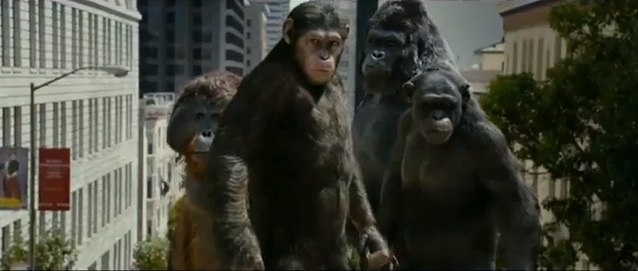
Ape-vengers, assemble!


THE MOVIE

Rise of the Planet of the Apes reimagines the origins of the Planet of the Apes in the context of a Michael Crichton-esque biotech thriller and stays about as grounded and realistic as possible for a movie about a super-intelligent ape uprising.  It also functions as a surprisingly effective domestic drama.  Thanks to another really terrific motion capture performance from Andy Sirkis (who has brought to life characters such as Gollum from the Lord of the Rings movies and King Kong from the Peter Jackson remake), we are wholly invested in Ceasar's journey from the adopted "son" of James Franco's scientist character and literal son of a chimp who was torn from her rain forest home and given an experimental Alzheimer's treatment to leader of movement of genetically enhanced apes.  They really need to give this guy a special Academy Award already.  As good as some of the prior Apes movies were, they were always more concerned with larger sociological themes than character relationships and they were never this emotionally involving.

That's not so say that Rise  is not "about" anything.  It serves as a moving meditation on man's relationship with animals and particularly the horrors and indignities suffered by lab animals.  This idea of the origins of the ape society being in lab chimp "culture" is new to the series and gives it weight and immediacy.

After Ceasar, the next most compelling character is the chimp Koba, who has a smaller role in this movie than in the sequel but who even with his small amount of screen time, strikes a memorable figure.  Koba represents a parallel development from Ceasar.  While Ceasar was raised in a loving home, Koba has been in and out of labs and is physically scarred from his experiences.  He is mangy-looking and mean with one milky blind eye.  It's particularly chilling the calm way he submits to laboratory tests.  Even before he is granted enhanced intelligence, Koba seems to be biding his time.


Perhaps granting super intelligence to this particular ape was not the best idea.


CREATURES/EFFECTS

The creatures in Rise are photorealistic apes created using amazing CGI mo-cap performances, a definite departure from the amazing make-up created for the all the previous Apes movies. This movie is definitely going for a kind of realism that would not be attainable with actors in apes suits, which was quite actually quire successful in the Burton remake.  As in all of the previous movies, the apes consist of Chimpanzees (and Bonobos), Gorillas and Orangutans.  I also wish that they would have included Baboons.  Because baboons are terrifying and an ape uprising with baboons as foot soldiers would scare the crap out of everyone.

Maybe the most striking thing about the success of the motion capture performances is in the characters eyes.  There is something about eyes that is hard to capture in human or humanoid creatures (including apes.) One of the hallmarks of a bad CGI character is dead soulless eyes. While animators have been able to capture eye anatomy successfully for years, there is something about the way eyes move that has proved elusive.  Perhaps the problem has been in animators themselves who may not be as studied in physical performance as they are technically proficient.  The inclusion of actors in this process perhaps provides the "soul" that is sometimes missing from CGI characters.  While the CGI in Rise  is not perfect, this ability to successfully recreate eye movement goes a long way towards supporting the performances and creating emotional investment in the characters, particularly in these performances which are largely silent and reliant on eye and body language.


HOME VIDEO AVAILABILITY

Widely available in all formats.

MOST MEMORABLE MOMENT

I love the whole sequence that takes place in the ape sanctuary in which Ceasar has to learn how to function in this new harsh environment.  This part of the movie almost plays like a prison film.

One question I am left with from this movie is how the apes increased their numbers so dramatically from the time that they escaped the facility to the battle at the Golden Gate Bridge.  I believe there is a sequence of them attacking a zoo to liberate the other apes but I don't believe that there is a sequence in which the apes have delivered the treatment to the zoo animals.

SEQUELS

Dawn of the Planet of the Apes was released in 2014 and considered by many to be a better film than its predecessor.  Certainly, it is more focused on the apes than the humans and it features a larger role for Koba.  It was considered a big hit and will certainly be follow up with another sequel.

TRAILER


Thursday, August 7, 2014

Universal Buys Rights to Anne Rice's Vampire Chronicles


I've been a huge fan of Anne Rice's vampire books since I first read them in the 1990's.  Her writing even inspired a couple of trips to New Orleans to check out the city she so wonderfully describes in many of her books.  So, I was very excited by the news today regarding the fact that Universal Studios has purchased the rights to Anne Rice's Vampire Chronicles novels.  More excitingly, producing and screenwriting team (and soon to be directors) Robert Orci and Alex Kurtzman are involved as producers.  These two have had their hands in a number of very successful (and mostly good) films such as Star Trek,  the original 2007 Transformers movie and many other TV shows and movies.  At the very least, they are now experienced about getting movies made and if anyone can guide the Vampire Chronicles out of Development Hell it's these guys.

The first book in the series, Interview with the Vampire was published in 1976 and became an unexpected best seller and is now considered a seminal piece of vampire fiction.  Interview was born from exploring the idea of what it would really be like to be a vampire and live for hundreds of years.  Stylistically, it gave us vampires who were complex characters instead of snarling villains.  Although it has some trappings of the horror genre, Rice's vampire novels are more concerned with moral or philosophical horror than scares and boogymen.

Interview was followed in the 1980's by a series of best selling sequels featuring Lestat, who was only a supporting character in the first book but who quickly took over as a more active and interesting protagonist in The Vampire Lestat, Queen of the Damned, Tale of the Body Thief,  and Memnoch the Devil.  Lestat retired and the series continued without him to tell spinoffs and some ancillary tales that flesh out the rich of backstories of the supporting characters in the chronicles.

There had been plans to make a movie out of Interview for many years but it was a difficult project for many reasons such as the oppressively dark tone of the first book, the passive and brooding protagonist,  ambiguous relationships between male characters, ambiguous relationships between "adult" vampire characters and a "child" vampire, etc.  When it comes to issues of love and gender, Rice's writing can be too transgressive for some audiences, certainly during the 1970's and 1980's.  It took almost twenty years to have a movie made and Interview with the Vampire  was released in 1994 under the direction of Neil Jordan, a director who was certainly unafraid of the material.  It was a worthy adaptation of the book and one that was surprisingly faithful to the source material.

The movie was a hit and there was talk immediately afterwards about making a sequel, likely based on The Vampire Lestat, which acts as both a sequel and prequel to Interview but the creative team moved on and the eventual sequel was a cheapo hatchet job based on Queen of the Damned and aimed squarely at the Hot Topic crowd.  It was not treated with any of the respect or care as the previous movie.  And that was the end of the Vampire Chronicles on film.  Until today.

What's less clear about today's announcement is which book will be adapted and filmed.  A couple of years ago, there was talk of a screenplay loosely based on Tale of the Body Thief   but starting with that book seems like a strange thing to do as it skips over so much important material and is really a self contained story that relies on your intimate knowledge of the characters.  If it were me, I would start with Lestat.  I don't think we need another Interview with the Vampire  adaptation, we have a good one already and, frankly, Louis' story is a bit of a downer.  A new movie based on The Vampire Lestat could even reference the  Interview with the Vampire movie in the same way that the novel references its predecessor.

My biggest fear with this production team, though, is that their wheelhouse is very much big blockbuster movies and the Vampire Chronicles  despite their success as best sellers have never been an overtly commercial type of book series.  Her writing is deeply personal and often dark and challenging.  Rice's vampires are also aggressively bisexual (or perhaps passionately asexual) and I would hate to see this watered down in order to make the movies more palatable, although I would hope that this would be less of an issue today than it had been in the past.

My biggest hope is that the filmmakers go very ambitious with this series.  After all, they did not just by one or two books, they bought The Vampire Chronicles, which contains about ten books or so and can loan itself very well to the kind of shared world that Marvel is doing with their superhero movies.  There is certainly plenty of material to work with.

What's more, most of Rice's supernatural novels already exist in a shared universe.  In 1990 Rice published what many consider her best book, The Witching Hour about a dynasty of witches and their deadly relationship with a spirit called Lasher.  Forget American Horror Story: Coven, this is the real deal when it comes to New Orleans witch stories and it is more overtly horror than her other books and probably more commercial.  This book is practically begging to be made into a cable miniseries.  These books eventually cross over with the later Vampire Chronicles.  Rice has also written a terrifically fun Mummy story in the same universe.  So there is really potential to do something ambitious with her work that could go cross-media.

Above all, I hope that the material is treated with the respect it deserves and it attracts talented filmmakers who are passionate about this universe and these great stories.  I hope bold and fearless actors are drawn to this material.  In an age when novel adaptations are increasingly popular and book fans are treated to loving multi-movie adaptations their favorite books, I hope the Vampire Chronicles get the loving adaptations that they deserve.

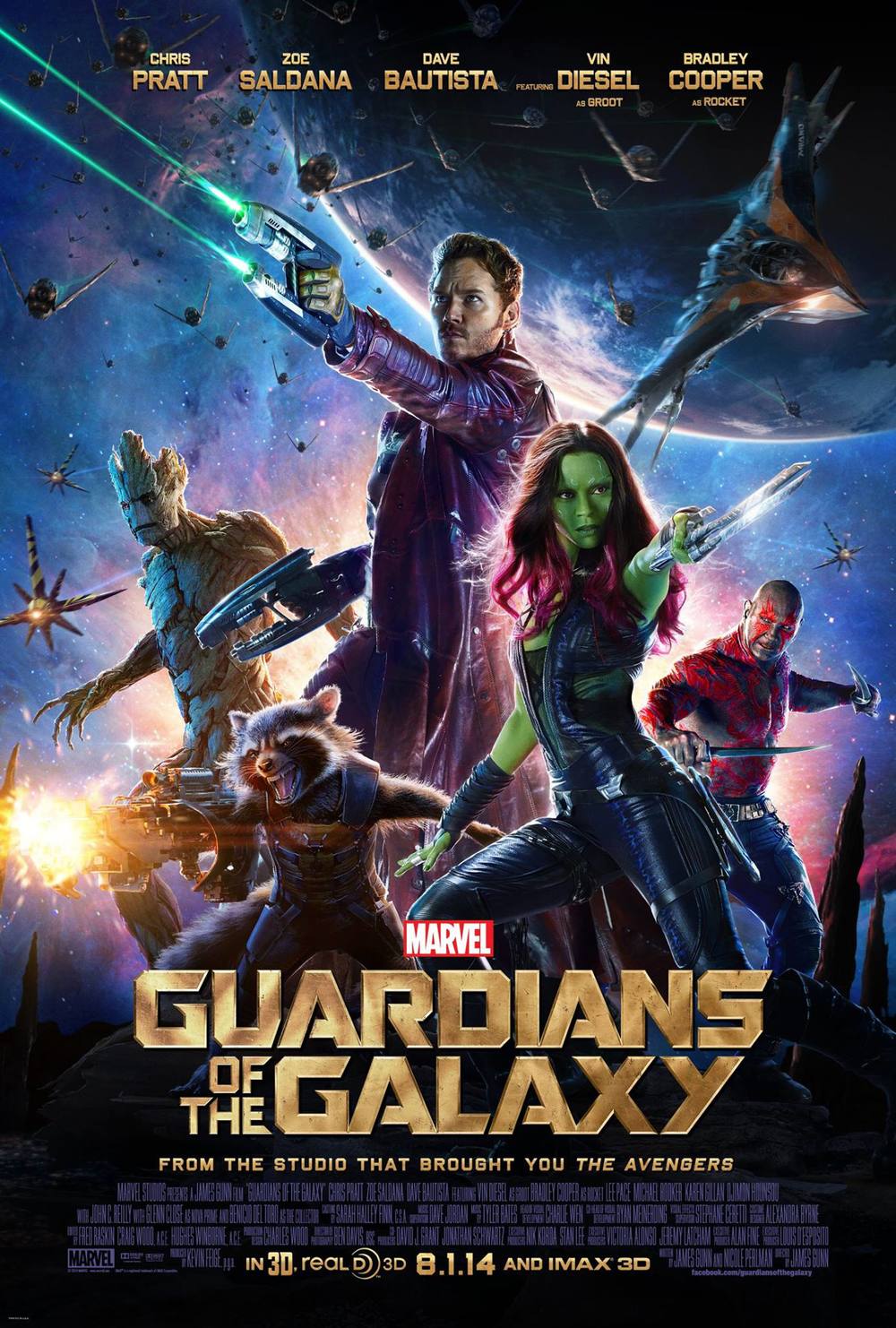
Guardians of the Galaxy: A Review-ette


Guardians of the Galaxy  is the 10th feature film in the Marvel Cinematic Universe, the ambitious multi-phase shared movie and TV continuity that includes the Avengers and their associates.  This project has been wildly successful and mostly of consistently high quality.  There hasn't really been a "bad" Marvel movie and even the most flawed of the movies are solidly entertaining.  So it has become fashionable for people to predict which upcoming Marvel movie will be the company's first flop.  First, the WWII period movie, Captain America  was going to be a flop.  Then  the weird cosmic Thor was going to be a failure.  Neither of those did.

Ten films in, it's hard to argue that Marvel doesn't take risks.  The whole crazy concept of interconnected superhero movies was a risk and something that had never been done before. Films based on second and third tier superheroes was also a risk.  Making bold stylistic choices within the superhero genre is also risky such as bringing Kenneth Branaugh on to Thor to make it a classically tinged tale of family power struggles or bringing Shane Black onto Iron Man 3 to make it an 80's style action movie with noir detective elements.

The Guardians of the Galaxy was predicted to be a risky endeavor for Marvel since it is a big-budget space opera with characters who are not widely known outside the comic shop and have little to do with the Earthbound Avengers action (yet.)  Also, two of the main characters are a talking raccoon and an ambulatory tree.   But this past weekend, the movie opened to rave reviews and a record-breaking opening weekend.  So now people can move their concern (justifiable this time)  on to the upcoming Ant-Man.

Guardians is a lot of fun and is one of the warmest and most enjoyably idiosyncratic blockbusters to come out in a long time.  It's collection of flawed "looser" characters are treated with great humor and affection.  It is a profoundly entertaining movie that in some ways is a throwback to the best Spielberg and Lucas movies from the 1980's.  It is not unreasonable to compare it to the original Star Wars, another profoundly fun and imaginative space adventure.  It's a good deal more like the original Star Wars movie than any of its dark, plotty prequels.

Much of the credit for the movie's success rests in the director and co-writer James Gunn, who helmed some very quirky indie genre movies like Super  and Slither.  Guardians is very much infused with his unique voice and point-of-view.  This is not one of those blockbusters that was directed by committee and it seems like Gunn was given free reign to make the movie his own, even when it means that the film doesn't necessarily feel like any of the previous Marvel movies.  In fact, one could say that it is refreshingly unconnected to stories told in the other movies.  The fact that it takes place out in space frees it from having to connect to a bunch of other movies.  Although, I'm sure the Guardians and Avengers will be meeting up at some point, I'm in no rush for this to happen.  I like that it is its own thing.

In a way, Guardians of the Galaxy is a bit edgy.  That's not to say that it goes out of its way to be dark or attempts to be "cool" but it is edgy in the sense that it's characters flirt with being unlikeable at times (They are variously referred to as "a-holes"  throughout the movie) and some of its humor is a bit sharper and weirder than your typical Marvel movie.  It's a PG-13 movie but you get the impression that any of the characters could yell out "Fuck!" at any given moment.  This is a movie that opens with the protagonist's mother dying of cancer and then veers into a sequence of him dancing to pop music on a bleak alien planet, alternately kicking rat-like creatures and singing into their screaming faces.  But it all works, somehow.

I find this idea of authorship in the Marvel movies very interesting in light of the whole Edgar Wright departure from Ant-Man  which created a kind of narrative that Marvel domineers or doesn't allow freedom for its directors.  I don't have any special knowledge of their process but based on the movies that the company has released so far, Marvel really allows their directors a good amount of freedom to shape their movies.  Certainly, Iron Man  is a unique combination of the visions of both its star and its director, Jon Favreau.  Joe Johnston certainly put his stamp on Captain America.  Shane Black absolutely shaped Iron Man 3 to his particular style and interests.  The Russo brothers seem to have been given a great amount of authorial control over the Captain America sequels.  Guardians  might just be the ultimate Marvel auteur movie


Monday, July 21, 2014

The Lotus Closet


I've decided to come out of the closet...as a Buddhist.    I'm also gay but that doesn't shock anyone these days.  But being a Buddhist, somehow is more problematic for people.

I've been on the fence about self-identifying for years.  I mean, I didn't want to be perceived as being a spiritual tourist and I didn't know at what point you reach critical mass and say, "Yup, I'm a Buddhist?"  Do you have to go to temple a certain number of times?  Do you have to meditate?  Chant? In considering it,  I've come to the conclusion that Buddhism occupies enough of my time and thought and influences my behavior enough that I feel comfortable saying, yes, I'm a Buddhist.  So, I made the decision to stop being Bu-curious and just let it out in the open.

The problem is that my declarations of Buddhism are met with with doubt and skepticism.  Especially from people who know me.

"You're a Buddhist," they ask.  "Nooo!You're kidding! "

I say:  "I am.  It's true."

"Wasn't your dad, like Catholic, or something?  How are you Buddhist?"

"I just am," I say.  "I didn't inherit it, I chose it."

"But you're American.  How can you be a Buddhist?  How does that even work?"

"There are a lot of us," I say.  "You should come to a service at my temple.  There's singing and someone talks in a language I don't understand.  It's just like church."

"Is that why you shave your head?"

"No," I say, "I shave my head because I don't like dealing with hair."

And when I've addressed their other questions they come to the real sticking point.

"But you're such a...asshole.  Aren't you supposed to not be a asshole?  Don't they, like, frown on that?"

I'm impatient, acerbic, rough-around-the-edges and self-involved.  I talk a lot of shit.  My sense of humor is dark. I'm not what you would picture as the poster child for Buddhism.

But I am a Buddhist.  In fact, I am a Buddhist because of those reasons.

People have an idea that all Buddhists are peaceful, serene, angelic people. And I know with a lot of work and practice people can reach this level.  But we're not all like that.  Not yet.  We are all on a path, working toward something. People don't become Buddhists because they are perfect (if you think you are perfect, you are definitely doing something wrong) but many find Buddhism helps them become happier people.

There's a great term I've come across in my research: Shinjin, where we are awakening to the reality of how far we have to go.  It's a small awakening but still a significant one that firmly puts one on the path to enlightenment.  For me, that small awakening was the threshold between being a Buddhist and a non-Buddhist.

I've actually come across people in my life who are naturally calm, serene, and filled with love and compassion.  I've been amazed by their ability not to get rattled by things.  By the fact they are truly comfortable in their own skins.   Some people are blessed with those qualities.  They are not necessarily Buddhists and Buddhism is probably not a tool that they even need.  It's okay because not everyone needs to be a Buddhist.  We don't have a monopoly on enlightenment.

I don't see Buddhism as being about preaching to the choir.  I see it, especially the kind of  practical, workaday Shin Buddhism that I practice being for real people with real flaws living in the real world.  To some extent we are all weathered and warped by this life and Buddhism helps us manage the damage done to us.

In my case, I was raised by my father and not with any particular religion.  He was raised Catholic but was never enthusiastic about it.  I think that I was drawn to Buddhism largely because of him.  He wasn't a Buddhist.  He was sort of an anti-Buddha, if there is such a thing: a volatile, overly-sensitive, self-involved person.  He was a slave to his emotions.  I knew from a young age that I did not want to be like that.  Buddhism seemed to offer a way to avoid that kind of life.

Those are my personal reasons for being a Buddhist.

As far as being American, I don't see there being a particular conflict between being an American and being a Buddhist.   In fact, I believe that one beautifully complements the other.  We Americans tend to describe ourselves as rugged individualists who are self-reliant and self-determined.  We like to talk about self-esteem.  We're prone to being self-righteous.  Some of us are self-deprecating.  We are so self-absorbed that we needed to create a word to describe taking a photo of ourselves.  In fact, if ever there was a nation that was in a position to benefit from the lessons of Buddhism, it is the United States in the twenty first century.

Buddhism is a belief system for imperfect people living in an imperfect country in imperfect times.  And I'm okay admitting it.

Thursday, July 10, 2014

TRANSFORMERS: AGE OF EXTINCTION - A REVEW-ETTE (SPOILERS)


Okay, so, it's certainly better than Revenge of the Fallen and a little bit better than Dark of the Moon, which I kind of enjoyed.  Surprisingly, for an almost three hour movie it doesn't feel like it drags the same way some of the other Transformers movies do.  There is also less of the obnoxious humor that has characterized the series so far and the human characters are less obtrusive than they have been in the past.  So, I was pleasantly surprised.

Probably the best thing about the movie is that for once it feels like there is a real overarching story or mythology that is happening outside the confines of the events of the movie.  There are some interesting mysteries and loose ends beyond the plot holes.  Actually, certain sequences of the movie feel like they are channeling Ridley Scott's Prometheus.

I particularly like the subplot about Megatron/Galvatron attempting to resurrect himself by manipulating a team of scientists into rebuilding his body-which is straight out of Transformers Animated.   Speaking of Galvatron, fans will notice that he is voiced by Frank Welker, who voiced Megatron on the original cartoon series from the 1980's.  He replaces Hugo Weaving who had previously voiced Megatron in the movies. Interestingly, Galvatron was originally voiced in the 1986 animated movie by Leonard Nimoy-who voiced Sentinel Prime in the last live action movie.  In the post animated movie cartoon series, Galvatron was voiced by...Frank Welker!  So, full circle.  Or something.

Also from Transformers Animated is the interesting new villain Lockdown, a bounty hunter working for a mysterious group of aliens who claim to have built the Transformers.  Quinessons, anyone?  Lockdown is a pretty cool character but I can't help think that he would be better voiced by someone else than Mark Ryan who has already done Bumblebee and Jetfire's speaking voice in the live action movies.  Lance Henrikson originally provided the voice for Lockdown and it would have been nice to have him do it in the movie too.

This movie also marks the live-action debut of the Dinobots, who are inexplicably incarcerated aboard Lockdown's ship.  Despite the movie's Cretaceous prologue and the subsequent appearance of a metallicized dinosaur later in the movie, the origin of the Dinobots is frustratingly unexplained.  Also, true to this series, they are ridiculously overdesigned.  Nor are they ever addressed by name or do they even speak.

The group of Autobots is mostly new and have become total alpha male a-holes.  They are constantly fighting amongst themselves like Decepticons and are generally unlikeable.  Even Optimus Prime has a huge chip on his shoulder and goes back and forth between emo and enraged throughout much of the movie.  One of the new Autobots-Drift-is hilariously over the top Japanese, which is surprising considering all of the China ass kissing found in this movie.  Drift is literally wearing a Samurai helmet and speaks in haiku.  He also refers to Optimus Prime as "Sensei."

I still think that this series needs a reboot.  A good Transformers movie can be made.  Just not by Michael Bay.

Patrick Garone
Follow Me On Twitter

Tuesday, July 8, 2014

Monster Movie of the Week: Godzilla (1998)


Godzilla (1998)
Directed by Roland Emmerich

Genre: Kaiju/Disaster

THE MOVIE

The beloved 1990’s series of Japanese Godzilla movies came to a close in 1996 with Godzilla vs Destoroyah, which killed off the Japanese Godzilla to make way for Toho’s long-held dream of a big-budget American movie.   A Hollywood Godzilla had been in Production Hell for a long time under various incarnations but was finally realized by the team of writer Dean Devlin and  director Roland Emmerich.  The two filmmakers, hot off the success of Independence Day, were given the task of reimagining the Godzilla mythos.  On paper, they may have seemed a good bet to make a Godzilla movie: they were known for making crowd-pleasing sci-fi disaster movies with loads of special effects, all things that would help one make a good Godzilla movie.  Even their weaknesses as filmmakers-generic stock characters, unoriginal ideas-had all also been long-standing issues with the Japanese Godzilla movies and might have actually allowed them to make something that captured the particular flavor of the Japanese movies.

However, it seems that these filmmakers didn't have a real understanding of or respect for the cinematic legacy of Godzilla or what made Godzilla an iconic movie creature.  Instead, they looked toward other inspirations such as The Beast from 20,000 Fathoms (itself an inspiration for the 1954 movie)  and Jurassic Park and its sequel The Lost World, which were very fresh in the public mind at the time.


Godzilla’s origins and nature are best left vague and mysterious.  As a creature, he doesn't hold up to a lot of scientific scrutiny.  When you start looking at Godzilla through some kind of Michael Crichton-esque hard sci-fi lens, he seems ridiculous and in attempts to make him “realistic,” you end up with  something that is little more than a 90 meter dinosaur, which itself is ridiculous.  And Godzilla is so much more than just a big dinosaur.  At his best, he has been a nuclear Hell-beast in his first movie, or a raging mystical war monster in Godzilla, Mothra, King Ghidorah: Giant Monsters All Out Attack, or even the mysterious primeval “alpha predator” in the 2014 movie.  A good incarnation of the King of the Monsters, has to carry some thematic weight and the 1998 version is merely a big mutated lizard whose existence is vaguely attributed to French nuclear testing.  Also, Zilla lacks Godzilla's trademark Atomic Breath.  Instead, he has what can only be called an accidental combustion sneeze.

Instead of inspiring us with dread and awe, the movie plods along with a kind of a light sitcomish tone, as the lead Mathew Broderick is joined by some generic comedy actors and a couple of cast members from The Simpsons.    There is also an idiotic subplot where the Mayor of New York and his aide are made to look like Siskel and Ebert, the famous movie reviewers who had justifiably panned Devlin and Emmerich's previous movie.  This petty and stupid running joke is indicative of the immaturity of the filmmakers.  But the light tone, above all, is where the movie really goes astray and what keeps it from feeling like a real Godzilla movie.  It is interesting to compare it with the 2014 American Godzilla movie, which, if nothing else, maintained an appropriately dark and ominous feel throughout.  It is also informative to compare it to Peter Jackson's King Kong remake, a movie that practically drips with love and respect for its source material.

THE MONSTER/EFFECTS
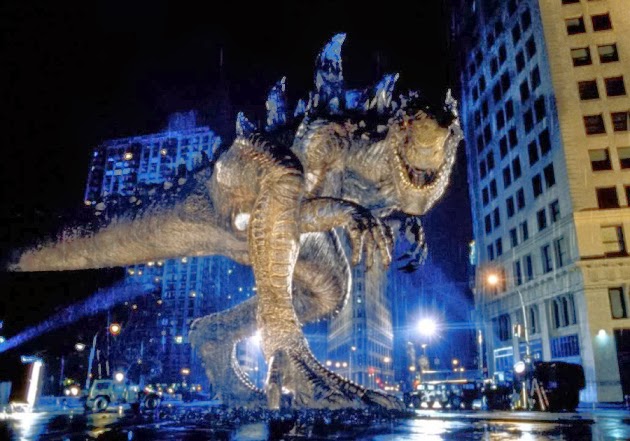
Despite his resemblance to Jay Leno, Zilla is really the Rodney Dangerfield of monsters: He gets no resepct. I’ll be honest, I don’t hate the movie’s creature design-which has officially been dubbed Zilla by Toho Studios.  Designer Patrick Tatopoulos did an decent job giving Godzilla a modernized makeover, making him to be a lot faster and more nimble and addressing some of the problems with the traditional Japanese suits.  A lot of fans dislike the T-Rex-like body of Zilla, but the fact is that Godzilla has always been modeled after a T-Rex, it’s just that he was originally designed based on A) outdated ideas about how Theropod dinosaurs actually moved and B) the need to have a man in a suit.  Neither of these factors should have really been an issue in 1998 and I don’t mind a horizontal walking Godzilla.  It has actually always bothered me that Godzilla dragged his tail on the ground as that never seemed like a plausible way for him to move.  I also don’t mind a skinnier Godzilla as he has always seemed comically obese in the Japanese movies.


Zilla testing out his nightly monologue.

I do take issue with Zilla’s head, however, which lacks any real character or menace.  The decision to give the head an exaggerated jaw is visually interesting and unexpected but it really is such an extreme departure from any previous incarnation of the character as to be unrecognizable.   I think that if the head had been tweaked to at least give Zilla a more traditional Godzilla head, people would not have reacted so badly to the design.

Remember, there are no bad monsters, only bad directors.

The movie also features a subplot about Zilla reproducing asexually and laying eggs in Madison Square Garden, which hatch into raptor-like babies.  Again, this is another instance of the filmmakers aping the Jurassic Park movies and has nothing to do with making a recognizable or good Godzilla movie. 

Finally, Zilla commits the cardinal sin of any incarnation of Godzilla: He goes out like a punk.  Godzilla’s toughness is one of his defining character traits.  Godzilla fans are fairly obsessed with this attribute of the character.  For Zilla to get taken down by some military helicopters while being tangled up in a suspension bridge was the final insult to the character.  It proves that the filmmakers really didn't "get" the character.

THE LEGACY

Although, the movie made quite a bit of money, it failed to meet the expectations set by its ostentatious publicity campaign (“Size matters!”).  The movie was also critically reviled.  These two factors both put a nail in the coffin of any potential franchise based off of the 1998 movie.

That said, the story of the movie was continued in an animated series that was actually quite a bit more faithful to the original movies.  It featured a surviving Zilla offspring, which battled any number of fanciful monsters, including a cyborg version of the movie Zilla, dubbed (in true late '90's style) Cyber Godzilla.

Animated Zilla is much more badass and even has a version of the Atomic Breath.

Perhaps most importantly, the failure of the American movie meant that the Japanese Godzilla series came out of hiatus much earlier than had been planned, and with a new vitality.  Godzilla 2000 was released in 1999 and is practically crackling with a need to redeem the character.  G2K features a badass new design of the character and the plot features him taking on a usurper who looks a bit like a cross between Zilla and Gamera.  This character, literally tries to become Godzilla and is violently thwarted.

Orga,, from Godzilla 2000, looks like what would happen if Gamera and Zilla got it on.

Interestingly, the Millenium series seems to have taken some inspiration from the American Godzilla movie in terms of scope and scale.  While the Japanese movies continued to rely on suitmation, the Millenium movies occasionally used CGI for certain effects.  In fact, certain sequences that have become standard in the series seem to have originated in the 1998 Godzilla.  Full body, underwater swimming shots were practically unheard of prior to the American movie but became somewhat common in the Japanese movies.  Also, the now ubiquitous “water swell” that invariably precedes Godzilla’s landing in the Shinsei movies (and even the 2014 American movie) seems to have memorably originated with Emmerich’s movie.  Zilla’s jagged spines were an influence on both the first Millennium Godzilla and even the second American Godzilla.


This ubiquitous "tidal wave" sequence started with the 1998 movie.


Since Toho actually owns the rights to the character, Zilla, and the events of the American movie have even crossed over into the Millennium movies.  In Giant Monsters All Out Attack two Japanese characters discuss the attack on New York but snarkily conclude that the Americans are mistaken in thinking that the monster was actually Godzilla.


 In the final Millenium movie, Godzilla: Final Wars, Zilla actually appears and is quickly dispatched by the Japanese Godzilla.  Zilla has even appeared in the ongoing IDW Godzilla comic series.  So, it’s nice to see that the monster has an official (although ignominious) place in Toho’s stable of kaiju.

 As if starring in the 1998 movie wasn't punishment enough.  Poor Zilla cannot get a break.

MOST MEMORABLE MOMENT

Zilla's initial New York landfall is actually pretty cool.  It is probably the one sequence in the movie that feels appropriately dangerous and awesome.

HOME VIDEO AVAILABILITY

Widely available in all major formats.

SEE ALSO

King Kong (2005), The Beast From 20,000 Fathoms, Godzilla 2000, Godzilla (2014)

TRAILER


Patrick Garone
Follow Me On Twitter