Showing posts with label 1950's. Show all posts

Saturday, September 26, 2026

REDUX Monster Movie of the Week: Gojira (1954)

Note this entry was originally published 10/3/2009 and revised and republished on 9/27/26.

GOJIRA* (1954)

Directed by: Ichiro Honda
Genre: Daikaiju eiga

THE MOVIE:

When you think of Showa Godzilla, chances are that you picture a big goofy looking rubber dinosaur grappling with a colorful and silly opponent. Unfortunately, most people’s conceptions of the King of the Monsters are rooted in the kid-friendly and badly-dubbed Technicolor movies of the late 60’s and early 70’s when the series had sunk irrevocably into camp. Because of this, most people are surprised by the tone of the original Japanese Gojira which is an urgent and somber meditation on the dangers of nuclear testing and scientific advancement. To a Japanese audience, only nine years after Hiroshima and Nagasaki this must have been powerful stuff.

However, not necessarily original stuff: Gojira was released only a year after The Beast from 20,000 Fathoms, an American movie which also featured a giant saurian creature woken by atomic testing which goes on a rampage through a major city but because of Japan’s legacy as the world’s sole atomic victim, there is an urgency and horror to the material in Japanese hands that’s not there in the American-produced Beast as though Gojira is the fevered nightmare of someone who experienced the aftermath of nuclear holocaust. This context is what makes Gojira more than just another radioactive monster movie and gives the film a richness and resonance that it wouldn’t otherwise have.


Another interesting element present in Gojira that is absent from the re-edited American version is a level of ambivalence about Japan’s relationship with America. It seems that the direct inspiration for the movie was a 1953 incident in which American nuclear weapons were tested in Japanese waters and the crew of a Japanese fishing boat became ill from radiation poisoning. This incident is actually directly referred to in the Japanese version of the movie but cut from the U.S. version to make it friendlier to American audiences. Thus, in the Japanese version of the movie, the blame for Godzilla is laid directly on America. There is a symbolic framework in place that makes Godzilla a symbol of U.S. (possibly and or Soviet) power in the world. In this sense, Gojira is a direct ideological ancestor of the 2006 South Korean film, The Host, another film that features a monstrous result of America’s policies in Asia. There is a long tradition of implicit or explicit US criticism in the series such as in Godzilla (1984), Shin Godzilla and Godzilla Minus Zero, this has sometimes resulted in those movies having America-friendly re-edits.
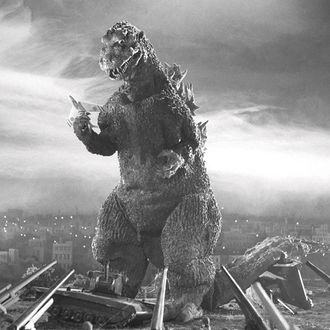
ShodaiGoji | Wikizilla, the kaiju encyclopedia

Another way to interpret the movie would be that Godzilla is visited on Japan as punishment for its aggression during the Second World War. Japan’s relationship with its wartime past is very complicated and they seem to feel simultaneously proud and guilty for their activities during World War II. In this interpretation Godzilla is a form of cinematic self-flagellation. This is explicitly the case in Godzilla Mothra King Ghidorah: Giant Monsters All-Out Attack. In Gojira, he is literally created by American nuclear testing. But the monster doesn’t go to LA or San Francisco to punish the Americans, he goes straight to Tokyo and completely destroys the city, leaving it as though a bomb were dropped on it. He punishes the Japanese. Over the years in Japanese cinema, Tokyo and other cities are destroyed over and over again. Why do the Japanese seem to enjoy seeing their cities destroyed so much? I wonder how these movies play in neighboring Asian countries that were Japanese occupied during the war. How do the Chinese feel seeing giant monsters destroying Japan? I mean, we have our big explosions and disaster movies as well but it is not as much a fetish for American moviemakers to show this level of meticulous urban destruction. In Godzilla, the Japanese are simultaneously punishing themselves and revisiting their nuclear victimization which is why Godzilla is so potent as a monster and a symbol.

THE MONSTER/EFFECTS:

undefined

Gojira pioneered the use of “suitmation,” what Toho Studio calls the combination of rubber suit acting combined with detailed miniature sets. It has since been a staple of Toho’s Godzilla series and one they kept up well into the digital age, only recently abandoning it for their mainline movies in 2016 (it is still actively used for the short festival films they put out on a regular basis.)


MONSTERS FEATURED:

This, along with Godzilla, (1984) and the American Godzilla (1998), Shin Godzilla, Godzilla Minus One are the only films in the series to feature Godzilla without another monster opponent.

This "Shodai"Godzilla suit is really the template for the later Godzillas, which would later emphasize and de-emphasize different features. It established Godzilla as a chunky bipedal, (although tail-dragging) creature, with dorsal spines, dark, scarred skin, and atomic breath. This original version is little inconsistent in different shots where they were using a puppet but is notable for it's large eyes and mouth full of conical teeth including pronounced fangs which Godzilla has seldom had over the years. This one also gives him the stylized brows often featured in Asian folkloric art.

Since this is one of only two black and white Godzilla movies, there is some debate about what color this suit actually was. There were those connected with the movie who claim it was charcoal gray, which is the traditional Godzilla color. Others state that the suit was brown or even reddish. Most state that the suits mouth was painted bright red for contrast, which I am sure was hilarious.

MOST MEMORABLE SEQUENCE:

Godzilla’s chilling nocturnal rampage through Tokyo.

WHERE TO WATCH:

Although the American Godzilla: King of the Monsters has been available on DVD for years, the original Japanese version was unreleased in the U.S. until 2006 when the two disc set Gojira was released featuring both versions of the movie with some documentaries on Blu-ray.

As this writing it can be found on MAX (along with many of both the Legendary and Toto movies) and also on the Criterion streaming channel which is home to some of the more obscure entries of the series including Godzilla (1984), Godzilla vs Biollante  and the Rebirth of Mothra movies.

Streaming rights change quickly so if you love a movie your best bet is to buy physical media. 


SEQUELS:

There are currently about thirty-three movies in the Japanese Godzilla series. This one was immediately followed by:

Godzilla Raids Again (1955), King Kong Vs, Godzilla (1962) and Godzilla Vs. Mothra (1964.)


SEE ALSO:

The Beast from 20,000 Fathoms (1953) - A direct influence on Gojira  released the year before.
Godzilla Vs. King Ghidorah (1991) - Through an insane time-travel plot deals with the wartime origins of Godzilla and Japan's complicated feelings about the West.
Godzilla, Mothra, King Ghidorah: Giant Monsters All Out Attack (2001) - Examines Godzilla's sometimes tortured relationship with Japan itself.
The Host (2006) - The US, making' monsters in Asia, Korea edition.
Shin Godzilla (2016) -A very on-the-ground response to Godzilla coming ashore movie. This one feels a bit like the original in that it is treated as an unprecedented event and taken very seriously. This Godzilla is more informed by the then-recent Fukushima radioactive accident.
Godzilla Minus One (2023): Recaptures both the urgency and the post-war time period of the original movie.

THE TRAILER:


TRIVIA:

Godzilla was originally to be realized as a stop-motion creature like the ’33 King Kong or the Rhedosaurus from The Beast from 20,000 Fathoms but Toho Studios lacked the budget and expertise to do this so they opted to go the rubber suit method. Can you imagine how cool a stop motion Godzilla would have been?

*In Japanese, “zee” actually sounds more like “dzjee” so “Gojira” actually becomes “Godzjeera” hence the anglicized Godzilla.
City of the Gods: The Return of Quetzalcoatl
If you are enjoying Monster Movie of the Week, check out my kaiju novel City of the Gods: The Return of Quetzalcoatl, the story of a UFO that appears over Mexico City and the gigantic Mesoamerican god who rises from the sea to confront it and the creatures in its thrall.
View on Amazon →
Patrick Garone

Patrick Garone

Chicago-based writer & director. Author of City of the Gods and We Lowly Gods.

Monday, August 31, 2026

Monster Movie of the Week: It Came From Beneath The Sea (1955)

It Came from Beneath the Sea - Wikipedia

IT CAME FROM BENEATH THE SEA (1955)

Director: Robert Gordon

Genre: Natural Horror/Monster on the loose


THE MOVIE


When it comes to bogeymen, there’s nothing like a good “It.”  “It” was a terror from beyond space!    “It” was alive!  Even Stephen King had an “It.”  Next to a good “Thing,” there’s nothing like “It” (unless you are an Addams in which case you have regular contact with both.)  One day I hope they will make a movie called “It! Vs. Thing!”


It Came from Beneath the Sea - Wikipedia


Today we will be talking about the particular “It” that came from beneath the sea. This is one of Ray Harryhousen’s most iconic monster movies and tells the story of a giant octopus irradiated by nuclear testing and driven from its home at the ocean depths. The fifties were the golden age of nuclear testing and this was fodder for all kinds of sci-fi and horror shenanigans in the movies. Not to mention the actual real world horrors associated with exploding nuclear bombs in the middle of the Pacific. Let us not forget, the original Godzilla movie was directly inspired not by the actual WWII bombing of Japan but by the US bomb testing in the Pacific in which a Japanese fishing ship was irradiated. 


The plot of ICFBTS is almost a template for everything from Jaws to many later kaiju movies. A submarine comes into contact with a mysterious sonar reading. It briefly collides with the object and later inspection of the submarine indicates the flesh of some kind of giant creature. Marine biologists are called in to identify the tissue, which they calculate is some kind of previously unknown giant octopus. Obviously the military doesn't buy it but they have to reconcile the havoc caused by this creature in the Pacific.


The mutated octopus of It Came from Beneath the Sea eventually makes its way to San Francisco and goes on a rampage before being blown up in the harbor. This movie gave Harryhousen the opportunity to work on a different kind of creature from the alien and terrestrial monsters he had already done, this being an aquatic monster composed mainly of tentacles. Even if you haven't seen the movie it's likely you've seen clips from it as it is often used to represent the whole genre and era of 1950's B-movies movies. There is something classic and iconic of the image of the stop-motion black and white tentacle running amok in 1950's America.


This is really a solid entry to the Atomic Monster genre that took off in the 1950's. Gojira was released the year before in Japan and other famous entries include classic creature features like Them!, Harryhousen's The Beast from 20,000 Fathoms, Tarantula!, and The Beginning of the End, among many many others In the aftermath of the bombings of Hiroshima and Nagasaki and at the height of the Cold War, nuclear annihilation was on everyone's mind.


It Came from Beneath the Sea - Wikiquote


THE MONSTER/EFFECTS


Other than its size, there is nothing particularly monstrous about this octopus (except that it has only six tentacles, but let's say it lost a couple in the initial run in with the sub. Is it then a sixtapus?)  The effects are overall very good as you would expect from a Harryhousen movie and the wonderful three-dimensionality that stop motion gives you.  There are some sequences that are among the most famous of 1950’s monster movies, such as the creature’s attack on the Golden Gate Bridge.


MONSTERS FEATURED


Just one octopus.


SEQUELS


None.


SEE ALSO


20 Million Miles to Earth 1957,  The Beast from 20,000 Fathoms 1954


TRIVIA


This is movie is being watched by a security guard in a scene prior to the creature’s initial attack in the American Godzilla (1998).


TRAILER


Patrick Garone

Patrick Garone

Chicago-based writer & director. Author of City of the Gods and We Lowly Gods.

Sunday, November 27, 2011

Monster Movie of the Week: Tarantula (1955)


TARANTULA (1955)
Directed by Jack Arnold
Genre: Monster on the Loose

THE MOVIE

Along with movies like Them! and The Black Scorpion, Tarantula is a standout in the genre of giant bug movies which became popular in the 1950's. And as far as insects and arachnids go, even normal tarantulas are pretty freaky with their hairy bodies and giant poisonous mandibles, so one that is a hundred times bigger than normal certainly can hold its own among cinema's nastiest monsters.

Tarantula
begins with a memorable and mysterious scene in which a deformed man stumbles through the desert and collapses. Like many of the other giant bug movies, Tarantula takes place in the western United States, a land of open spaces and secret experimentation. We soon meet a scientist at a remote lab in which he is developing a super nutrient which he hopes will fight the hunger that he thinks will overtake the world as the population grows in the coming decades.

In one scene, the old man looks ahead to the future predicting population growth in the far future of 1975 and 2000. As someone who was actually alive in both of those years, it felt a bit disconcerting being called out in a movie from 1955. It made me feel like kind of a backward-looking voyeur, watching this movie in 2011 with technology that had not yet even been dreamed up in 1955.


The practical effect of this super nutrient is that is causes animals to develop quickly and grow to enormous sizes. In his lab, we see oversized rats and other animals, including a very large tarantula. Why he would need to test on a tarantula is for smarter people than me to figure out.

When the scientist's former partner returns to the lab, having fallen victim to the effects of the nutrient, the two engage in a struggle which destroys part of the lab and frees the tarantula which escapes into the desert and grows to an enormous size.

Much as in the later movie, Sssssss!, the shady scientist has to replace his mysteriously missing assistant. Only this time, the replacement is an attractive young female grad student, who also catches the eye of the doctor from the nearby town. The doctor and his new friend begin to piece together the suspicious activity centered around the lab, including horses that have been totally stripped of their flesh and huge pools of arachnid venom. The giant spider soon reveals itself in the open and goes on a rampage. It is only defeated by jets which fire napalm projectiles and are piloted by young Clint Eastwoods.


You've gotta ask yourself one question spider, do I feel lucky?


MONSTERS/EFFECTS

The giant tarantula is brought to life through a mix of puppetry and trick photography using a real tarantula composited onto a live action plate. This was a well-worn technique in old movies and many an unfortunate lizard has been dolled up to look like a ferocious dinosaur. It works surprisingly well, partially because the spider is so dark but also because a large puppet wouldn't have been able to capture the creepy way that a tarantula moves.

The two scientists also undergo a kind of inexplicable transformation after having been exposed to the experimental nutrient. While the other animals suffer from gigantism, the two scientists morph into deformed snub-nosed creatures that look a bit like the pig-people from the classic Twilight Zone episode "The Eye of the Beholder." That whole subplot seems a little unnecessary for a movie that has enough going on with a hundred foot spider running around.


MOST MEMORABLE MOMENT

The brief view of the twisted flaming tarantula corpse at the end of the movie.

HOME VIDEO AVAILABILITY

Available on DVD in a double feature with The Mole People.

TRAILER


Patrick Garone
Follow Me On Twitter
Author of City of the Gods: The Return of Quetzalcoatl

Monday, November 22, 2010

Monster Movie of the Week: The Fly (1958)


The Fly
Director: Kurt Neumann
Genre: Horror


THE MOVIE

Based on the short story of the same name, the original version of The Fly is a decidedly different experience than its more famous remake. The 1958 movie features classic horror icon Vincent Price, and the story unfolds as a murder mystery, instead of the body horror/love story of the 1986 David Cronenberg movie. The movie is set in Montreal, (making both this and the remake Canadian-set) and there is a lot of Quebecois flavor throughout, which is a little confusing at first.

When a local scientist is found brutally murdered in an industrial press, his wife becomes the sole suspect. She refuses to reveal what she knows, instead she is obsessed with locating a strange white-headed fly that has been seen around her home. Her brother-in-law and the local police investigator are tasked with finding out what happened, which is finally revealed in a lengthy flashback. The scientist had invented a teleportation device, which he decided to try on himself but when a common housefly flew into the chamber, he and the fly ended up swapping heads and arms. In order to reverse the condition, he must locate the aberrant fly and go through the teleporter one more time.

Framing the movie as a kind of detective story was a nice touch, which allows the audience to peel back the mystery of The Fly a little bit at a time, as opposed to the more direct approach taken by Cronenberg, which allowed us a more intimate look at the characters. I imagine for someone watching the movie, not knowing anything about the story, The Fly would be a wild, weird ride. Also, the presence of the smaller fly/hybrid is a horrific little subplot that is not found in the remake. One has to wonder, to what extent can the poor creature reason. We don't see it until the movie's most famous shot at the end, in which the tiny screaming human-faced creature is devoured by a spider.

THE CREATURE/EFFECTS

This version of the creature does not feature the full genetic transformation that was featured in the 1986 movie, instead we see a man with a giant fly head and an insect arm. The head is actually pretty effective and realistic, covered in black hair and with a quivering proboscis and multifaceted eyes. The total effect is fairly revolting.


This scientist has neatly traded heads and limbs with the fly and doesn't really undergo any kind of transformation, except perhaps a mental one. We see him late in the movie, losing the ability to write and think, shades of Jeff Goldblum's performance two decades later. The actor playing the scientist, David Hedison, does some very nice work physicalizing the creature, with erratic jerky body language.


MOST MEMORABLE MOMENT

I really like the scenes late in the movie when Dr. Delambre really starts to really loose it. He begins having difficulty hanging on to his humanity. In these scenes lay the seeds for tragic horror of the remake.


SEQUELS

Return of the Fly 1959, and Curse of the Fly 1965

HOME VIDEO AVAILABILITY

DVD and currently streaming on Netflix.

TRAILER


Patrick Garone
www.patrickgarone.com
twitter.com/patrickgarone
facebook.com/cityofthegodsnovel

Monday, September 20, 2010

Monster Movie of the Week: The Creature from the Black Lagoon (1954)


When TV first became popular and affordable for most people, the medium was seen as a serious threat to the motion picture industry. There was a time when, if you wanted entertainment, you went to the movies. And that was it. In the 1950's, TV offered people the option of being able to consume prepackaged entertainment in their own home. Why go out to the movie theater when you could watch TV at home? Movie studios began concocting different schemes to get people out to their cinemas, by offering experiences that could not be replicated on TV, thus 3D was born as a desperate attempt to lure people to their local movie theaters. Some things never change.

The Creature from the Black Lagoon was a standout monster movie from this "Golden Age of 3D" and introduced audiences to one of the most iconic movie creatures of all time, Gill Man. The creature also spun off into two sequels, and a truly staggering amount of tie-in merchandise. Gill Man is also a junior member of that elite club known as the Universal Monsters, which is sort of a monster Rat Pack.

The movie is also notable for its extensive use of underwater photography, which was far from common in 1954. The Creature from the Black Lagoon spends a surprising amount of time underwater. Gill Man is also the forefather of the numerous fish man creatures that have appeared in movies and TV over the subsequent years, such as Abe Sapien from Hellboy and Mer-Man from the Masters of the Universe franchise.


The Creature from the Black Lagoon is inspired by a legendary South American fish-man creature. The producers decided to build a horror movie around this creature set in an Amazonian research station. The science team encroaches on the Gill Man's lair and are picked off one by one. Unlike many '50's movie monsters, the creature is presented in a fairly sympathetic way and there is a definite environmental message buried in The Creature from the Black Lagoon.

Like many horror movies, The Creature has a beauty and the beast theme running through it. Gill Man takes a liking to one of the scientist's girl friend. One of the most memorable and even erotic moments occurs during an extended scene in which she goes for a swim with the creature swimming below her in the murky water, apparently enjoying her silhouette.


THE MONSTER/EFFECTS


Gill Man is realized through a couple of different rubber suits, which are actually very photogenic. When I watch this movie, the phrase "Glorious black and white" comes to mind and the suit looks really great on film. I've seen images of the creature in color and he usually looks pretty awful, with rubbery dark green skin and often bright red lips. In the movie, though, he looks great. The creature even manages to look realistic in the movie's many underwater shots, in which Gill Man's various fins and flaps move in a fluid and natural way.

MOST MEMORABLE MOMENT

Gill Man's synchronized swim with his would-be girl friend is a great moment. The kind of of lyrical, visually poetic moment is rare in genre movies like this.

SEQUELS

Revenge of the Creature (1955) , The Creature Walks Among Us (1956)

There has been a lot of talk about a remake of this movie and one is tentatively schedule for next year.

TRAILER


Monday, August 2, 2010

Monster Movie of the Week: Them (1954)


THEM! (1954)

Director: Gordon Douglas

Genre: Monster-on-the-loose, atomic mutants


THE MOVIE


Them! is the prototypical 1950’s giant bug movie and one of the best sci-fi/horror movies of the decade. The movie has a very contemporary tone and its very matter-of-fact approach to action and horror are a precursor to James Cameron’s classic movies like Aliens, as are it’s mute, terrified little girl and its labyrinthine and claustrophobic insect nest. Like its contemporaries Gojira and The Beast from 20,000 Fathoms, Them! is shot in stark black-and-white, which helps create a disconcerting documentary feel and loans the film a realism that it wouldn’t have had in color.


The movie opens in New Mexico, where there has been a mysterious sandstorm and several disappearances. The only witness present is a little girl who is in such a state of shock that she will not speak. This character is handled quite nicely and is the antecedent for spooked children in movies for decades to come. Her memorable freak out upon smelling the ant’s formic acid is what gives the movie its name: “It’s them! It’s them!”


The police in cooperation with a father and daughter pair of scientists, soldiers and government agents discover the presence of gigantic mutated ants who have established a nest in the area. The explanation given is that they have been mutated due to atomic testing in the area. They destroy this nest only to find out that the queen has escaped and the rest of the movie is concerned with attempts to locate and contain the nascent ant colonies.


THE MONSTERS/EFFECTS


The ants are decently realized in the form of large puppets or animatronics. The movie is filmed in such a way as to conceal the parts of them that the filmmakers did not want you to see but they are good enough and the special effects are decent for the time period.


HOME VIDEO AVAILABILITY


On DVD.


MOST MEMORABLE SEQUENCE


The opening scenes of the movie do a great job of creating a sort of menacing, apocalyptic tone, with scenes of a destroyed Western landscape and an unnatural sandstorm in which anything can be hiding.


SEQUELS


None.


SEE ALSO


Aliens (1986), Mimic (1997)


THE TRAILER


Friday, May 7, 2010

MONSTER MOVIE OF THE WEEK: THE BLOB (1958)


The Blob (1958)
Director: Ivan Yeaworth
Genre: Teen/Sci-Fi/HorrorTHE MOVIE

It's hard to believe that there was a time when there were not movies aimed at teen audiences. While today, a huge chuck of movies and media are aimed at the free-spending teen market, it was only in the 1950's that a distinct "teen culture" emerged, with its own stars, music, and movies. The Blob is aimed directly at that audience and quite shamelessly panders to it with its group of young heroes who rally to save their town from an alien menace despite the clueless and disbelieving adults. It also introduced moviegoers to Steve McQueen who went on to become an iconic American movie star.


Among all of the schlocky 1950's monster movies, The Blob stands out as one of the more memorable ones and has a rich legacy in American pop culture. The movie also features one of the most unique movie monsters of its time. The Blob also had it's own comedic sequel in the 1970's, Beware! The Blob and a pretty cool 1988 remake. Rumor has it that a new remake is in preproduction to directed by Rob Zombie. The movie also popularized the word "blob" into the public lexicon, to the dismay of fat kids everywhere.


THE MONSTER/EFFECTS

Believe it or not, the Blob is actually based on an observed phenomenon: Star Jelly, a gelatinous substance that has been observed around meteorites (although still not scientifically verified). An incident of Star Jelly in the '50's actually inspired The Blob. Despite the technicolor 1950's presentation, the Blob seems to have its roots in Lovecraftian horror, because, if nothing else, H. P. Lovecraft sure loved him some shapeless slimy monstrosities.

While in its purest form, the Blob is nothing more than a slimy gelatinous mass but during the course of the movie, it attaches to people, consumes them and grows to a larger size, until it is able to wrap itself around a small diner. As far as movie aliens go, the Blob is actually quite credible. Instead of a big-headed tentacle monster who arrives on a flying saucer, I can totally buy a simple, voracious overgrown germ which hitches a ride on a meteor. As a monster is rife with horror, but this movie, understandably, plays it a little safe. I mean, the possibilities are certainly there: a creature than can envelope, suffocate, and consume you and is translucent so you can see it happening is pretty hardcore.

The effects, while effective for 1958, leave a lot to be desired as far as selling the creature, usually the Blob is being pretty obviously manipulated by someone off camera.

MOST MEMORABLE MOMENT

The creature's slow consumption of the old man at the beginning of the movie is quite effective, as is the make-up application. It's a genuinely creepy element of body horror.

DVD AVAILABILITY

Available in a nice Criterion Collection set on DVD.

No Bluray as of yet.

SEQUELS

Beware! The Blob 1972

THE TRAILER


Sunday, March 28, 2010

Monster Movie of the Week: The War of the Worlds (1953)


THE WAR OF THE WORLDS (1953)
Directed by Byron Haskin
Genre: Sci-Fi

THE MOVIE


Loosely based on the groundbreaking novel by H.G. Welles, The War of the Worlds is the archetypical global alien invasion movie and inspired legions of clones, everything from Independence Day, Mars Attacks, and of course the 2005 Welles adaptation, the Spielberg-directed, War of the Worlds. The 1953 version was critically-acclaimed and even won an Academy Award for its visual effects. It was a movie that I saw at a young age, during those pre-VCR and cable years when I would watch old sci-fi movies on TV for a lack other exciting options.


The War of the Worlds takes the basic premise of the novel—an alien invasion of England by a faltering Martian civilization—and updates the Victorian-era story to 1950’s California. Welles’ novel was published in 1898, over a decade before the idea of a truly continental war would become a reality in Europe, and three decades before a near-global war would break out. The American filmmakers were only a few years removed from the Second World War, and they re-imagined the story as an epic planetary conflict during the Atomic Age with invaders landing all over the world. Like many of the sci-fi/disaster movies of the 1950’s, we are given a top-down view of the conflict. The convention of those kinds of movies was to put us with the elite: top scientists, generals, Presidents even. Our proxy in The War of the Worlds is a famous scientist, Dr. Forrester, and we spend lots of time in bunkers listening to high-ranking military officials as they discuss plans and tactics. Compare this to a movie like M. Night Shyamalan’s 2002 invasion movie, Signs, which focuses on an invasion from the point of view of one rural family.


The Martian invaders are seemingly indestructible in their sleek warships. Not even the mighty atomic bomb is able to defeat them. Ultimately, they make one fatal (and pretty stupid) error: the Martians are not immune to our germs and all die of earth illnesses. This rather hare-brained conclusion is a holdover from the 19th Century, when germ theory was in its infancy. Even in the 1950’s the idea of an invading advanced civilization not preparing for the possibility of earth disease was ridiculous.

MONSTERS PRESENT

Martians

MONSTER/EFFECTS

The actual Martians are seen only briefly in this movie, a fact that made little sense to me as a child. You only get a good look at one in the scene in the farmhouse and then a another look at an alien arm at the end of the movie. Their “Simon”-like faces are composed of red, blue, and green lenses and their bodies are squat with long arms, not unlike ET. Their fingers end in suckers.


Their warships are featured more prominently in the movie, and are actually pretty cool-looking and seemingly influenced the design of the Enterprise from Star Trek, The Next Generation, with its sleek organic lines and ocular deflector dish. The Martian ships feature a long serpentine neck which ends in a deadly, death-ray shooting head, like some kind of deadly street lamp. They were a conscious departure from the flying saucers of the day.
They were also a departure from the tripods that were described in the book. The movie does point out that the craft are actually using invisible energy “legs” to stay aloft and to move. Supposedly there is a point in the movie during which these legs are visible. So, technically they are tripods. Technically.

SEQUELS

No direct theatrical sequels, however there was a syndicated War of the Worlds TV series in the ‘80’s that served as a de facto sequel to this movie.

MOST MEMORABLE SEQUENCE

I’m a fan of the big “Oh shit” moment that occurs after the Army attempts to nuke the Martian ships, only to see them float out of the debris cloud completely unscathed.

DVD AVAILABILITY

Widely available on DVD with some good extras, such as a featurette on the life and work of H. G. Welles. Not available on Bluray as of this writing.

SEE ALSO

War of the Worlds (2005), Independence Day (1996)

TRAILER

Saturday, February 20, 2010

Monster Movie of the Week: The Black Scorpion (1957)


THE BLACK SCORPION (1957)

Directed by Edward Ludwig

Genre: Natural Horror


THE MOVIE


The Black Scorpion is notable mainly as having been worked on by the great Willis O’Brien, the animator behind the original King Kong. O’Brien here animates a bunch of giant scorpions. The movie is also unique in its Mexican setting, of which it only barely makes use. Otherwise, we have a pretty standard 1950’s giant bug movie.


Mexico clearly does not have the same level of monster preparedness as, say, Japan.


When a series of mysterious earthquakes strike rural Mexico, American Geologist, Dr. Hank Scott and his sidekick Dr. Arturo Ramos are dispatched to investigate. They discover a newly formed volcano and evidence of non-geological violence. The volcano erupts again and a group of giant scorpions are unleashed upon the countryside. After a recon trip into a fissure deep below the earth, the scientists, an annoying kid, and the Mexican military decide they can seal the scorpions under the earth by blowing up the fissure. However, the scorpions find a way to escape and the largest (and blackest) scorpion makes its way to Mexico City to wreak havoc.


THE MONSTER EFFECTS


If Ray Harryhousen is the Obi-Wan Kenobi of stop motion effects, then Willis O’Brien was the Yoda (or at least the Qui-Gon Jinn). The scorpions look and move beautifully in any long or medium shot but like many movies that feature stop motion creatures, The Black Scorpion relies on a larger puppet for close-ups. This particular puppet is pretty wacky looking with googly eyes and a drooling mouth. What’s worse it that it looks like the same painfully slow dolly shot is used EVERY time we get a close up. It must be repeated four or five times in the movie.


"Get back, man! Don't make me steeeng you!"


MONSTERS FEATURED


A group of scorpions and some other subterranean creepy-crawlies.


DVD AVAILABILITY


A bare bones version is available on Netflix.


Was also featured on an episode of MST3K.


MOST MEMORABLE MOMENT


The cave sequence is particularly creepy.


"This senorita likes her scorpions like she likes her men..."


SEQUELS


None, but this film would be a good candidate for a remake with nice effects and that makes more use of the Mexican flavor.


SEE ALSO


Them! (1954)


TRIVIA


Another claim to fame that this film has is that spider and worm that were featured in the cave sequence were actually leftovers from King Kong That in itself is not that interesting as all the dinosaurs from that movie were leftovers from the earlier unfinished film Creation. However, the spider and the worm were featured in the infamous and lost “Spider Pit” sequence from King Kong. This was a sequence (with a counterpart in the 2005 version) that was supposedly filmed and then cut from the movie and misplaced and all that remains from it are a few reference photos. So the spider and worm give you a glimpse of a couple of creatures from that famous lost scene.


TRAILER