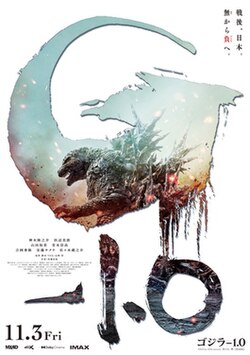
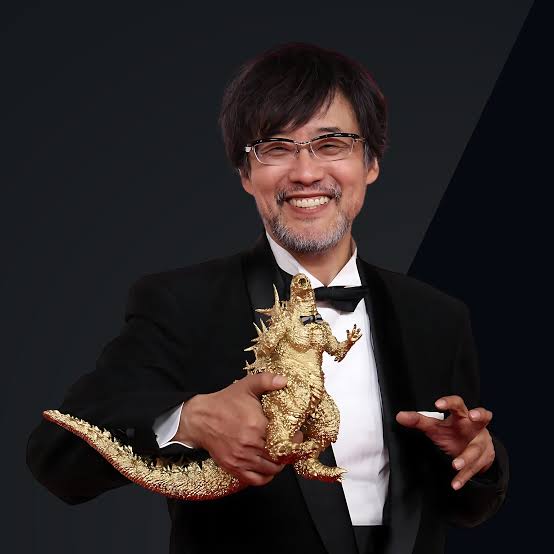
Director: Takashi Yamazaki
Genre: Kaiju Eiga
Director Takashi Yamazaki had been circling the Godzilla franchise for a long time. His 2005 feature, Always: Sunset on Third St 2 even features a Godzilla cameo in a sequence that very much prefigured the Showa vibes and creature design of his eventual Godzilla debut, 2023’s Godzilla Minus One. G-1 is remarkable for a lot of reasons. First, it is genuinely a good movie. I am a huge Godzilla fan but I can count the number of legitimately good movies in the series on one hand. Many are fun, awesome, entertaining, even inspired, but few of them I would call well-made, high quality films but Godzilla Minus One is just that. It is a compelling wartime drama with complex character relationships that just happens to also have Godzilla in it. Ironically, that particular recipe of ingredients might make G-1 less of a successful Godzilla experience for some people, sort of a Godzilla Minus Fun. I love it although it’s not my favorite Godzilla movie.
Another remarkable thing about the movie is its American success and prestige. US releases of Japanese Godzilla movies are not particularly common and have had a mixed track record of success, but G-1 had a record-breaking run (for a Japanese and non-English language release) and received ecstatic reviews in the US and it went on to win the Academy Award for Best Visual Effects. Let’s stop and appreciate that for a moment because it wasn’t long ago that Godzilla movies were a punchline, especially their special effects. Seemingly a lot of Toho’s creative and business decisions with the series were either in pursuit of American success or reaction to American failure, so to win an fricking Oscar must have been a huge triumph for Toho. To make it even more delicious, for a movie that was made for a fraction of the cost of its Hollywood competitors like Mission Impossible and Guardians of the Galaxy Vol 3.
As is the case for many modern Godzilla movies, Godzilla Minus One is in its own continuity and unrelated to its predecessor, Shin Godzilla nor any previous entries to the series. It is a fresh take on the creature and set in early post-war Japan. This new time setting gives is a fresh feel, which is ironic because this actual era was the heyday of the original Showa run of films.
THE MOVIE
At the tail end of WWII with the Japanese forces facing defeat, kamikaze pilot Koichi Shikishima returns to a Japanese base at Odo Island for repairs to his plane. It becomes immediately obvious that there is nothing wrong with his plane and he is faking the damage to get out of his mission. Whether this is purely born out of cowardice or the hopelessness and futility of the war or some combination is explored throughout the rest of the movie. From the beginning, this is a very complex and nuanced characterization and Koichi is an unexpectedly compelling character. The movie is also surprisingly ambivalent about the war with characters openly questioning its purpose and value. By contrast, the official line of the Japanese government has been to celebrate the war effort, much to the annoyance of its Asian neighbors many of whom suffered under Japanese aggression in the twentieth century.
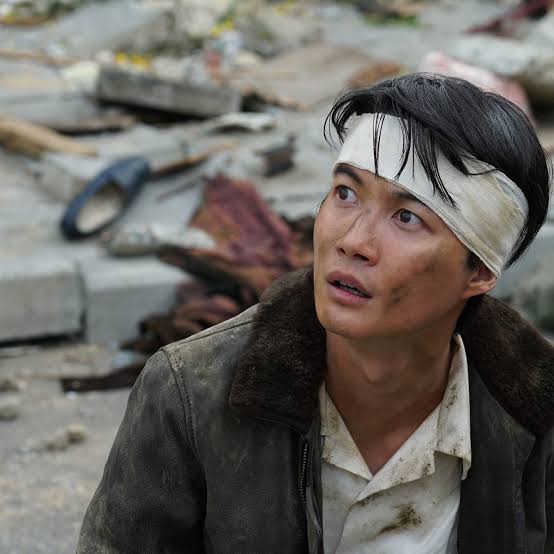
As Koichi ruminates about his situation, he notices the appearance of strange deep sea fish. The locals here have a legend of a creature called Godzilla which arises from the ocean depths and is preceded by the appearance of these fish. Soon the creature attacks the military base. This Godzilla is not the same Godzilla we know and love but instead a much smaller more dinosaur-like creature. Koichi mans the high caliber guns on his aircraft but freezes and allows Godzilla to destroy the base. He awakens to find he is one of only two survivors of the attack.
The Japanese government covers up the incident claiming it was the result of an American attack. Koichi returns to Tokyo to find his old neighborhood in ruins and his family dead. He struggles to rebuild his life in the almost post-apocalyptic landscape of post war Japan.
He meets another survivor, Noriko who is caring for a baby, a war orphan and the three end up living together in Koichi’s small house forming a de facto family unit. This little family is at the heart of Godzilla Minus One and is a fascinating and beautiful picture of how these people all come together and fall into these roles in an extreme situation. The nature of Koichi and Noriko’s relationship is mostly ambiguous and aromantic throughout most of the movie as Koichi is tortured with PTSD and survivor’s guilt and unable to function emotionally. He is particularly troubled by his encounter with Godzilla.
As was the case with Japan in those years after the war, the family’s situation gradually improves. Koichi lands a good paying job on a ship with crew who is tasked with finding and removing all of the mines off Japans coast. The crew is lead by the scientist Mizushima and they also form a kind of family. Things are looking good for our protagonists and for Japan, which,in our history at least, made a truly spectacular recovery after the war. Noriko even picks up work at a shop in Ginza, already then as now a fashionable shopping district and symbol of Japan’s impending prosperity.
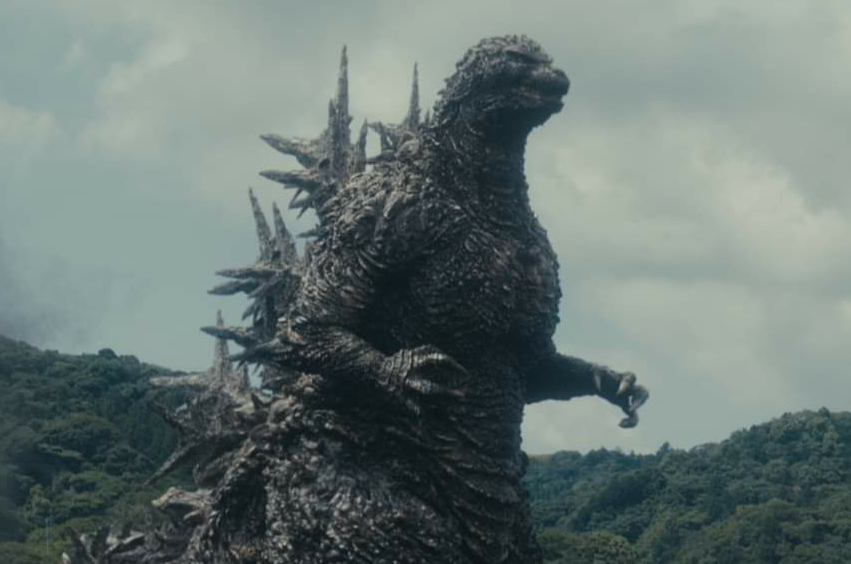
However, the proto-Godzilla has been exposed to radiation from American atomic tests at the Bikini Atoll and now grown into something far larger, more monstrous and resembling the Godzilla we all know and love. This new supercharged kaiju immediately begins attacking ships in the Pacific.
Koichi and his crew are tasked with delaying the creature’s progress toward Japan. In a thrilling scene that recalls Spielberg’s Jaws, the ship engages the kaiju. We’ve certainly seen Godzilla wade in water, even swim in water, improbably stand in the middle of the ocean but Godzilla Minus One is the first film to really sell Godzilla as a truly terrifying aquatic menace. This sequence with the 3/4 submerged Godzilla chasing after the tiny boat was instantly iconic.
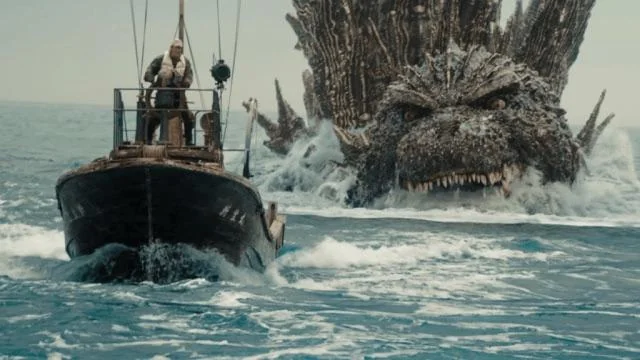
Godzilla’s proves invulnerable to both projectiles and mines. The crew only manages to do some damage to him when Koichi shoots a mine that had become lodged in Godzilla’s jaws, which blows away a big chunk of the monster’s face…before it immediately grows back. Regenerator G1 in action! Koichi’s crew is only saved by the appeance of a battle ship which gets some hits on Godzilla before the creature destroys it with his heat ray.
Koichi’s ship manages to return to Tokyo and he finally opens up to Noriko about his wartime experience and his encounter with Godzilla. Under normal circumstances this kind of unburdening might have brought them closer together and allowed their relationship to blossom but the two will not have that opportunity because days later Godzilla comes ashore and attacks Ginza while Noriko is there working. She narrowly escapes the initial wave of the attack. Godzilla, enraged by tank fire unleashes his atomic breath, which is particularly destructive and A-bomb coded. Noriko is caught in the shockwave and, pushing Koichi to safety, she vanishes into the destruction. This attack is the Minus One of the title bringing Japan back into destruction and chaos.
Vowing revenge, Koichi joins a loosely organized coalition of ex-military groups plotting a counterattack against the kaiju. This group is led by Mizushima who concocts an elaborate plan to lure Godzilla to the ocean and attach a series of devices to him which will sink him into deep trench allowing water pressure to destroy him. Koichi commandeers a fighter jet and aims to fulfill his original kamikaze mission. He lures Godzilla to the trench where the ships attach the devices to him once he has exhausted his atomic breath on a decoy battleship.
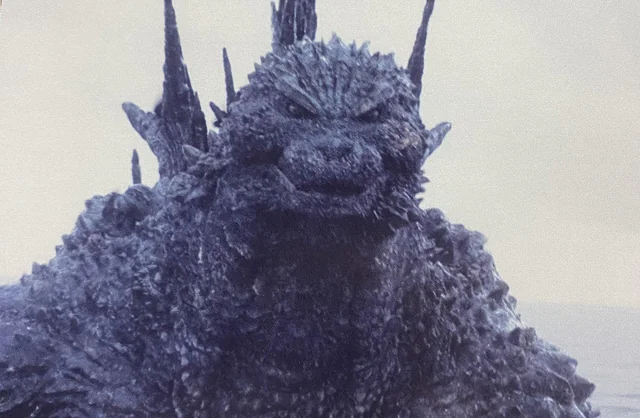
Godzilla is submerged but then breaks free becoming injured from the decompression. He attempts to use his atomic breath but Koichi crashes his plane into Godzilla’s mouth, ejecting at the last minute. This injury destroys Godzilla’s head at the moment it was to have unleashed his heat ray which tears his body apart.
After the battle, Koichi reunites with Noriko who had been recovered from the Ginza attack seriously wounded. Notably, she is suffering from a mysterious black rash growing up her neck.
We end the movie with a chunk of Godzilla’s flesh regenerating in the ocean.
THE MONSTERS
This is one of a handful of solo outings for Godzilla and there are really only two distinct designs here. The proto-Godzilla known as the Odo Island Beast and the final irradiated version of the creature. My unpopular opinion is that I like the Odo Island Beast muuuch better. The concept of a pre-irradiated Godzilla is not new, Godzilla vs King Ghidorah features a dinosaur-like “Godzillasaurus,” also in a WWII-era setting. It is executed much better here, of course. The Odo Island beast also walks horizontally, recalling the Tri-Star Godzilla. This version is also very quick moving and animalistic compared to the more deliberate and stylized movements of the evolved Godzilla. It also has an oversized head which gives it a more Tyrannosaurus profile.
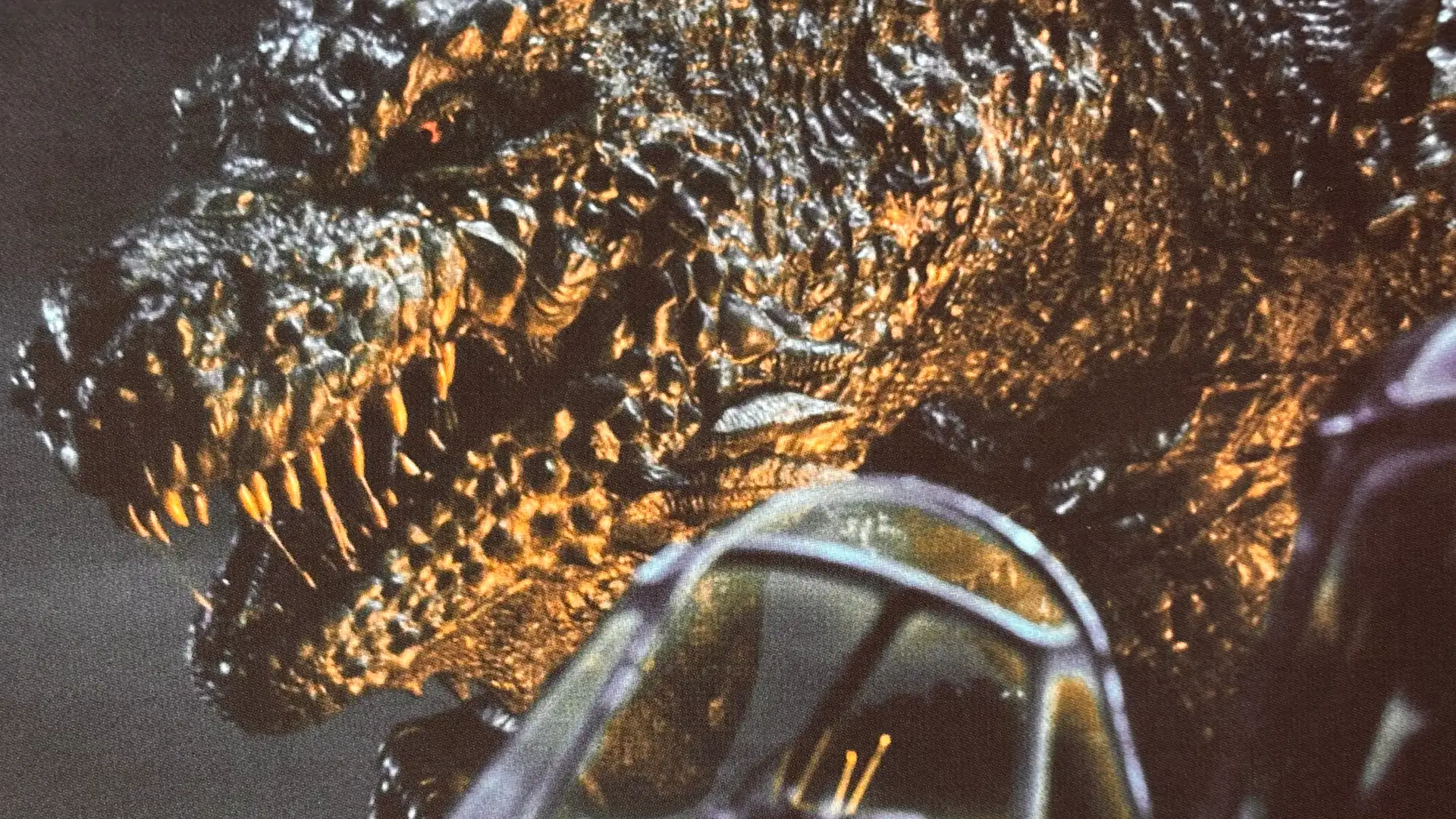
I may be in the minority here but I prefer a more dinosaur-like Godzilla. That he walks upright and drags his tail has always seemed weird to me. So this Odo Island beast was a real treat and it was also fun to enjoy a version of Godzilla in a smaller scale. The movie offers no explanation for this creature which is presumably some kind of surviving prehistoric animal.
The irradiated Godzilla is a fairly conservative iteration especially coming after the wild Shin Godzilla designs. He’s got some heavy Heisei elements and even some influences from the Monsterverse Godzilla. If you fed all the popular Godzilla designs into an AI and asked for a composite you would get something like this.
MOST MEMORABLE MOMENT
The initial ocean encounter with Godzilla. They could have kept him fully aquatic and it would have been an awesome movie.
WHERE TO WATCH
Currently streaming on Netflix but the streaming landscape is extremely fluid and physical media is always your best bet for movies you love. Easily available on home video, along with its black and white edition, Godzilla Minus Color.
SEQUELS
Godzilla Minus Zero (2026)
SEE ALSO
Godzilla Mothra King Ghidorah: Giant Monsters All-Out Attack (2001)-Another candidate for best Godzilla movie of all time, Shusuke Kaneko’s mythic and majestic kaiju movie gave us one of the all time evil versions of the character and was an influence on this one.
Shin Godzilla (2016) Another excellent modern Godzilla movie. If Minus One hadn’t been so damn good we’d be talking more about this one.
Gamera 3: The Revenge of Iris (1999)-Another Shuske Kaneko movie and an influence on this one, particularly the excellent Shibuya attack sequence.


Patrick Garone
Chicago-based writer & director. Author of City of the Gods and We Lowly Gods.
No comments:
Post a Comment