We Lowly Gods.
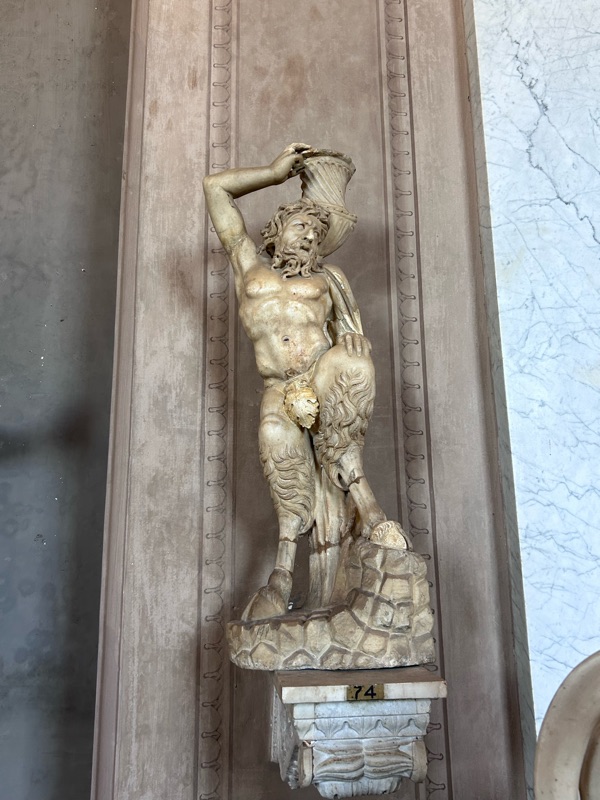
It’s right there in the title. My new novel focuses on the minor characters of Greek mythology, the demigods and Chimerics-fauns, nymphs, centaurs-inhabiting a post-Olympian world. The core characters are mostly original inventions which brush up against the known mythology but for some of the elder characters that I pulled out of established legend. The faun “Storylord” Sylvano, for example, is derived from the Roman pastoral god Sylvanus. His centaur and nymph cohorts-Cylarro and Asteroda-are also drawn from very minor mythological characters. All of these minor players from Greco-Roman mythology are here thrust into very important roles by the story’s events. That said, some more famous and consequential gods do make important appearances in We Lowly Gods and I wanted to talk about them here.
When talking about Greek mythology, it is important to note that there is no real canon, what we know about mythology comes from shockingly few sources which people have put their own spin on over the millennia. Whether we are talking about classicists like Robert Graves or Thomas Bullfinch, these famous collectors and translators of Greek mythology often judiciously edited the stories to fit their social mores, sanitizing them of sexuality, violence and darkness which is why they have come down to many of us with the air of children’s stories. So I had a lot of room to operate and search for stories and characterizations that had the feel of truth without having to actually worry about operating under a canon and certainly feeling free to write it with all the darkness and fluid sexuality I liked. As Sylvano teaches his young pupils in We Lowly Gods, “The history of this world…lies scattered and embedded in these stories like a broken amphora…and a mind that is sharp and well-trained can put them back together again.” I have tried to heed his lesson to the best of my ability.
Ouranos
Ouranos has a critical role in the story and he was a character that I was very excited to write because he has almost no characterization in the surviving stories. As one character in the novel notes “All we know of him was that he was terrible.”
I could do with the Greek All-Father what I liked and I was keen to get into his head and explore his perspective a bit. He is the prototypical Western sky god, a lineage that includes the current occupant of heaven. When you close your eyes and think of God, you are probably picturing a version of old Ouranos, a bearded and cranky old sky god.
Ouranos goes through a transformative journey in this story with quite a dramatic arc. When we first meet him, he is a shell of his former self, having been stripped of his power and existing in an elemental, barely sentient state.
Hermes
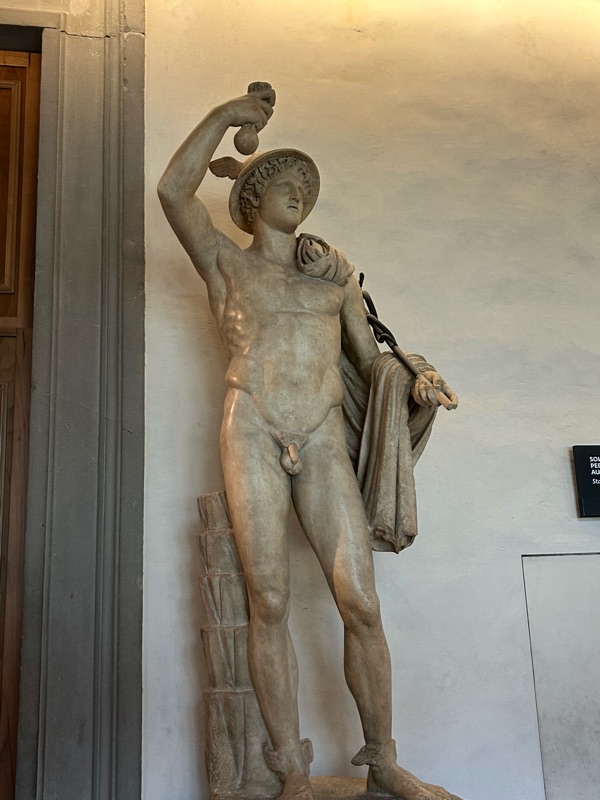
I love Hermes. I have a tattoo of him. He is the god of many of the things that I hold dear: travel, commerce, information, language and communication. On top of this robust portfolio, he was also a psychopomp who guided souls to the afterlife. All of that made it irresistible to me to include him in the story in some capacity and get into his voice in a more intimate way than with other characters.
Dionysos
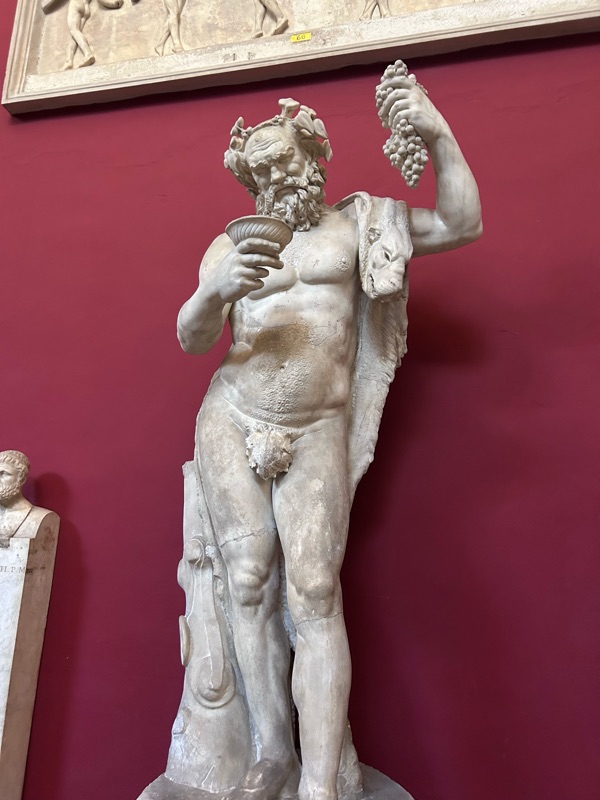
While he is not in the book a lot, Dionysos plays a pivotal role in the backstory of Sylvano, and in the history of this world, which at the start of the world is already a broken place existing in a precarious state and Dionysos played a big part in ending the orderly Golden Age.
While he may be known to us as “the god of wine,” and sometimes juxtaposed with his more innocuous Roman counterpart, Bacchus, he has a much more complicated legacy in the book. I was keen to explore his legacy as a disruptor and (in my book, at least) a kind of accidental revolutionary whose movement sets the stage for the fraught relations between gods and men. As with many figures of the Greco-Roman era, he was a proto-Christ and I wanted to make sure I explored that aspect of him, as well.
Malakbel
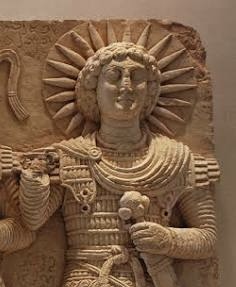
Malakbel was an Eastern Sun God from modern Syria and he was one of those gods whose worship sprouted in the West during Hellenistic times. His worship was far-flung and even made its way to Rome. He is an antagonist in We Lowly Gods with a complicated history with the Greek gods. During the time of the disappearance of the Olympians, Malakbel is making a move to spread his worship. He is another proto-Christ, and sees the writing on the wall, though his timing is not ideal.
In earlier versions of this story, this role was fulfilled by another solar deity, Helios, who along with his sister, Selene had survived the fall of Olympos and were seeking to rule as king and queen but they had lost the ability to reproduce, only begetting misshapen Sun Dogs, which were kind of hideous armored baboon-like creatures with horrible Gigeresque fetal heads. Much of the description of Malakbel, such as his distinctive armor were carried directly over from when he was Helios.
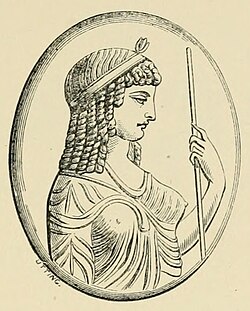
Isis
Another Eastern god who later became successfully entrenched in Greco-Roman culture, the a Egyptian god Isis is another foreign god who is seeking to fill the void left by the Olympians, although she is far smarter than Malakbel and is playing a long game. A very long game.
I loved writing her. She is very ancient and powerful and has what I found to be a slyly humorous perspective on the world of the story. If there were ever a follow up, I would love to write her in the present day as she is 💯 still going strong.
Chimerics
Chimerics are any of the sentient weird and wonderful mix-and-match creatures from Greek mythology, which seems to have an odd fascination with human/animal hybrids. Our protagonists, Khairo and Sylvano are both fauns which-like satyrs-are goats from the waist down. I went with fauns instead of the better-known satyrs because they have a more approachable, chill vibe than the wilder satyrs and I thought they would make more relatable POV characters and Khairo and Sylvano are both rather gentle scholarly creatures.
Some of the main characters are nymphs and this is where I took a little more liberty with the established mythology on which nymphs are pretty and helpless. I really had no interest in writing those kinds of characters and instead made them decidedly capable and even scary. I also wanted them to be full Chimerics so that they would share a perspective with the story’s fauns and centaurs.
There are more characters from mythology who appear in We Lowly Gods but I’ve already said too much. I’ll let you discover this for yourself. I’ll save a more spoilery deep-dive for a future date.

Patrick Garone
Chicago-based writer & director. Author of City of the Gods and We Lowly Gods.
No comments:
Post a Comment