Thursday, October 22, 2026

Monster Movie of the Week: Primitive War (2025)

Primitive War - Wikipedia

Although it is a lower-budget movie a couple of rungs above the average Asylum release, Primitive War has a couple of things going for it. First, it has a bold and unique genre profile being a Vietnam War movie AND ALSO a dinosaur horror flick. It’s almost worth seeing for that gonzo combination alone. Secondly, despite its meager budget, Primitive War does dinosaurs shockingly well. If you are in any way a dinosaur fan, you really need to check it out.

The movie does a decent job of conjuring up that Vietnam-era ambiance, complete with a Creedence Clearwater Revival-heavy soundtrack. Actually, it’s all a little too on-the-nose as though someone had watched Platoon, and Full Metal Jacket or any of the classic 1980’s produced Vietnam movies and transplanted all the cliches from the subgenre into this movie, which follows a squad of soldiers sent to investigate their missing comrades deep in the heart of North Vietnamese territory. The movie and the book on which it is based aim to differentiate these characters and give them pathos but the characterizations are all fairly surface-level and don’t really escape the genre’s war movie tropes.

The dinosaurs, on the other hand are quite good and on the terrifying side. The Primitive War novel opens with a thank you to Michael Crichton and both the book and movie really embrace the gore and horror of Crichton’s books which are decidedly absent from the Jurassic movies. The dinosaurs in Primitive War are mean and nasty head-biting, gut-slurping monsters and I love them. If you are someone who has always wanted more horror and gore from your dino movie and less Spielbergian wonder, this movie might do it for you.

Primitive War' Review - Liselotte goes to Hollywood | Story Lamp Reviews

THE MOVIE 

…follows the ill-fated Vulture Squad-a rag-tag group of misfit soldiers which includes both a recovering addict and a schizophrenic. They face both the Horrors of War and also with the task of locating a missing group of Green Berets far behind enemy lines in North Vietnam. 

Upon arriving in the mysterious valley, the group immediately gets attacked by a flock of Deinonychus, analogues to the Velociraptors made famous in Jurassic Park, although smaller and feathered. The squad makes a harrowing escape through the animals’ den and are separated, encountering a T-Rex and some Utahraptors (larger than the Jurassic raptors and feathered).

Primitive War review – it's Green Berets vs dinosaurs in cheerfully cheesy Vietnam war gorefest | Movies | The Guardian 

We also learn there is a Russian presence in the valley linked to the dinosaurs and a pair of our survivors meet up with a Russian paleontologist who has been surviving on her own (one of the few familiar faces in the movie, Battlestar Galactica’s Tricia Helfer).

The other soldiers attempt to cross the valley, inhabited by both herbivores and carnivores. The squad is attacked both by Russian soldiers and-more memorably-by a flock of Quetzalcoatlus, airplane-sized pterosaurs which have long creepy tongues they use to slurp up intestines like fettuccine.

Ryan Kwanten, Tricia Helfer Dino Movie 'Primitive War' Gets UK Deal

The squad reunites but are chased out of their shelter by the relentless Utahraptors. They escape on a rickety boat attempting to make it to the Russian base housing the particle collider which opened up a wormhole to the prehistoric past and which served as a gateway to the dinosaurs into our world. 

The team make it to the base and destroy the collider, closing the wormhole but leaving a whole valley of dinosaurs. The end credits roll over a montage of 1960’s footage of dinosaurs in our world.

THE MONSTERS

What’s particularly interesting about the roster of dinosaurs that appear in Primitive War is how much it lines up with the dinosaurs of the Jurassic franchise but with an emphasis on scientific accuracy. You have T-Rex, Raptors, Spinosaurus, all showcased according to our current understanding of how these animals looked whereas the Jurassic series is generally beholden to a 1990’s retro depiction of dinosaurs. For example, the Deinonychus and Utahraptors are heavily feathered and bird-like and very terrifying. So much for the argument that feathered dinosaurs are not scary.

Primitive War - Plugged In

Both of these are important dinosaur species that are seldom featured in popular culture. Deinonychus is really the animal that is referred to as “Velociraptor” in the Jurassic movies, although it was scaled up slightly for those movies. Here  it is kept small and there is something very menacing about hordes of these vicious coyote-sized animals swarming our characters. 

The scaling up of these animals started with Michael Crichton. The actual Velociraptor was native to Mongolia and the size of a large turkey so definitely not the skeleton that Grant was digging up in Montana at the beginning of Jurassic Park (while traumatizing a child). As though vindicating Crichton and Spielberg’s creative choices, Utahraptor was discovered in 1993 and is actually a larger animal than the cinematic Velociraptor, here used to great effect. It is actually a unique and interesting size that we don’t see explored a lot in dinosaur movies where the tendency is to showcase huge animals. Utahraptor being larger than man-sized but smaller than a big theropod like T-Rex and Allosaurus.

Primitive War 2': Dinosaurs in Vietnam War Sequel Set

The other star creature here is the Quetzalcoatlus. We have actually seen Quetzalcoatlus in some of the later Jurassic movies, memorably in Jurassic World Rebirth. Quetzalcoatlus is considered the largest pterosaur and is particularly creepy hunting on land on all fours like a freaky giraffe. An invention for this movie is their long creepy, barbed tongues.

SEQUELS

A sequel is scheduled for reales in 2027. The book has had several sequels.

MOST MEMORABLE MOMENT 

Utahraptor (Primitive War) | Antagonists Wiki | Fandom

I love the Utahraptor’s attack on Keyes. It is depicted in a particularly evil and sadistic way, the way it pins him down under its sickle claw and casually pulls a strip of flesh off his face. Of course, Keyes manages to stab it in the eye and the dinosaur improbably manages to keep that knife in his eye for the rest of the movie, giving it a bit of a “grid alien” vibe.

TRAILER


SEE ALSO

Kong: Skull Island (2017), a movie with a similar genre profile, here a Vietnam-era giant monster movie set on the titular remote tropical island.

The End of Oak Street (2026), another non-Jurassic dinosaur survival movie.

City of the Gods: The Return of Quetzalcoatl
If you are enjoying Monster Movie of the Week, check out my kaiju novel City of the Gods: The Return of Quetzalcoatl, the story of a UFO that appears over Mexico City and gigantic Mesoamerican god who rises from the sea to confront it and the creatures serving it.
View on Amazon →

Patrick Garone

Patrick Garone

Chicago-based writer & director. Author of City of the Gods and We Lowly Gods.


Sunday, October 18, 2026

Monster Movie of the Week: Q: The Winged Serpent (1982)


Director: Larry Cohen

Genre: Monster-on-the-loose/Detective/Crime/Exploitation


THE MOVIE

An Aztec god. A series of ritualistic murders. A botched Jewelry store robbery. A small-time crook in over his head. David Carradine and Richard Roundtree are on the case. No it’s not a lost Quentin Tarantino/Robert Rodriguez collaboration; it’s Larry Cohen’s Q: The Winged Serpent, a potent mix of American monster movie, gritty crime drama, and plain old horror exploitation film.

No, nothing suspicious about this at all...

I checked out Q because I was writing a novel that features Quetzalcoatl as a giant monster and this film’s creature is based on the same Mesoamerican legend of the “feathered serpent.” The anthropology is fuzzy and the effects are pretty bad but Q is the kind of movie that has a great time reveling in its own cinematic trashiness. For example: a scene in which a rooftop sunbathing woman removes her bikini and rubs suntan lotion on her breasts, her nipples unnaturally erect. It’s an R-rated movie so, of course, she takes longer to do this than she would in real life. She’s then eaten by a giant monster.


Mmmm...Art Deco...yummy...

I watch a lot of monster movies and the monster-less scenes are generally pretty boring but this movie is actually interesting to watch apart form the fact that it features a giant Quetzalcoatl nesting in the Chrysler building and terrorizing New Yorkers. Michael Moriarty plays Quinn, a criminal/jazz pianist who gets involved a bungled jewel heist and in his attempts to escape the police and the mob he stumbles into Quetzalcoatl’s lair. Moriarty gives a wildly neurotic performance and he’s so weird and crazy that it is hard to take your eyes off him when he is on screen. The movie seems torn as to whether it is about him or about the titular creature.

By contrast, David Carradine is disconnected and laconic kind of like Clint Eastwood on Quaaludes and he has a habit hilariously stating the obvious in a way they only do in movies such as when he first sees Quetzalcoatl he mutters, “Man that thing is big” or after he shoots a knife wielding cultist who returns from seeming death for the forth time Carradine calmly observes: “You don’t die easy.”

And finally, Q features one of my favorite monster movie cliché sequences in which the hero studies a series of well-illustrated books about the monster in question (most famously done in Jaws.) In this instance, he borrows the books from a museum curator. He visits the curator to do background research on the Aztec cultists and the two discuss Aztec culture while walking through an exhibit of colorful and exotic artifacts from Indians of the Pacific Northwest of the United States. The curator never actually says that they are Aztec artifacts; he only sort of vaguely acknowledges them, giving the movie some wiggle room in case someone like me points out that those are clearly not Aztec in origin.


THE MONSTER/EFFECTS


You don’t actually see much of the monster in this movie until the last quarter, which works well because the movie does a good job of making you feel Quetzalcoatl’s presence while either not showing any of her at all or doling out small glimpses and also because once you do see it, it is a bit of a let down. This interpretation is very monochromatic and avian and vaguely resembles the Fell Beasts from the latter two Lord of the Rings movies.


Where Brooklyn at?

MONSTERS FEATURED

Quetzalcoatl, mama and baby.

SEQUELS

None.

Eagle Man gets his revenge.

SEE ALSO

The Feathered Serpent (1946)

TRAILER


Trivia

This is not Quetzalcoatl’s first foray into giant

monsterdom. He was previously featured in the 1946 film,

“The Feathered Serpent.” A monster named Quetzalcoatl

also appeared in the “Bird of Paradise” episode of the

animated Godzilla series based on the 1998 American

movie. This episode featured numerous allusions to Cohen’s

film, proving that the show's writers were actual monster

movie nerds.

City of the Gods: The Return of Quetzalcoatl
If you are enjoying Monster Movie of the Week, check out my kaiju novel City of the Gods: The Return of Quetzalcoatl, the story of a UFO that appears over Mexico City and gigantic Mesoamerican god who rises from the sea to confront it and the creatures serving it.
View on Amazon →

Patrick Garone

Patrick Garone

Chicago-based writer & director. Author of City of the Gods and We Lowly Gods.


Wednesday, October 14, 2026

The Gods of We Lowly Gods

We Lowly Gods. 

It’s right there in the title. My new novel focuses on the minor characters of Greek mythology, the demigods and Chimerics-fauns, nymphs, centaurs-inhabiting a post-Olympian world. The core characters are mostly original inventions which brush up against the known mythology but for some of the elder characters that I pulled out of established legend. The faun “Storylord” Sylvano, for example, is derived from the Roman pastoral god Sylvanus. His centaur and nymph cohorts-Cylarro and Asteroda-are also drawn from very minor mythological characters. All of these minor players from Greco-Roman mythology are here thrust into very important roles by the story’s events. That said, some more famous and consequential gods do make important appearances in We Lowly Gods and I wanted to talk about them here.

When talking about Greek mythology, it is important to note that there is no real canon, what we know about mythology comes from shockingly few sources which people have put their own spin on over the millennia. Whether we are talking about classicists like Robert Graves or Thomas Bullfinch, these famous collectors and translators of Greek mythology often judiciously edited the stories to fit their social mores, sanitizing them of sexuality, violence and darkness which is why they have come down to many of us with the air of children’s stories. So I had a lot of room to operate and search for stories and characterizations that had the feel of truth without having to actually worry about operating under a canon and certainly feeling free to write it with all the darkness and fluid sexuality I liked. As Sylvano teaches his young pupils in We Lowly Gods, “The history of this world…lies scattered and embedded in these stories like a broken amphora…and a mind that is sharp and well-trained can put them back together again.” I have tried to heed his lesson to the best of my ability.

Ouranos 

Ouranos has a critical role in the story and he was a character that I was very excited to write because he has almost no characterization in the surviving stories. As one character in the novel notes “All we know of him was that he was terrible.” 

I could do with the Greek All-Father what I liked and I was keen to get into his head and explore his perspective a bit. He is the prototypical Western sky god, a lineage that includes the current occupant of heaven. When you close your eyes and think of God, you are probably picturing a version of old Ouranos, a bearded and cranky old sky god.

Ouranos goes through a transformative journey in this story with quite a dramatic arc. When we first meet him, he is a shell of his former self, having been stripped of his power and existing in an elemental, barely sentient state.

Hermes

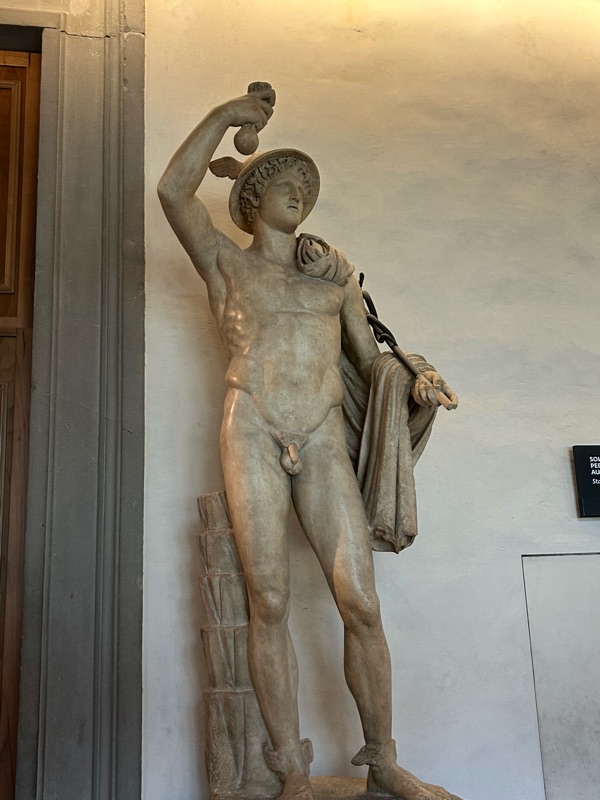
I love Hermes. I have a tattoo of him. He is the god of many of the things that I hold dear: travel, commerce, information, language and communication. On top of this robust portfolio, he was also a psychopomp who guided souls to the afterlife. All of that made it irresistible to me to include him in the story in some capacity and get into his voice in a more intimate way than with other characters.

Dionysos

While he is not in the book a lot, Dionysos plays a pivotal role in the backstory of Sylvano, and in the history of this world, which at the start of the world is already a broken place existing in a precarious state and Dionysos played a big part in ending the orderly Golden Age. 

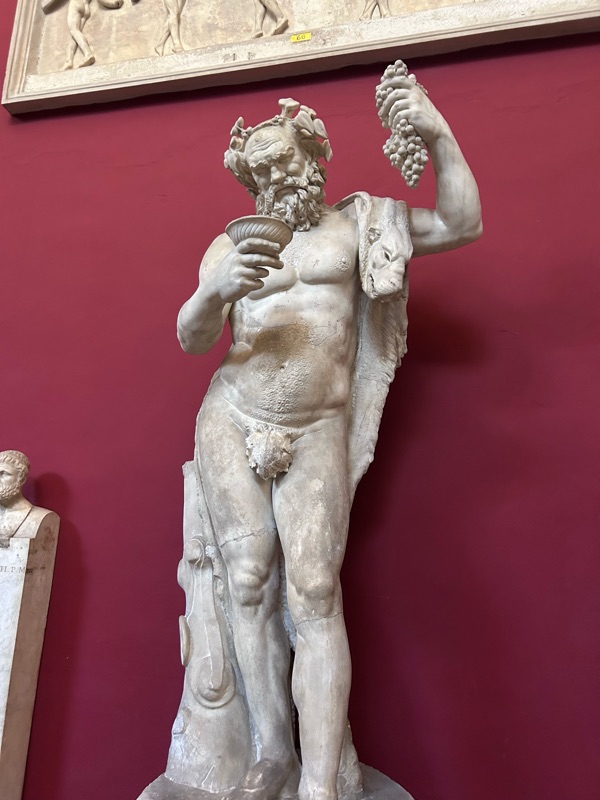
While he may be known to us as “the god of wine,” and sometimes juxtaposed with his more innocuous Roman counterpart, Bacchus, he has a much more complicated legacy in the book. I was keen to explore his legacy as a disruptor and (in my book, at least) a kind of accidental revolutionary whose movement sets the stage for the fraught relations between gods and men. As with many figures of the Greco-Roman era, he was a proto-Christ and I wanted to make sure I explored that aspect of him, as well.

Malakbel

Malakbel was an Eastern Sun God from modern Syria and he was one of those gods whose worship sprouted in the West during Hellenistic times. His worship was far-flung and even made its way to Rome. He is an antagonist in We Lowly Gods with a complicated history with the Greek gods. During the time of the disappearance of the Olympians, Malakbel is making a move to spread his worship. He is another proto-Christ, and sees the writing on the wall, though his timing is not ideal.

In earlier versions of this story, this role was fulfilled by another solar deity, Helios, who along with his sister, Selene had survived the fall of Olympos and were seeking to rule as king and queen but they had lost the ability to reproduce, only begetting misshapen Sun Dogs, which were kind of hideous armored baboon-like creatures with horrible Gigeresque fetal heads. Much of the description of Malakbel, such as his distinctive armor were carried directly over from when he was Helios.

Isis 

Another Eastern god who later became successfully entrenched in Greco-Roman culture, the a Egyptian god Isis is another foreign god who is seeking to fill the void left by the Olympians, although she is far smarter than Malakbel and is playing a long game. A very long game.

I loved writing her. She is very ancient and powerful and has what I found to be a slyly humorous perspective on the world of the story. If there were ever a follow up, I would love to write her in the present day as she is 💯 still going strong.

Chimerics 

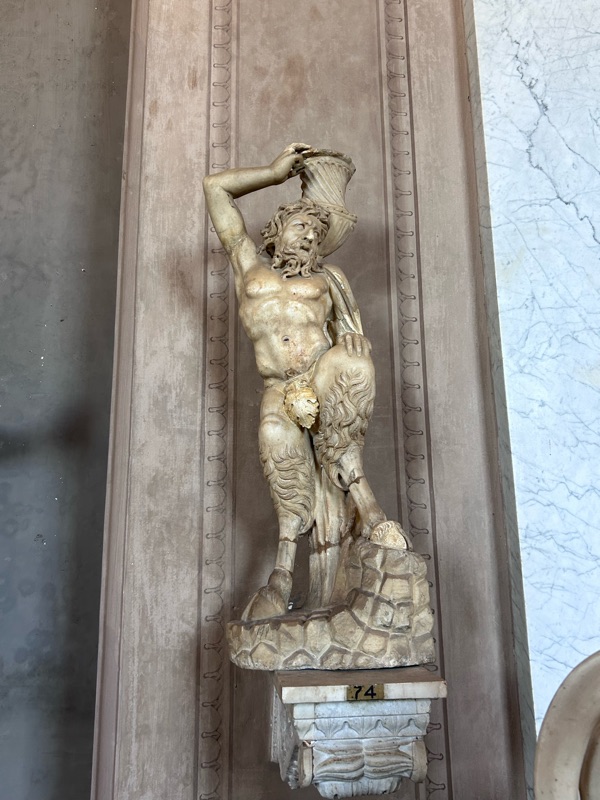
Chimerics are any of the sentient weird and wonderful mix-and-match creatures from Greek mythology, which seems to have an odd fascination with human/animal hybrids. Our protagonists, Khairo and Sylvano are both fauns which-like satyrs-are goats from the waist down. I went with fauns instead of the better-known satyrs because they have a more approachable, chill vibe than the wilder satyrs and I thought they would make more relatable POV characters and Khairo and Sylvano are both rather gentle scholarly creatures. 

Some of the main characters are nymphs and this is where I took a little more liberty with the established mythology on which nymphs are pretty and helpless. I really had no interest in writing those kinds of characters and instead made them decidedly capable and even scary. I also wanted them to be full Chimerics so that they would share a perspective with the story’s fauns and centaurs.

There are more characters from mythology who appear in We Lowly Gods but I’ve already said too much. I’ll let you discover this for yourself. I’ll save a more spoilery deep-dive for a future date.

Patrick Garone

Patrick Garone

Chicago-based writer & director. Author of City of the Gods and We Lowly Gods.

Sunday, October 11, 2026

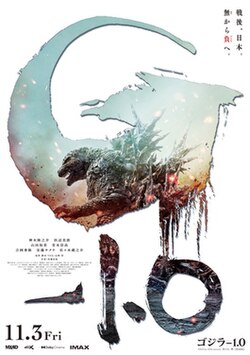
Monster Movie of the Week: Godzilla Minus One (2023)

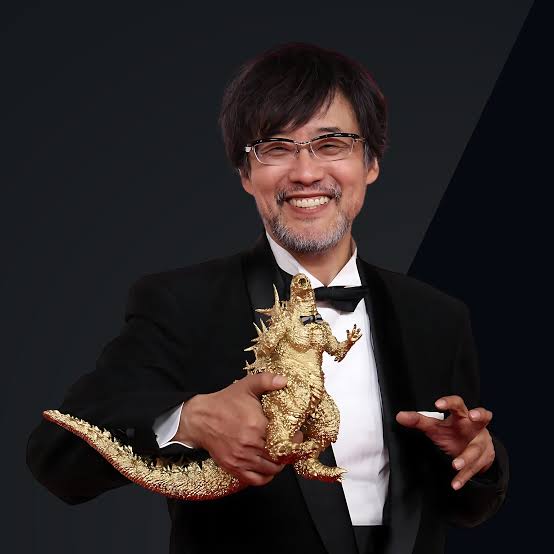
Director: Takashi Yamazaki 

Genre: Kaiju Eiga


Director Takashi Yamazaki had been circling the Godzilla franchise for a long time. His 2005 feature, Always: Sunset on Third St 2 even features a Godzilla cameo in a sequence that very much prefigured the Showa vibes and creature design of his eventual Godzilla debut, 2023’s Godzilla Minus One. G-1 is remarkable for a lot of reasons. First, it is genuinely a good movie. I am a huge Godzilla fan but I can count the number of legitimately good movies in the series on one hand. Many are fun, awesome, entertaining, even inspired, but few of them I would call well-made, high quality films but Godzilla Minus One is just that. It is a compelling wartime drama with complex character relationships that just happens to also have Godzilla in it. Ironically, that particular recipe of ingredients  might make G-1 less of a successful Godzilla experience for some people, sort of a Godzilla Minus Fun. I love it although it’s not my favorite Godzilla movie.

Another remarkable thing about the movie is its American success and prestige. US releases of Japanese Godzilla movies are not particularly common and have had a mixed track record of success, but G-1 had a record-breaking run (for a Japanese and non-English language release) and received ecstatic reviews in the US and it went on to win the Academy Award for Best Visual Effects. Let’s stop and appreciate that for a moment because it wasn’t long ago that Godzilla movies were a punchline, especially their special effects. Seemingly a lot of Toho’s creative and business decisions with the series were either in pursuit of American success or reaction to American failure, so to win an fricking Oscar must have been a huge triumph for Toho. To make it even more delicious, for a movie that was made for a fraction of the cost of its Hollywood competitors like Mission Impossible and Guardians of the Galaxy Vol 3.

As is the case for many modern Godzilla movies, Godzilla Minus One is in its own continuity and unrelated to its predecessor, Shin Godzilla nor any previous entries to the series. It is a fresh take on the creature and set in early post-war Japan. This new time setting gives is a fresh feel, which is ironic because this actual era was the heyday of the original Showa run of films. 

THE MOVIE

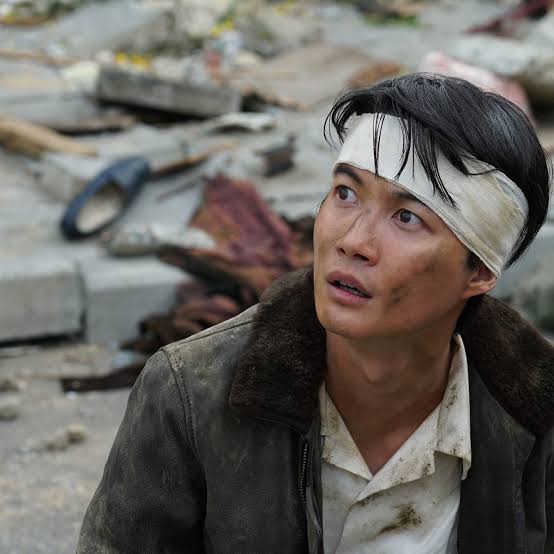
At the tail end of WWII with the Japanese forces facing defeat, kamikaze pilot Koichi Shikishima returns to a Japanese base at Odo Island for repairs to his plane. It becomes immediately obvious that there is nothing wrong with his plane and he is faking the damage to get out of his mission. Whether this is purely born out of cowardice or the hopelessness and futility of the war or some combination is explored throughout the rest of the movie. From the beginning, this is a very complex and nuanced characterization and Koichi is an unexpectedly compelling character. The movie is also surprisingly ambivalent about the war with characters openly questioning its purpose and value. By contrast, the official line of the Japanese government has been to celebrate the war effort, much to the annoyance of its Asian neighbors many of whom suffered under Japanese aggression in the twentieth century.

As Koichi ruminates about his situation, he notices the appearance of strange deep sea fish. The locals here have a legend of a creature called Godzilla which arises from the ocean depths and is preceded by the appearance of these fish. Soon the creature attacks the military base. This Godzilla is not the same Godzilla we know and love but instead a much smaller more dinosaur-like creature. Koichi mans the high caliber guns on his aircraft but freezes and allows Godzilla to destroy the base. He awakens to find he is one of only two survivors of the attack.

The Japanese government covers up the incident claiming it was the result of an American attack. Koichi returns to Tokyo to find his old neighborhood in ruins and his family dead. He struggles to rebuild his life in the almost post-apocalyptic landscape of post war Japan.

He meets another survivor, Noriko who is caring for a baby, a war orphan and the three end up living together in Koichi’s small house forming a de facto family unit. This little family is at the heart of Godzilla Minus  One and is a fascinating and beautiful picture of how these people all come together and fall into these roles in an extreme situation. The nature of Koichi and Noriko’s relationship is mostly ambiguous and aromantic throughout most of the movie as Koichi is tortured with PTSD and survivor’s guilt and unable to function emotionally. He is particularly troubled by his encounter with Godzilla.

As was the case with Japan in those years after the war, the family’s situation gradually improves. Koichi lands a good paying job on a ship with crew who is tasked with finding and removing all of the mines off Japans coast. The crew is lead by the scientist Mizushima and they also form a kind of family. Things are looking good for our protagonists and for Japan, which,in our history at least, made a truly spectacular recovery after the war. Noriko even picks up work at a shop in Ginza, already then as now a fashionable shopping district and symbol of Japan’s impending prosperity.

However, the proto-Godzilla has been exposed to radiation from American atomic tests at the Bikini Atoll and now grown into something far larger, more monstrous and resembling the Godzilla we all know and love. This new supercharged kaiju immediately begins attacking ships in the Pacific. 

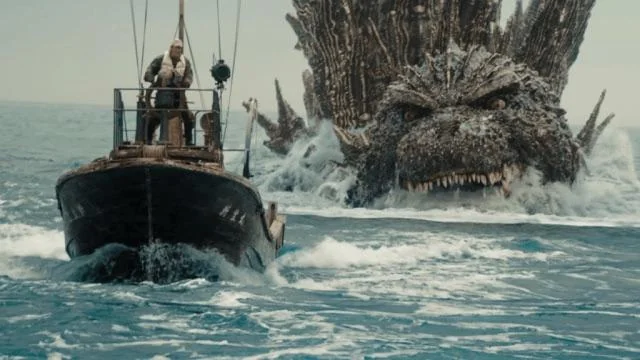
Koichi and his crew are tasked with delaying the creature’s progress toward Japan. In a thrilling scene that recalls Spielberg’s Jaws, the ship engages the kaiju. We’ve certainly seen Godzilla wade in water, even swim in water, improbably stand in the middle of the ocean but Godzilla Minus One is the first film to really sell Godzilla as a truly terrifying aquatic menace. This sequence with the 3/4 submerged Godzilla chasing after the tiny boat was instantly iconic. 

Godzilla’s proves invulnerable to both projectiles and mines. The crew only manages to do some damage to him when Koichi shoots a mine that had become lodged in Godzilla’s jaws, which blows away a big chunk of the monster’s face…before it immediately grows back. Regenerator G1 in action!  Koichi’s crew is only saved by the appeance of a battle ship which gets some hits on Godzilla before the creature destroys it with his heat ray.

Koichi’s ship manages to return to Tokyo and he finally opens up to Noriko about his wartime experience and his encounter with Godzilla. Under normal circumstances this kind of unburdening might have brought them closer together and allowed their relationship to blossom but the two will not have that opportunity because days later Godzilla comes ashore and attacks Ginza while Noriko is there working. She narrowly escapes the initial wave of the attack. Godzilla, enraged by tank fire unleashes his atomic breath, which is particularly destructive and A-bomb coded. Noriko is caught in the shockwave and, pushing Koichi to safety, she vanishes into the destruction. This attack is the Minus One of the title bringing Japan back into destruction and chaos.

Vowing revenge, Koichi joins a loosely organized coalition of ex-military groups plotting a counterattack against the kaiju. This group is led by Mizushima who concocts an elaborate plan to lure Godzilla to the ocean and attach a series of devices to him which will sink him into deep trench allowing water pressure to destroy him. Koichi commandeers a fighter jet and aims to fulfill his original kamikaze mission. He lures Godzilla to the trench where the ships attach the devices to him once he has exhausted his atomic breath on a decoy battleship.

Godzilla is submerged but then breaks free becoming injured from the decompression. He attempts to use his atomic breath but Koichi crashes his plane into Godzilla’s mouth, ejecting at the last minute. This injury destroys Godzilla’s head at the moment it was to have unleashed his heat ray which tears his body apart.

After the battle, Koichi reunites with Noriko who had been recovered from the Ginza attack seriously wounded. Notably, she is suffering from a mysterious black rash growing up her neck.

We end the movie with a chunk of Godzilla’s flesh regenerating in the ocean.

THE MONSTERS

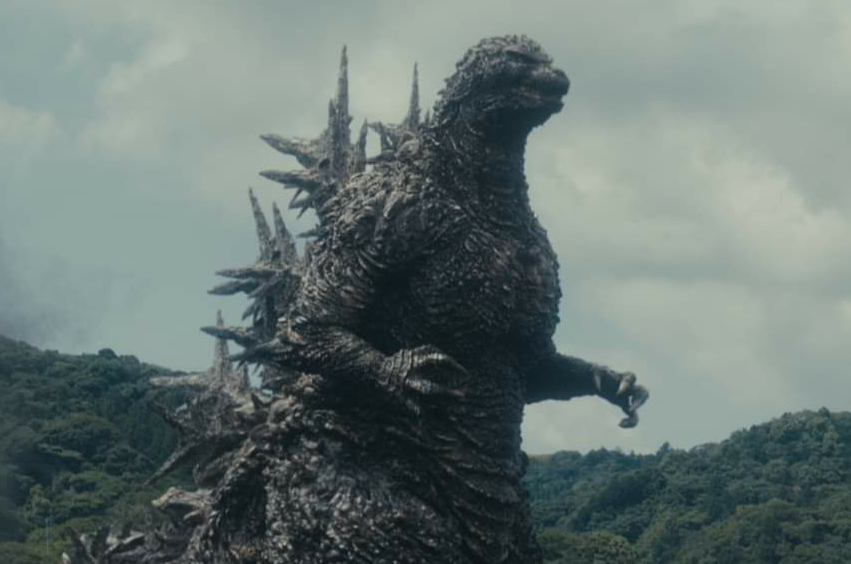
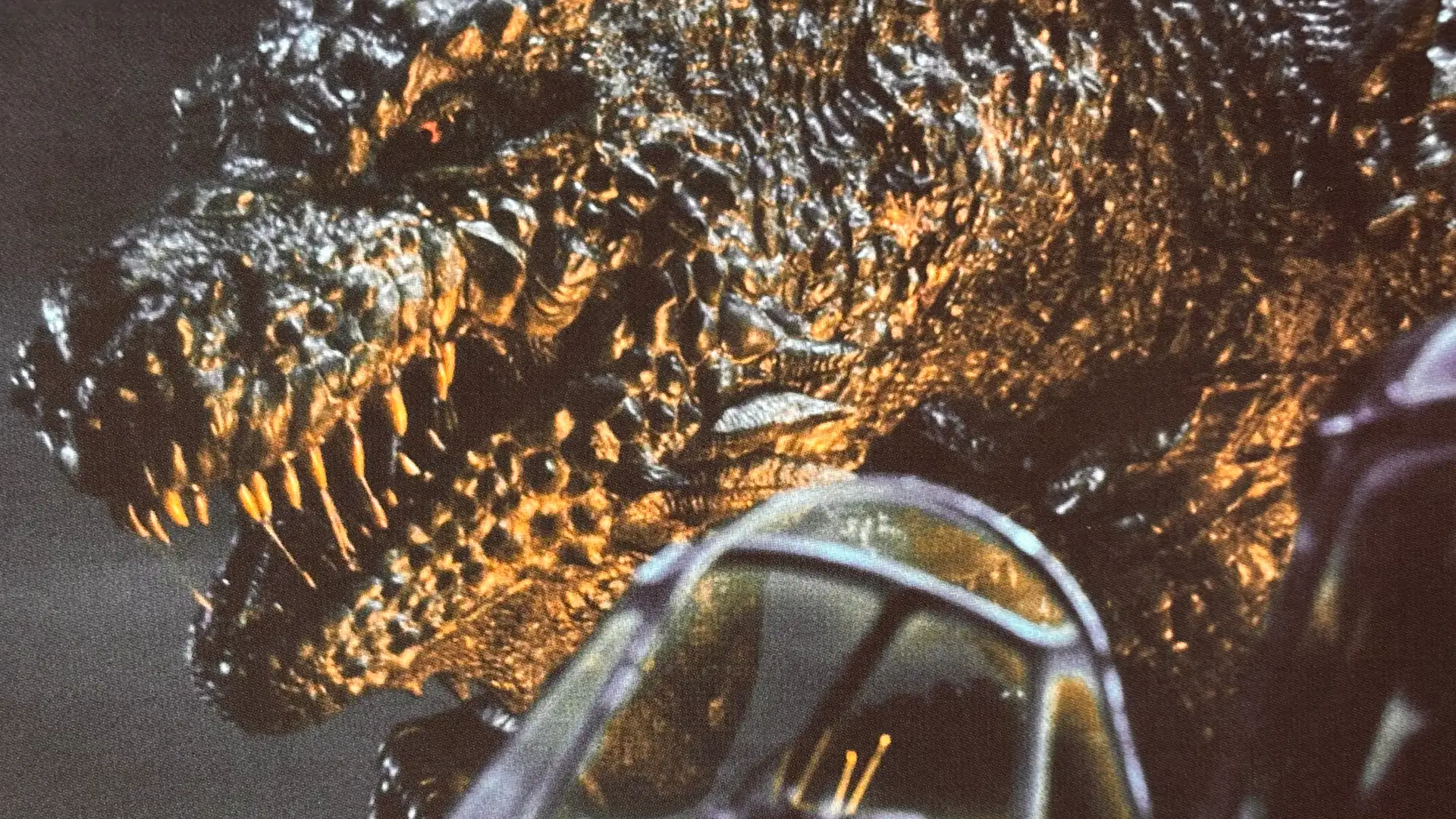
This is one of a handful of solo outings for Godzilla and there are really only two distinct designs here. The proto-Godzilla known as the Odo Island Beast and the final irradiated version of the creature. My unpopular opinion is that I like the Odo Island Beast muuuch better. The concept of a pre-irradiated Godzilla is not new, Godzilla vs King Ghidorah features a dinosaur-like “Godzillasaurus,” also in a WWII-era setting. It is executed much better here, of course. The Odo Island beast also walks horizontally, recalling the Tri-Star Godzilla. This version is also very quick moving and animalistic compared to the more deliberate and stylized movements of the evolved Godzilla. It also has an oversized head which gives it a more Tyrannosaurus profile.

I may be in the minority here but I prefer a more dinosaur-like Godzilla. That he walks upright and drags his tail has always seemed weird to me. So this Odo Island beast was a real treat and it was also fun to enjoy a version of Godzilla in a smaller scale. The movie offers no explanation for this creature which is presumably some kind of surviving prehistoric animal.

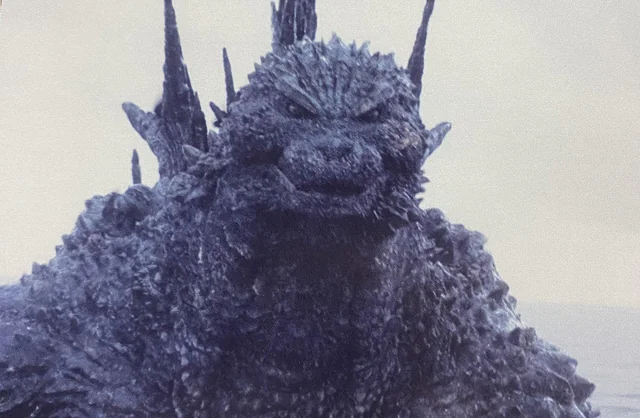
The irradiated Godzilla is a fairly conservative iteration especially coming after the wild Shin Godzilla designs. He’s got some heavy Heisei elements and even some influences from the Monsterverse Godzilla. If you fed all the popular Godzilla designs into an AI and asked for a composite you would get something like this.

MOST MEMORABLE MOMENT

The initial ocean encounter with Godzilla. They could have kept him fully aquatic and it would have been an awesome movie.

WHERE TO WATCH 

Currently streaming on Netflix but the streaming landscape is extremely fluid and physical media is always your best bet for movies you love. Easily available on home video, along with its black and white edition, Godzilla Minus Color.

SEQUELS

Godzilla Minus Zero (2026)

SEE ALSO

Godzilla Mothra King Ghidorah: Giant Monsters All-Out Attack (2001)-Another candidate for best Godzilla movie of all time, Shusuke Kaneko’s mythic and majestic kaiju movie gave us one of the all time evil versions of the character and was an influence on this one.

Shin Godzilla (2016) Another excellent modern Godzilla movie. If Minus One hadn’t been so damn good we’d be talking more about this one.

Gamera 3: The Revenge of Iris (1999)-Another Shuske Kaneko movie and an influence on this one, particularly the excellent Shibuya attack sequence.

City of the Gods: The Return of Quetzalcoatl
If you are enjoying Monster Movie of the Week, check out my kaiju novel City of the Gods: The Return of Quetzalcoatl.
View on Amazon → 

Patrick Garone

Patrick Garone

Chicago-based writer & director. Author of City of the Gods and We Lowly Gods.

Monday, October 5, 2026

Monster Movie of the Week: Jurassic Park 3 (2001)


Given the recent passing of actor Sam Neil it seems like an ideal time to pick up our look at the Jurassic series in this column. It’s hard to believe the last movie we looked at in this series was The Lost World and that was back in 2010. Neil returned to headline JPIII in one of the most underrated movies in the series which is a back-to-basics Jurassic movie with a terrific and relentless new dinosaur antagonist and some great set-pieces. Unfortunately, most of the actual human characters are pretty bland and uninteresting and the movie is full of lazy and simplistic interpersonal conflicts with trite resolutions. A couple of extra passes on the screenplay might have made this a much better movie.

This film has the distinction of being both the first in the series not based solely on Michael Crichton’s source material and the first not directed by Steven Spielberg (who produced it). While The Lost World was only very loosely based on its source novel, Jurassic Park III is a wholly original story set on Isla Sorna, the Site B created in The Lost World novel.

This film is directed by Joe Johnston, a talented journeyman director who has a long history with Lucasfilm and especially the Star Wars franchise, mostly as an artist and designer (he designed the Boba Fett character and many other iconic original trilogy elements.) He is also an accomplished director of such notable films as Honey, I Shrunk the Kids, The Rocketeer, and Captain America: The First Avenger. He was a logical choice to step into this movie with his extensive history of VFX and adventure movies and long history with ILM.

JPIII is set an unspecified amount of time after The Lost World and its very public San Diego climax. The island of Isla Sorna is a protected area where the dinosaurs are allowed to live undisturbed and people are expressly forbidden from visiting it although there don’t seem to be a lot of measures in place to keep that from happening. It actually seems super easy to get there.


THE MOVIE

The movie starts with young Eric Kirby paragliding near the island and getting attacked and stranded there. His parents recruit Alan Grant to assist them under the ruse that they are a wealthy couple with special permission to do a flyover of Isla Sorna. They make a similar offer as that of John Hammond in the first movie and promise to fund Grant’s hard-up expedition which is excavating raptors. Apparently they are still digging up that same raptor from 1993. He and his protege Billy accompany the Kirbys but we learn they are not what they had claimed and are actually Eric’s divorced parents who have thrown all of their resources into a last ditch mission to land on the island to find their son.

Their plane is attacked by a previously unseen dinosaur, Spinosaurus which obsessively dogs them throughout the movie. The Spinosaurus tangles with one of T-Rexes, and in one of the movie’s most infamous scenes, quickly dispatches it.


The group makes their way to a previously unseen abandoned InGen lab (remember this is the same island seen in The Lost World). This spooky location is the “factory floor” where Jurassic Park’s dinosaurs are made and grown. While JWIII is narratively very self-contained, the movie does a great job of at least visually telling a lot of the backstory and connecting it to Jurassic lore. This kind of visual storytelling is no surprise from someone who came up through the ranks at Lucasfilm. 

The group is then attacked by velociraptors and separated. Grant is rescued by Eric who has been surviving on the island for two months. Eric is actually the most interesting human character in the movie in that he is smart and resourceful. He is one of those Jurassic legacy characters still on the table that could make an interesting adult protagonist in a future movie. 

Following his father’s satellite phone ringtone, Eric and Grant manage to reunite with Eric’s parents and Billy, the only survivors of the Spino and raptor attacks, only to find out that the phone was last seen in the possession of one of the mercenaries eaten by the Spinosaur. The creature then attacks and the group takes refuge in an abandoned aviary and here is one of the two instances of the movie loosely adapting some unfilmed material from Crichton’s first book. In that novel, Grant and the kids escape from the pursuing T-Rex via raft on a river which takes them into a disused aviary attraction filled with territorial and aggressive pterosaurs. In the book, book the creatures are creepy croc-mouthed Cearodactyls. In JWIII the go with the better known Pteranodons teased at the end of The Lost World.

In the aviary, Grant learns that Billy had stolen a couple of raptor eggs, which is why the raptors have stalked them through out the island. Billy explains he did it because he thought they would be valuable and help them get out of the financial hole that the expedition is in. Oddly, Grant goes out of his way to shame him for it.

When Eric is carried off by a Pteranodon, Billy goes after him in a paraglider. Which is…a choice. Eric is rescued but Billy is last seen being pecked at as he flows down river, bleeding.

The group recovers the satellite phone in some Spino poop and make their way downriver in a boat. As the Spinosaur attacks, Grant is able to make a call to Ellie Sattler, who early scenes in the move established is married to a high ranking State Department official. This is the other scene that seemingly adapts the famous T-Rex river escape scene from the book although that scene is more faithfully adapted in 2025’s Jurassic World Rebirth.

They manage to escape the Spino and are then confronted by the raptor pack. Grant offers them the eggs. Scared off by approaching helicopters, the raptor take the eggs and flee. The group is rescued and reunited with a bandaged Billy who had already been picked up by the forces Ellie had sent.


THE MONSTERS

The Spinosaurus is a fantastic addition to the franchise and is beautifully designed and executed through the same combination of animatronics and CGI used in the first two movies. Interestingly, Spinosaurus was not in any ways present in the books and at the time of JPIII’s production it was a fairly obscure dinosaur known only through a single skeleton which had been destroyed during WWII-era bombings. Literally, all they had of it were sketches and photos of a destroyed specimen. The Jurassic series has certainly done a lot to raise Spino’s profile (as it has done for other lesser known dinosaurs) but we’ve also recovered a lot more material from Spinosaurus and its close relatives in the quarter decade since this movie was released. Earlier this year they announced the discovery of a new species with a damn horn growing out of its head. So Spinosaurus is a “hot” dinosaur with a lot of active debate about its biology and lifestyle.


Was it as awesome and photogenic as the handsome boy in JWIII? No. It probably looked a lot more like its fugly depiction in Rebirth. Could it actually have beat T-Rex in fight? Probably not. While it is technically the longest known theropod dinosaur it was relatively slightly built and T-Rex was a more powerful animal with a stronger bite force. Spinosaurus evolved to eat fish not for gladiatorial combat against apex predators. That said, Spino has some long deadly claws on its arms that, famously, T-Rex does not.

Verdict: T-Rex.

Also, I don’t love the disrespectfully quick Rex kill. And that would have been one of the two adult rexes from The Lost World which, as audience members we were somewhat invested in. No bueno.


The movie is also famous for arguably the best raptor designs in the franchise (although the briefly-seen raptors from Rebirth are close). As the Jurassic Park franchise went on, they got more and more adventurous with the raptors in terms of coloration and plumage. By JPIII, we’ve got some really colorful and exotic designs and even some basic quills. It should be noted, the animals depicted in these movies are not  velociraptors but closer to something like Deinonychus or Utahraptor. In any case, they would have been fully feathered bird-like animals.

Some other appearances here include Ankylosaurus, and even a cameo from one of my favorite theropods, the horned Ceratosaurus. The distinctive crested herbivore Corythosaurus makes its first Jurassic appearance here as well.

MOST MEMORABLE SEQUENCE

The initial intro of the Spinosaurus and its infamous tangle with the T-Rex.

Also the satellite phone ringtone is forever burned into my brain. 

SEE ALSO

Grant and Sattler appear against in 2019’s Jurassic World: Dominion

A pod of redesigned Spinos are featured in Jurassic Park Rebirth more in keeping with our current understanding of their appearance.

Spinos also appear in small roles in the recent non Jurassic dino movies Primitive War and The End of Oak Street.

This particular Spinosaurus shows up to menace our Nublar Six survivors in one of the later seasons of the fun Netflix animated show set in the Jurassic series, Camp Cretaceous, a show that more than fulfills the requisite child endangerment of this franchise. 

City of the Gods: The Return of Quetzalcoatl
If you are enjoying Monster Movie of the Week, check out my kaiju novel City of the Gods: The Return of Quetzalcoatl.
View on Amazon →

Patrick Garone

Patrick Garone

Chicago-based writer & director. Author of City of the Gods and We Lowly Gods.

Sunday, September 27, 2026

REDUX Monster Movie of the Week: The Thing (1982)


Note this entry was originally published 8/18/09 and revised, expanded, and republished 8/28/26.

Director: John Carpenter
Genre: Horror/Suspense

THE MOVIE:

John Carpenter's The Thing is the story of a small group of men who are assigned to a remote American Antarctic outpost. Their isolation is interrupted by the arrival of a mysterious dog which is chased by a helicopter from a distant Norwegian settlement. Attempting to kill the dog, the helicopter and its pilot are destroyed. MacReady (Kurt Russell) and some others from the American base investigate the Norwegian settlement to find a gruesome mess. They also find what appears to be a flying saucer half buried in the ice and a mangled semi-human body.

When they return to the American station, the mysterious dog begins to mutate into some sort of Lovecraftian tentacle monster, attempting to absorb and mutate the other dogs in its pen but is torched by the crew before it can finish. From here we can very well have Alien On Ice, after all, this was produced immediately after the success of Ridley Scott's movie. No doubt, the success of Alien allowed The Thing to be made. 

However, the twist offered by Carpenter's movie is that this alien creature is able to assume the form of any other organism, so there is a compelling mystery element of never knowing which members of the crew are human and which have been infected by the monster. This fact alone helps underscore the tension and heighten the relationships between the characters. It's the rare movie of this genre that gives its actors something to do other than running around screaming. The cast is pretty stacked including the perennially elderly Wilford Brimley (Cocoon) and a young Keith David, who's face and voice are known from everything to Platoon to Rick and Morty.

The Thing was released at the tail end of the late '70's and early 80's sci-fi movie boom and was lost in the shuffle, actually being released the same month as Blade Runner and the massively popular E.T. Clearly, 1982 audiences were looking for a different kind of alien experience, and it was widely considered to be a box office flop. At the time of its release, it was criticized for its excessive gore and disgusting special effects. 

There was a time in which you either had to see a movie in the theater or on a television broadcast. Theatrical runs were much less front loaded than they are now, and movies would literally be in theaters for months and hit movies would even have re-releases. Popular movies had splashy TV premieres several years after their theatrical runs. If a movie had an unsuccessful theatrical run there weren't a lot of ways to recover the investment. That changed drastically with the advent of the home video rental market in the 1980's and also the rise of premium cable around the same time. Movies that didn't do well on first release could find a second life on home video. Movies that found their legs on the home video market include such classics as Blade Runner, The Terminator, and The Shawshank Redemption. The Thing is also a great example of a movie that was considered a flop upon release that people rediscovered in the subsequent years at home and the movie's reputation as a classic has only grown over time.

The movie has spawned a number of comic book sequels as well as a classic survival horror video game, and even a 2011 prequel movie, which confusingly shares the same title. Like Alien and Aliens,the influence of The Thing, can be felt in everything to the Halo and Resident Evil series of videos games to Tarantino's snowy ensemble thriller The Hateful Eight.

The Thing is actually a remake of a fifities sci-fi movie, The Thing From Another World, which in turn was loosely based on the novella "Who Goes There?" written in the '30's by John W. Campbell, which seems to have borrowed the Antarctic setting and themes from "At the Mountains of Madness" by H. P. Lovecraft. Carpenter's remake actually stays closer to the plot of the novella and restores the movie's idea that the creature can assume anyone's shape or identity. It also seems to have inspired the first season X-Files episode "Ice."

THE MONSTER/EFFECTS:

The Thing is a seriously gory movie but the effects are groundbreaking and imaginative and push the envelope of pre-digital effects. You don't really see creature effects this ambitious until T2 is released in 1991. I can even say that for a movie released in 1982 there are a few shots that DONT look dated today, which is pretty good for a movie that relies on stop-motion and animatronics.

The monster is only recognizable as a monster when it is in mid-transformation, when it is a mismatched collection of tentacles and bizarre flowery appendages, with human and animal parts randomly thrown in. Sadly, one never gets to see the alien's true form which would have been cool at the finale. Perhaps it doesn't have one.

MONSTERS FEATURED:

"The Thing" in various forms.

WHERE TO WATCH


There are various collector's editions which are loaded with extras and documentaries about the movie and its groundbreaking visual effects.

SEQUELS:

The 2011 prequels is set immediately before this and tells the story of the Norweigean station and an American scientist (Mary Elizabeth Winstead, in Ripley mode) brought in to examine the frozen creature. It was criticized for using CGI but using in-camera effects of the scale and ambition of the original movie was not.really a practical option in 2010 when this movie was made. I found it to be a fun companion piece to Carpenter's movie although not of the same level of quality.

SEE ALSO:

Alien (1979), The Fly (1986), The X-Files "Ice" 1993, The Thing (2011)

TRAILER:


City of the Gods: The Return of Quetzalcoatl
If you are enjoying Monster Movie of the Week, check out my kaiju novel City of the Gods: The Return of Quetzalcoatl.
View on Amazon →
Patrick Garone

Patrick Garone

Chicago-based writer & director. Author of City of the Gods and We Lowly Gods.